 The Duck Curve
GridLab: V2G could supply 30% of California's utility-scale storage target
Enrolling 10 percent of the state's projected light-duty EVs by 2036 could do it, the GridLab, Kevala, and E3 report finds, but only if V2G is accredited like grid storage.
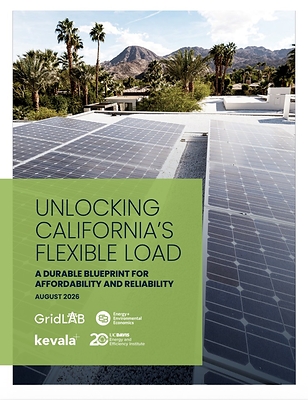
California is planning to procure 31 GW of utility-scale storage through 2036, and a new report argues a meaningful share of that capability is already parked in garages. "Unlocking California's Flexible Load: A Durable Blueprint for Affordability and Reliability", an August 2026 report by the nonprofit GridLab with Kevala and the consultancy E3, announced on August 18, finds that enrolling just 10 percent of the 9.7 million light-duty EVs the California Energy Commission projects for 2036 in vehicle-to-grid programs could supply 30 percent of the state's cumulative utility-scale storage procurement target for that year. That finding carries a condition: V2G resources would need to be accredited and operated on a comparable basis with grid-scale storage, which they are not today.
The arithmetic and its assumptions
The EV figure is a modeled scenario, not a program. The report's footnotes assume a light-duty fleet averaging 9.6 kW of charging capacity and a fleet-weighted average battery of 120 kWh in 2036, with vehicle counts from the CEC's 2025 Integrated Energy Policy Report and procurement targets from the CPUC's 2026-2027 Transmission Planning Process proposed decision. The announcement describes the same finding as approximately 9 GW of 12-hour storage and calls it "more than one-third" of the state's 2036 long-duration procurement target; the report body's own phrasing is 30 percent of the cumulative utility-scale target. Trade coverage, including pv magazine USA, has carried the release's more generous fraction.
The report treats the big top-down numbers in its field with the same caution, including its own. It cites a 2024 Brattle Group study, commissioned by GridLab, that put statewide virtual power plant technical potential at 7,671 MW by 2035, avoiding $550 million a year in system costs, and an updated Kevala analysis, also GridLab-commissioned, finding that 3.5 GW of additional peak flexibility could avoid up to $6.7 to $9.9 billion in distribution upgrade costs. Then it warns that both rest on statewide-average assumptions and are directional rather than achievable-program estimates. The granular comparison it offers is PG&E's Phase 2 Electrification Impact Study, where the utility's most aggressive flexible-load scenario cut summer peak demand by 2.8 GW and cumulative distribution costs by $1.8 billion through 2040, roughly 7 percent of PG&E's projected base-case distribution investment.
Pay for performance, not enrollment
The authors, Eric Cutter of E3, Pete Skala of Kevala, and Ric O'Connell of GridLab, attribute the underperformance of California's past demand-response programs to four recurring flaws: paying for enrollment rather than verified delivery, gameable baselines, wholesale market rules designed for central power plants, and stacking new programs on old ones without consolidation. Their proposed replacement is three standardized pathways (retail pay-for-performance, contracted firm capacity with resource adequacy value, and streamlined wholesale market access) governed by two rules: pay only for measured performance, and pay below verified avoided costs so non-participating ratepayers come out ahead. "The next generation of grid infrastructure is already sitting in our driveways, homes, and businesses," GridLab executive director Ric O'Connell said in the announcement.
That design brief is starting to appear in actual programs elsewhere: New Jersey's proposed Garden State Energy Storage Program would pay home batteries performance-based payments over ten years rather than upfront enrollment incentives.
The shadow of the solar cost shift
The report is blunt about why compensation design matters in California specifically: the state has run this experiment before. Net energy metering, it notes, credits rooftop solar at retail rates without performance standards, and it cites CPUC estimates that bills for non-participating customers had risen by $7 billion a year by the end of 2024 as a result; reports from the CPUC and NRDC, also cited in the paper, put 12 to 19 percent of customer bills down to the cost shift. Flexible load compensation, the authors argue, cannot become a back-door subsidy; they lay out three options for whether NEM customers should even be eligible, from exclusion to eligibility conditioned on migrating off legacy tariffs. E3's Cutter, in the announcement, framed the affordability test as rewarding customers for measurable grid value without increasing anyone else's bills.
The storage procurement the report benchmarks against is itself moving: US utility-scale battery capacity has been compounding at roughly 70 percent a year, and California's targets segment into 4-, 8-, and 12-hour tranches through 2036.
Outlook
The 30 percent figure counts only if regulators let verified V2G capacity count the way grid batteries count, so accreditation is the thing to watch. The report itself claims no regulatory standing: E3's front-matter disclaimer says the analysis is separate from any work E3 does for the California Public Utilities Commission, and that the commission did not participate in the project and does not endorse its conclusions. The recommendations matter only if the CPUC, CAISO, or the legislature picks them up; the venues the report points to are the CPUC's High DER Future proceeding (R.21-06-017) for distribution planning reform, and any load-serving entity willing to pilot the retail pay-for-performance structure the authors sketch.
⚠ The Outlook extrapolates from the report's own accreditation conditional and its cited CPUC proceeding (R.21-06-017); no adoption by any regulator is predicted.
Sources
Primary
- Unlocking California's Flexible Load: A Durable Blueprint for Affordability and Reliability · GridLab, Kevala, and E3
Supporting
- New Report: California's Path to Affordable Energy Bills Starts in Homes and Driveways · GridLab via PR Newswire
- Enrolling 10% of California EVs in vehicle-to-grid programs by 2036 could deliver a third of the state's energy storage goals · pv magazine USA
Copies of cited sources are retained where available. If a link no longer resolves, request a copy at contact@theduckcurve.com.