 The Duck Curve
Sage Geosystems puts its 3 MW Texas geothermal plant in service
After more than 120 days of grid-connected operation and reported water losses under 10 percent, the Houston startup calls its engineered reservoir validated and turns to Nevada.
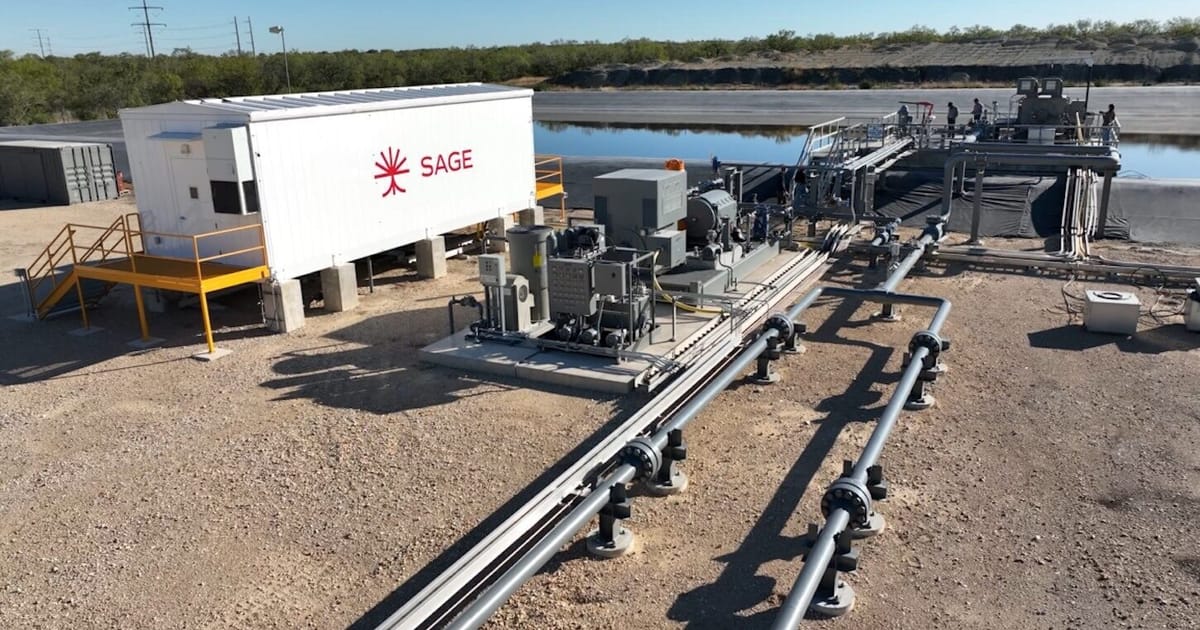
Sage Geosystems has placed its SMECI facility in South Texas in service, the Houston-based enhanced geothermal developer announced on August 19, 2026. The facility sold its first electricity in the second quarter of 2026 and has since logged more than 120 days of operation, according to the release. The plant is a 3 MW installation at San Miguel Electric Cooperative's site in Christine, Texas, near San Antonio, per Sage's project page and Canary Media's reporting.
The in-service designation is less about the megawatts than the measurements. Sage ran the multi-month campaign to evaluate subsurface pressure response, injection and production performance, water management, system efficiency, and reservoir behavior, and says the results met or exceeded its objectives.
What the 120-day campaign measured
Sage's approach belongs to the family of enhanced geothermal systems (EGS): instead of hunting for naturally permeable hot rock, the company drills into hot formations and fractures them, then stores water in the engineered reservoir under pressure and produces it in controlled cycles. CEO Cindy Taff has described the siting constraint of conventional geothermal, which needs co-located heat, water, and permeability, as "very unicorn geology," as she told Canary Media.
The headline result is water retention. Engineered reservoirs have a habit of losing the water pumped into them; in the release, Taff called high water losses "one of the industry's most persistent challenges." Sage says the SMECI reservoir lost less than 10 percent of its water across multiple cycles. Co-founder and CTO Lev Ring said the company sees a path to losses below 5 percent; that figure is a target, and the sub-10 percent showing is what the campaign demonstrated.
The company also reports that GeoTwin, its subsurface modeling tool, predicted the operating behavior observed in the field. For a technology whose economics depend on engineering reservoirs on purpose rather than finding them by luck, model fidelity is the important claim: it is what Sage will use to convince lenders that well number two will behave like well number one.
A battery first, a power plant second
The Christine site has had two careers. Sage's own project page lists SMECI as the company's first commercial energy storage facility, commissioned and cycling since the first quarter of 2025; the pressurized-water reservoir that now validates its power generation approach was doing duty as a long-duration battery first. The storage and generation modes share the same underlying mechanism, water forced into the fracture network and released back through surface equipment in controlled cycles.
The pivot has a market explanation. Sage initially planned to develop the site as long-duration storage, Canary Media reports, but Texas has built one of the largest grid-battery fleets in the world in recent years, making the timing less ripe for a novel storage technology, and the company is now focused on around-the-clock generation. The host is San Miguel Electric Cooperative, a rural generation cooperative whose land sits near a coal-fired power plant, per Canary Media; Sage installed its own substation to connect.
The third engineered-geothermal plant on the US grid
By Canary Media's count, Sage's plant is only the third EGS project ever to deliver power to a US grid. Ormat's 1.7 MW Desert Peak demonstration in Nevada came online in 2013 and no longer produces; Fervo Energy runs a 3.5 MW project in northern Nevada backed by Google. Fervo's 500 MW Cape Station development in Utah is expected to begin partial operation in October 2026, which would move the category from single-digit megawatts to utility scale for the first time.
Outlook
Sage says it is applying the SMECI results directly to the design of its planned development at an Ormat site in Nevada, which its project page lists as its first commercial power generation facility with estimated completion in 2027. Canary Media reports drilling is set to begin later in 2026, with full production targeted for 2028. Behind that sit a 150 MW supply deal with Meta for projects east of the Rockies, listed on the project page for 2030, and, per Canary Media, an expectation of managing approximately 1 GW of projects in total.
The numbers to watch are the ones the pilot just posted. The sub-10 percent water loss and the model-matching reservoir behavior were demonstrated at 3 MW on a site Sage had been cycling for over a year; the Nevada project is where those results meet commercial well costs and a paying offtaker. Sage's own sub-5 percent loss target is a useful measure of the gap the company still expects to close.
⚠ The Outlook section extrapolates from the operating results and project plans in Sage Geosystems' August 19, 2026 release, the company's published project pipeline, and Canary Media's August 19, 2026 reporting. The Nevada, Meta, 1 GW, and sub-5 percent water-loss figures are the company's stated plans and targets; the sub-10 percent water-loss result is what the pilot demonstrated.
Sources
Primary
- Sage Geosystems Places SMECI Facility in Service, Validating Key Elements of its Scalable EGS Approach · Sage Geosystems via Business Wire
Supporting
- Projects - Sage Geosystems · Sage Geosystems
- Sage Geosystems brings its first next-gen geothermal plant online · Canary Media
Copies of cited sources are retained where available. If a link no longer resolves, request a copy at contact@theduckcurve.com.