 The Duck Curve
Xcimer Energy finalizes up to $30.5M more from DOE fusion milestone program
The second-budget-period award lifts the laser fusion developer's potential DOE milestone payments to $39.5 million, paid only as independently verified milestones are met.
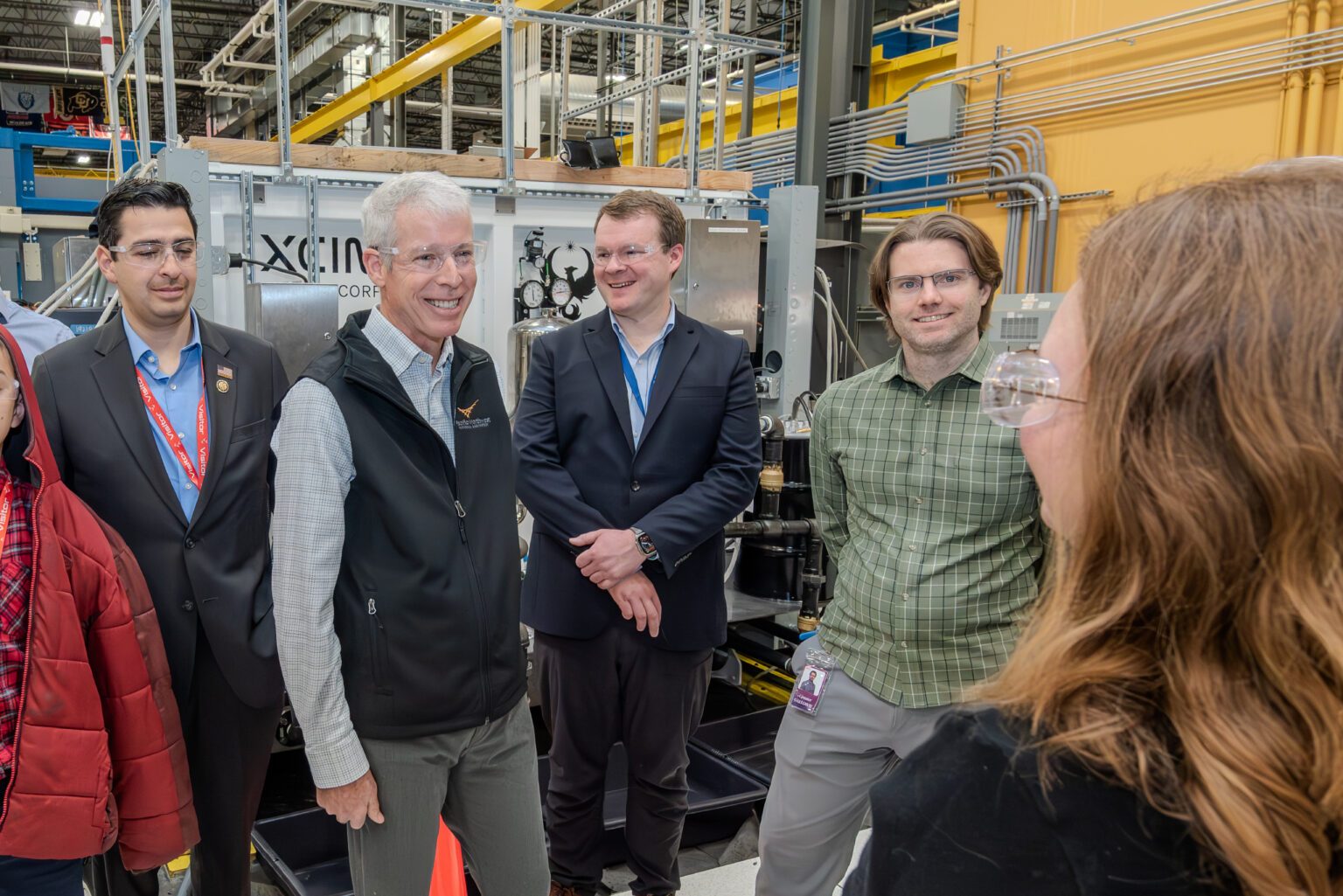
Xcimer Energy has finalized an agreement for up to $30.5 million in additional federal funding from the Department of Energy's Milestone-Based Fusion Development Program, the Denver laser fusion developer announced on October 6, 2026. The award covers the program's second budget period and brings the total DOE funding available to Xcimer for potential milestone payments to $39.5 million. None of it arrives up front: Xcimer will receive the payments "upon successful completion and independent verification of pre-agreed technical and commercialization milestones."
By our arithmetic, the company's earlier milestone award accounts for $9 million of that total. Counting a $4 million ARPA-E award in 2024, Xcimer puts its non-dilutive federal funding at $43.5 million, beside the roughly $200 million it says it has raised from investors including Breakthrough Energy Ventures, Lowercarbon Capital, Emerson Collective and Prelude Ventures.
Where Xcimer stands
The second budget period opens on a design DOE has already signed off on. In a June 10, 2026 release, Xcimer said DOE had formally approved the preconceptual design and technology development roadmap for Athena, its architecture for fusion power plants, following milestones completed over the program's first 18-month budget period. The company's submission ran to 724 pages, and the release said its next phases of work include full-scale subsystem testing, engineering validation and preparation for an integrated plant demonstration.
The October release puts the first commercial plant at 2035 and says its commercial fusion program is "targeting electricity on the grid in the mid-2030s." The hardware behind that date is a laser. Xcimer began operating Phoenix, which it calls the world's largest privately owned laser system, in June 2026. Per the June release, Phoenix is a proof of concept for a krypton fluoride excimer laser that uses stimulated Brillouin scattering to compress a microsecond-long pulse into the nanosecond timescales fusion requires. The company's pitch is cost: gas lasers, gas optics and two beamlines in place of the many solid-state beams and expensive optics of conventional approaches, "designed to deliver megajoule-scale laser energy repeatedly and economically."
The same lasers have a second customer in view. In September 2026, the release says, Xcimer and RTX announced a partnership to develop directed-energy air defense systems based on Xcimer's pulsed laser technology, and RTX invested in the company. The companies plan to demonstrate Xcimer's lasers containerized and integrated with RTX's air defense systems, aimed at airborne threats rather than fusion targets. Xcimer argues the two jobs share one core challenge: a pulsed excimer laser that fires repeatedly and reliably at a low cost per joule and can be mass-manufactured.
DOE's science leadership is on the record behind this award. Under Secretary for Science Darío Gil said in the release that "Xcimer is making real progress toward a new generation of laser fusion technology, and this award will help accelerate that work." Chief executive Conner Galloway said the money "gives us another powerful mechanism to accelerate that work while keeping the majority of the investment and risk in the private sector." Energy Secretary Chris Wright toured the Denver laser facility in December 2025, per POWER.
Authorized $415 million, appropriated $200 million
DOE launched the program on May 31, 2023 with $46 million for the first 18 months across eight companies, Xcimer among them alongside Realta Fusion and Type One Energy. Projects could last up to five years, DOE said, "with outyear funding contingent on congressional appropriations, and continued participation from the teams contingent on satisfactory progress in meeting the negotiated milestones." Xcimer's second-period award by itself comes to about two-thirds of that launch figure, by our arithmetic. Thea Energy said in January 2026 that it was the first awardee to have its pilot plant design certified.
Three former DOE staff who helped design and implement the program posted a retrospective to arXiv on September 23, 2026. It puts the program's authorization at $415 million for fiscal years 2021 through 2027 and its appropriations at $200 million over five years through fiscal 2026, and concludes that the appropriated budget "remains an order of magnitude short of program needs, limiting the program's ability to move rapidly and with certainty." As of September 2026, the authors write, most awardees had received notification from DOE that their preconceptual design and roadmap milestones were complete.
The lead author, Scott Hsu, was DOE's lead fusion coordinator from 2022 to 2025 and is now a fusion partner at Lowercarbon Capital, one of the investors Xcimer names. The paper says the authors had no financial interests in the companies it names while they were at DOE, and discloses that Hsu and co-author Samuel Wurzel now hold financial interests in some of those companies and that some of them are clients of the third author's employer.
The program itself is now up for evaluation and for more money. The National Academies are taking suggestions for experts through October 30, 2026 for a new consensus study that "will assess the status and effectiveness of the MBFD Program, with a focus on the benefits and drawbacks of its milestone-based approach." And H.R. 10574, the American Leadership in Fusion Act, would appropriate $2 billion for fiscal 2027 to the program's activities. Introduced on September 24, 2026, the bill was referred to the House Committee on Science, Space, and Technology that day, and that referral is still its latest action in GovInfo's bill status record as of October 7, 2026.
Outlook
The $30.5 million is a ceiling, not a deposit. Per the release, Xcimer collects it only as independently verified milestones are met, and under the terms DOE set in 2023 the program's later years depend on appropriations. The first test is likely to be the work Xcimer's June release lists next, full-scale subsystem testing and engineering validation. The program-level question sits with the National Academies study and with H.R. 10574. The retrospective's authors argue that appropriations run an order of magnitude below the program's needs; whether Congress closes that gap bears directly on how many second-period awards like Xcimer's the program can carry.
⚠ The Outlook extrapolates from Xcimer's October 6 and June 10, 2026 releases, DOE's May 31, 2023 program terms, the September 2026 arXiv retrospective by former DOE program staff, the National Academies call for experts and the H.R. 10574 text and status record.
Sources
Primary
Supporting
- DOE Announces $46 Million for Commercial Fusion Energy Development · U.S. Department of Energy (Wayback Machine capture, 2023-06-01)
- U.S. Department of Energy approves Xcimer's fusion power plant preconceptual design and technology roadmap milestone · Xcimer Energy
- Retrospective on the Design and Implementation of the Milestone-Based Fusion Development Program of the U.S. Department of Energy · arXiv (Hsu, Wurzel, Subramanian)
- H.R. 10574 (Introduced in House): American Leadership in Fusion Act · U.S. Government Publishing Office (GovInfo)
- BILLSTATUS-119hr10574 · U.S. Government Publishing Office (GovInfo)
- Call for Experts: Accelerating the Path to U.S. Fusion Power: An Evaluation of the DOE's Milestone-Based Fusion Development Program · National Academies of Sciences, Engineering, and Medicine
- Denver-Based Fusion Group Receives $30.5-Million Award from DOE · POWER
- Xcimer Energy Receives Additional $30.5 Million Award from DOE Milestone Program · Business Wire (Xcimer Energy)
Copies of cited sources are retained where available. If a link no longer resolves, request a copy at contact@theduckcurve.com.