 The Duck Curve
Thea Energy's Helios stellarator design lands in 16 peer-reviewed papers
The refereed papers cover a preconceptual design Thea posted as a preprint in December 2025 and says DOE certified in January 2026; the first wall's 15-year average life is now an 11-year minimum and 18-year average.
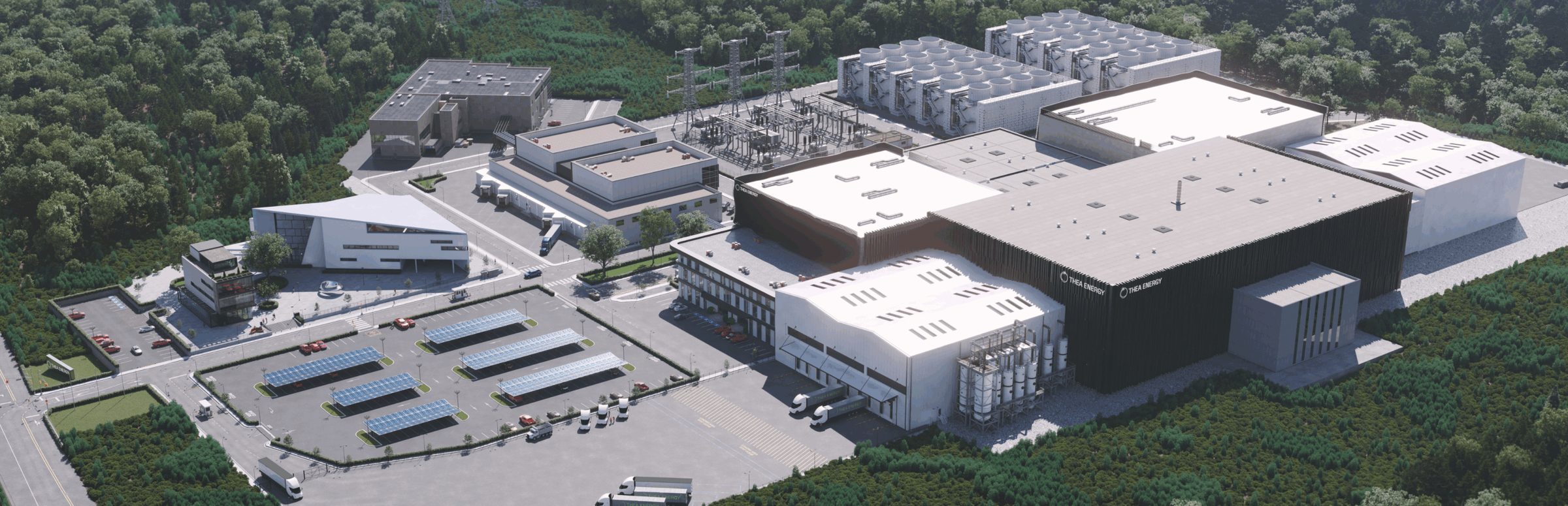
Thea Energy said on September 9, 2026 that 16 peer-reviewed papers on its Helios fusion power plant have been published as a special issue of Fusion Engineering and Design titled "The Helios Stellarator Power Plant Design by Thea Energy." The Kearny, New Jersey company's Helios is a planar coil stellarator with an 8 m major radius that, according to the arXiv preprint of the collection's overview paper, produces 1.1 GW of thermal power and 390 MW of net electric power; the release gives it as "approximately 400 megawatts (MW) of electrical power to the grid."
The overview paper is not new; the peer review is. Thea announced the completed preconceptual design on December 15, 2025 and posted the overview paper to arXiv on December 8, 2025, revised a third time on January 5, 2026, with 41 named authors plus "the Thea Energy team." On January 13, 2026 the company said the Department of Energy had certified the design following "a detailed review by a panel of independent fusion experts," that the "preconceptual design review marks the completion of the final major milestone" in the Milestone-Based Fusion Development Program, and that Thea is "the first awardee company to receive certification of its pilot plant design." The December 2025 and September 2026 releases scope the same milestone to the program's "initial" and "inaugural" phase. What the September release adds is the refereeing: two guest editors, Benedikt Geiger of the University of Wisconsin-Madison and Sophia Henneberg of MIT, with Henneberg calling the collection "an important example of the private fusion sector submitting its work to rigorous peer review."
The published papers themselves could not be independently reviewed: both the special issue page and the overview paper's own ScienceDirect page sit behind a robot check that blocked The Duck Curve, so every design figure in this article, the lede included, comes from the preprint and from Thea's releases and may differ from the refereed text. What was verified is their existence: Crossref's records for the 16 titles, each with Helios in the name, place them across volumes 229 to 232, dated August through November 2026, the overview paper in volume 232 under a CC BY 4.0 license.
What the preprint describes
Per the preprint, Helios is built around a two-field-period quasi-axisymmetric equilibrium with an aspect ratio of 4.5 and a tokamak-like X-point divertor. The coil set is 12 large plasma-encircling coils and 324 smaller field-shaping coils, all planar and convex, all high-temperature superconducting, with the shaping coils individually controllable to reconfigure the field around manufacturing and assembly error. The paper caps the field on the coils at 20 T, "a value which has been achieved in existing large-bore HTS coils," and keeps at least 1.2 m between plasma and coil for a breeding blanket and shield, which it says gives every coil a minimum 40-year lifetime, the plant's own minimum.
The preprint's power balance runs from 958 MW of fusion power to 1.1 GW of thermal power once the blanket's lithium-6 breeding reaction is counted, to 438 MW of gross electric power after coolant pumping, to the 390 MW net figure in the abstract. Maintenance removes entire toroidal sectors of first wall, blanket, shield, vessel and shaping coils from between the encircling coils in one planned outage of approximately 84 days every two years, which the paper says enables a capacity factor of about 88%. The release states the same scheme as a capacity factor "of over 85%" and a "40+ year system lifetime."
One figure moved between December 2025 and September 2026. The preprint's first wall is a 2 cm vanadium alloy with tungsten armor, "chosen for its long survival (15 years)," and the December release said the first wall "is expected to have an average lifetime of 15 years before needing replacement." The September release says instead that "neutronics analysis concludes a minimum 11-year and average 18-year lifetime for first wall systems," and does not say which of the 16 papers carries that analysis. The release's claim that the X-point divertor exhausts gas "10x more effectively than prior stellarator divertors" restates the preprint, which says the divertor "can be expected to exhaust gas 10 times more effectively than existing stellarator divertors" and rests that on tokamak modeling: "In tokamaks, the X-point divertor has been modeled to compress plasma density at the target an order of magnitude more effectively than the island divertor."
Where Thea stands among the stellarator developers
Type One Energy's design basis went through a journal special issue first. The Journal of Plasma Physics collection on Type One Energy's Infinity Two, six peer-reviewed articles on the physics basis, includes an editorial published online on March 24, 2025 describing a four-field-period, aspect ratio 10, quasi-isodynamic design with 800 MW of fusion power and a nominal 350 MWe output that, the editorial says, TVA believes could provide "a complementary source of base load electrical generation" as early as the mid-2030s. Tennessee issued the company a fusion-specific byproduct material license on August 31, 2026 for a project at TVA's Bull Run Energy Complex, where the state's June and August 2026 announcements both forecast 400 MWe.
Thea has the design certification it announced in January 2026 and, so far, no address. The January release said Eos, the integrated stellarator that precedes Helios, "is scheduled to be online by 2030," that the company was "in conversations with five states for the siting of Eos," and that it "expects to select and announce a location for the integrated system in 2026." The August 18, 2026 Series B extension release listed "Evaluated multiple potential sites for Eos" among the company's accomplishments since the $100 million Series B it announced on May 27, 2026, and the September 9 release does not mention a site, saying only that Helios will follow Eos and that Eos "leverages the same planar coil stellarator architecture."
The Milestone Program, per the January release, launched with $46 million across eight companies and pays only when a review panel approves a completed milestone. The August release recounts the Series B led by Thomas Tull's US Innovative Technology Fund, an extension joined by Brevan Howard Macro Venture, Aloniq, ALJ Investments, Beyond Earth Ventures and unnamed "additional top-tier global strategic investors," and a $20 million ARPA-E SCALEUP award for domestic production lines of modular HTS magnets; the extension's own size is not stated. The same release lists "Advanced talks with power offtakers, hyperscalers, and utility partners" among the things the company has done since the round, a claim of progress rather than of stage, and names none of them.
Outlook
If the January release's calendar holds, Thea names an Eos site before the end of 2026, has the machine online by 2030 and follows it with Helios in the 2030s. Type One's March 2025 papers were followed by a state license in August 2026, with construction of Infinity Two as early as 2028 under TVA's letter of intent, pending development work and approvals. Whether the certified design draws the same kind of commitment from the offtakers Thea says it has been talking to is not something the releases answer; as of September 14, 2026 none has been announced.
⚠ The Outlook extrapolates from the dated commitments in Thea Energy's January 13 and August 18, 2026 releases and from the Type One Energy timeline reported in The Duck Curve's August 31, 2026 licensing post.
Sources
Primary
- Thea Energy Publishes the Most Practical Fusion Power Plant Design and A Clear Path Toward Energy on the Grid · Thea Energy via GlobeNewswire
- Overview of the Helios design: A practical planar coil stellarator fusion power plant · Fusion Engineering and Design (Elsevier), vol. 232, article 115999
Supporting
- A comprehensive, unified baseline physics design for the type one energy stellarator fusion pilot power plant, 'Infinity Two' · Journal of Plasma Physics, vol. 91, issue 2, e65
- Thea Energy Completes Fusion Power Plant Preconceptual Design · Thea Energy
- Overview of the Helios Design: A Practical Planar Coil Stellarator Fusion Power Plant (preprint) · arXiv
- U.S. Department of Energy Certifies Thea Energy's Fusion Pilot Plant Preconceptual Design · Thea Energy
- Thea Energy Raises $100 Million Series B Funding to Build Scalable Fusion Power Plants · Thea Energy
- Thea Energy Extends Series B Funding to Deploy Efficient and Economical Fusion Power · Thea Energy
- Physics Basis of the Infinity Two Fusion Power Plant (collection) · Journal of Plasma Physics, Cambridge University Press
- Special issue: The Helios Stellarator Power Plant Design by Thea Energy · Fusion Engineering and Design / ScienceDirect