 The Duck Curve
South Coast AQMD opens $73.1M of warehouse fees to zero-emission trucks
Fees paid by warehouse operators under the Warehouse Indirect Source Rule will cover up to $120,000 per battery-electric Class 8 truck, first come first served, in the area where the fees were paid unless no eligible project turns up there.
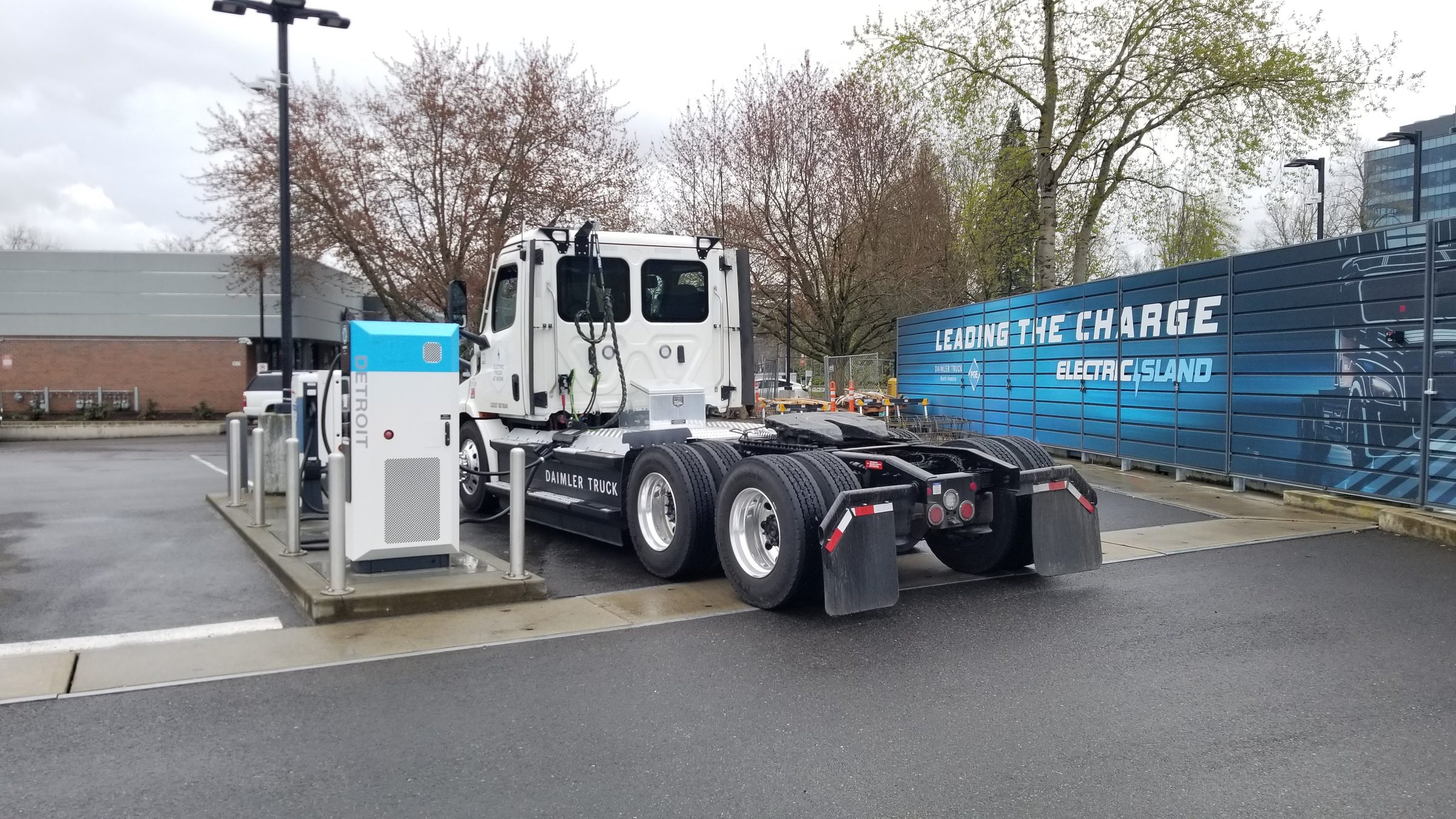
The South Coast Air Quality Management District's Governing Board approved on September 4, 2026 a program announcement offering up to $73,135,300 in incentives for zero-emission Class 4 to 8 trucks, yard trucks, and truck charging and hydrogen fueling infrastructure serving warehouses, the district said. The money is a grant from neither Sacramento nor Washington. It is mitigation fees paid by warehouse operators who chose to write a check rather than earn compliance points under the district's Warehouse Indirect Source Rule, and the board letter says the money must be spent in the same Source Receptor Area where the fees were collected, with one exception carried in both the letter and the program announcement: a move to an adjacent area in the same county if no eligible projects are found.
The terms are in Program Announcement PA2027-01. The district will pay up to $60,000 toward a zero-emission Class 4 or 5 truck, $85,000 for Class 6 or 7, $120,000 for a battery-electric Class 8 or an off-road yard truck, and $240,000 for a hydrogen fuel cell Class 8, with incentives from all sources combined capped at 85 percent of the truck's cost. Charging stations can draw up to $300 per kW of output and hydrogen stations up to $8,000 per kilogram per day of capacity, under the same 85 percent cap. Each incentivized connector must be a DC fast charging or Megawatt Charging System port of at least 24 kW, and funded stations must be publicly accessible or shared unless they serve only yard trucks. Trucks must be bought, not leased, enter service within 18 months, and operate for at least three years.
Awards go first come, first served within each Source Receptor Area, or SRA, the district's geographic units for tracking air quality. The program page says the application portal opens for drafting at noon on September 22, 2026, accepts submissions from noon on October 13, and closes at noon on December 15, 2026; the release says only that the portal will be available at the end of September. Once funds in an SRA are reserved, later applications go to a waitlist, per the program announcement, and the board letter says eligible projects return to the Governing Board for award and final approval.
The same September 4 agenda carried the district's federally funded truck programs beside the fee-funded one. Item 6 proposed contracts of up to $54,246,495 for battery-electric Class 8 trucks and charging under INVEST CLEAN, the $499,997,415 EPA Climate Pollution Reduction Grant the board recognized in September 2024, with the Ports of Los Angeles and Long Beach committing $10,000,000 of Clean Truck Fund rate revenue. Item 4 proposed a $6,000,000 contract with Symbio North America for fifteen hydrogen fuel cell drayage trucks, contingent on the EPA's final award approval. The region's other recent electrification money also came from Washington: a nearly $4.15 million FAA grant for electric ground-equipment chargers at Ontario International Airport, announced August 26, 2026.
How the fee pool got here
Rule 2305, adopted May 7, 2021 according to the board letter, applies to approximately 4,000 warehouses per the release, and runs on a points menu: operators earn WAIRE Points by acquiring zero- or near-zero-emission trucks, installing chargers or solar, and similar actions, or they can buy points at $1,000 apiece as a mitigation fee, according to the district's third annual report on the program, dated January 2026. That report says only about 5 percent of total compliance was achieved through mitigation fees over the first three compliance periods; the release puts it differently, saying less than five percent of WAIRE participants choose to pay. The EPA announced its approval of the rule on September 11, 2024, and its Pacific Southwest regional administrator, Martha Guzman, said the agency had "now made [it] federally enforceable."
The fee pool has been growing as the rule tightens. The annual report counted $55.1 million in fees reported through August 31, 2025: about $11.7 million for the 2022 compliance period, $18.4 million for 2023, and $23.9 million for 2024, and it notes that the rule's stringency rises through its first five years, which raises the number of points operators must earn or buy. By April 20, 2026, the date of the tally in PA2027-01, which notes the figures are subject to auditing, the pool stood at $73,135,300. On top of that sits a 6.25 percent administrative surcharge, $4,570,956, which the board letter recommends drawing from the fee fund, up to that amount, to reimburse the district's general fund for running the program; the release does not say whether the board acted on that recommendation.
Where the fees came from decides where the trucks go. Table 1 of the program announcement lists mitigation funding by SRA, and two of them, Central San Bernardino Valley at $16,660,600 and Southwest San Bernardino Valley at $16,036,700, together hold about 45 percent of the total by our arithmetic. Metropolitan Riverside County has $7,788,900, Southeast Los Angeles County $7,219,400, and Perris Valley $6,870,600. Fourteen of the 37 SRAs in the table, Coachella Valley and Capistrano Valley among them, have $0. If no eligible project turns up in an SRA, the announcement allows the money to move to an adjacent SRA in the same county; otherwise it is banked for a later year.
Outlook
The design points to an uneven first year. The San Bernardino Valley SRAs hold the largest balances and the warehouses that generated them, so the first-come rule there will likely test how fast fleets can assemble complete applications. Six SRAs hold a funded balance below the $240,000 cap for a single hydrogen Class 8 truck, from $19,200 in North Coastal Orange County to $168,700 in Saddleback Valley, and the fourteen $0 SRAs can be served only if an adjacent SRA in the same county has money left and no eligible projects of its own. The annual report expects additional fees for the 2025 compliance period, and the rule's stringency keeps rising, so the second-year pool is likely to be larger than the first. The December 15 close and the board's subsequent award list will show which SRAs oversubscribed and which banked their money.
⚠ The Outlook extrapolates from the first-come, first-served and SRA-locking rules in Program Announcement PA2027-01, the per-SRA balances in its Table 1, and the fee growth and stringency schedule described in the district's January 2026 annual report on the WAIRE Program.
Sources
Primary
- South Coast AQMD Approves $73 Million for Zero-Emission Trucks and Infrastructure · South Coast Air Quality Management District
- Year 2026 WAIRE Mitigation Program, Program Announcement PA2027-01 · South Coast Air Quality Management District
- Board Meeting September 4, 2026, Agenda No. 10: Issue Program Announcement for Zero-Emission Trucks and Zero-Emission Infrastructure for Year 2026 WAIRE Mitigation Program · South Coast Air Quality Management District
Supporting
- EPA Approves South Coast AQMD's Groundbreaking Rule to Reduce Southern California Air Pollution Associated with Warehouses · U.S. Environmental Protection Agency
- 3rd Annual Report for the Warehouse Actions and Investments to Reduce Emissions (WAIRE) Program · South Coast Air Quality Management District
- Governing Board Meeting Agenda: September 4, 2026 · South Coast Air Quality Management District
- WAIRE Mitigation Program · South Coast Air Quality Management District
Copies of cited sources are retained where available. If a link no longer resolves, request a copy at contact@theduckcurve.com.