 The Duck Curve
PG&E picks six community microgrids for $30M in second incentive round
Several first-round awardees are executing grant agreements, and three Lake County projects that would pair solar with pumped hydro in roofed tanks are entering feasibility work; PG&E's final application window opens in 2027.
Pacific Gas and Electric Company selected six community microgrid projects in the second application window of its Microgrid Incentive Program, directing $30 million to projects it says will serve more than 2,200 customers and support critical facilities including schools, fire stations and health centers, the utility announced on September 17, 2026. The release places the projects across PG&E's service area, "including projects in Humboldt, Sonoma, San Mateo, Butte, Placer, and El Dorado counties," puts award amounts at $2 million to $6 million each, and says they use a mix of solar, battery storage, biomass and biodiesel. It counts the first round as "$43 million PG&E announced in 2025 for nine initial projects"; the March 26, 2025 release it refers to had announced PG&E's "intent to award up to $43 million." On that basis the new release puts PG&E's authorized community microgrid investment at "more than $73 million."
One second-round project is named. In San Mateo County, the Pescadero microgrid will be led by WestLight Energy, which the release identifies as the former Peninsula Clean Energy, and is meant to energize most of the town of Pescadero on the San Mateo coast, more than 200 customers including key critical facilities. The release says the microgrid will integrate a roughly 1.5 MW solar system and a 2 MW battery energy storage system, to support a minimum of 24 hours of standalone operation; it gives no energy rating for the battery, the kW vs kWh figure a 24-hour claim turns on, the same gap The Duck Curve found in Duke Energy Florida's community microgrid batteries. WestLight and the County of San Mateo will add funding to PG&E's grant.
Lake County's pumped-hydro microgrids
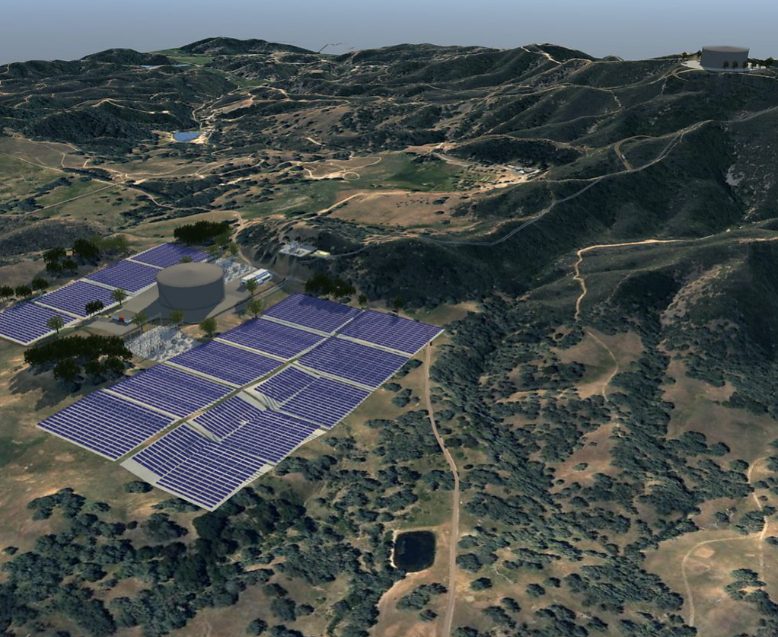
The release's first-round news is that "several of the nine projects" selected in 2025 are advancing, with awardees executing grant agreements that it says set the terms for disbursing funds for engineering, design and development work. The three projects it describes are in Lake County and share a design PG&E calls "a first-of-its-kind approach," Firemain Linked Auxiliary Supply/Hydraulic Energy Storage, or FLASHES: the proposed projects intend to pair tens of megawatts of locally generated solar with pumped hydroelectric storage that uses subsurface water resources; solar power would pump water to roofed tanks at higher elevations when energy is abundant, and the water would be released through turbines when electricity is needed. The release says the result could provide long-duration storage, multi-day resilience during outages and additional water supply for firefighting.
The three microgrids would serve communities along the northwest shore of Clear Lake, from North Lakeport to Nice, and parts of the Hidden Valley Lake area. All three are moving into early development to determine feasibility, with geotechnical core boring and initial test-well drilling among the activities the release schedules for the months after its September 17 date. The release says all three came out of collaboration between local governments and Trane Energy Services; Trane's Johnny Brown, quoted in it, puts his company's collaboration "with county and community partners" at seven years. Lake County Board of Supervisors chair Brad Rasmussen says in the release that "Funding pre-development work has long been a barrier to this project's progress," and names the County Jail and Northwest Wastewater Treatment Plant among facilities that would be hardened, if the project is constructed.
The three Lake County projects were already in the first round: the 2025 release counted "three projects in Lake County" among the nine and listed pumped hydroelectric storage among the resource types selected.
Where the money comes from and how much is left
The money is a California Public Utilities Commission program, created in the commission's microgrid rulemaking under Senate Bill 1339 of 2018. Decision 21-01-018 authorized a $200 million budget, and on April 6, 2023 the commission adopted Decision 23-04-034, issued April 14, 2023, setting the implementation rules; the commission's press release that day put the allocations at $79.2 million for PG&E, $83.3 million for Southern California Edison and $17.5 million for San Diego Gas & Electric. The decision adopts $79,200,000, $83,340,000 and $17,460,000, a split it says follows each utility's forecast 2022 energy sales after a 10 percent reserve for administrative costs, and quotes the utilities' joint statement that funding of the program "will be via distribution rates." It caps the incentive award portion at $14 million per project, the figure PG&E's release uses; the commission's press release said projects "can receive up to $15 million in award funding," and PG&E's MIP Handbook itemizes a grant agreement as an incentive request of up to $14 million, an interconnection allowance of up to $1 million and a special facilities allowance of up to $3 million, which puts the award plus the interconnection allowance, the "up to an additional $1 million" per project the 2025 release also describes, at the press release's $15 million.
The arithmetic on PG&E's share is short. The two announced waves, $30 million and the first round's $43 million as the September 17 release states it, sum to $73 million, which the release states as "more than $73 million," against the $79.2 million allocation; that leaves at most about $6 million for the third window, or more if the first round draws less than the 2025 release's "up to $43 million." PG&E's community microgrids page calls that window its final application tranche and says it launches in 2027, and the decision directs the utilities "to return leftover MIP program funds to ratepayers." The page also tells applicants a community microgrid "can take 3-5 years or more to develop," and the September 17 release gives no operating date for any project. The program does set one: the decision's conclusions of law give a MIP project "a 24-month commercial operation deadline upon execution of a microgrid operating agreement," extendable by mutual agreement to a total term of no more than 36 months, and the handbook says signing the grant agreement concludes the application stage and triggers the studies stage, so that clock starts at the later operating agreement, not at the agreements being signed now.
Demand has outrun the money from the start. The 2025 release said PG&E received approximately 50 inquiries after launching the program in late 2023, that 22 advanced to applications with $25,000 development grants each, and that the nine projects chosen would serve nearly 9,000 customers. The second wave's more than 2,200 customers across six projects works out to more than about 370 per project, against just under 1,000 in the first round, The Duck Curve's division of the releases' floor and ceiling.
The state budget may add a parallel pot. AB 113, the end-of-session budget bill The Duck Curve covered for carrying no 2027 money for the DSGS virtual power plant, was "Enrolled and presented to the Governor" on September 8, 2026, the last action on its history page. Its text carries two items with $10 million each for the Distributed Electricity Backup Assets program, both restricted to funding "exclusively for new clean microgrids, or new non-residential or aggregated residential distributed clean energy and storage projects."
Sources
Primary
- PG&E Advances Deployment of Community Microgrids, Announces New Grant Agreements and Second Round of Funding Awards · Pacific Gas and Electric Company
Supporting
- CPUC Charts Course for Microgrid Incentive Program To Increase Community Resilience · California Public Utilities Commission
- Decision 23-04-034, Decision Adopting Implementation Rules for the Microgrid Incentive Program (R.19-09-009) · California Public Utilities Commission
- PG&E Advancing $43 Million for Nine New Community Microgrids in Northern California · Pacific Gas and Electric Company
- PG&E Microgrid Incentive Program Handbook (May 2025, V1.2) · Pacific Gas and Electric Company
- AB-113 Budget Act of 2026 (amendments), as amended August 28, 2026 · California Legislative Information
- AB 113 bill history (2025-2026 session) · California Legislative Information
- Community Microgrids (program page) · Pacific Gas and Electric Company
Copies of every cited source are retained. If a link no longer resolves, request a copy at contact@theduckcurve.com.