 The Duck Curve
NVIDIA opens DSX Ready battery qualification for AI factories, names three
DSX Ready starts with battery storage and cooling units; partners run NVIDIA's guideline tests on a battery's inverter behavior at the AC terminals for NVIDIA review, and the guideline says passing does not imply site-level stability.
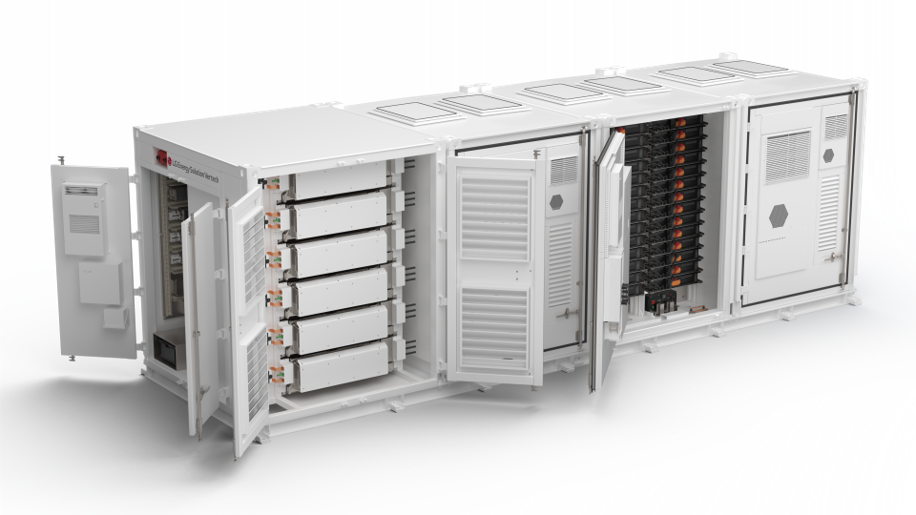
NVIDIA said on September 21, 2026 that it is introducing NVIDIA DSX Ready, "a qualification program for partner products and solutions that meet applicable NVIDIA DSX AI factory reference design requirements," starting with two categories: battery energy storage systems and cooling distribution units. At launch, the post by Vishal Ganeriwala, NVIDIA's senior director of product marketing for the DSX platform, lists qualified BESS solutions from Hitachi Energy, LG Energy Solution and Tesla, and qualified CDU solutions from LG Electronics, LiquidStack and Vertiv, and says additional categories across infrastructure and software will be rolled out over time.
For batteries, the post says partners "run the required qualification tests and submit supporting data for NVIDIA review and approval within a defined qualification boundary," and adds: "Passing qualification does not replace site-level engineering or imply site-level stability." The boundary comes from NVIDIA's BESS Self-Qualification Guidelines, version 1.0 dated May 28, 2026, which describe a partner-run process and set the boundary "at the AC terminals (PCS inclusive) because the BESS is being qualified as a grid asset." The PCS is the power conversion system; in the words of NVIDIA's technical post, "the inverters and controls make the system grid-interactive." Site transformers, line reactors, switchgear, relays, generators and campus control systems sit outside the scope, though the partner must provide models and evidence for NVIDIA to validate site-level integration. Battery sizing "is irrelevant to qualification," cell chemistry is an OEM decision outside the boundary, and, in the guideline's words, "A system passes or fails based on PCS behavior alone." The guideline's own note on stability has two halves: passing "does not imply site-level stability," but "failure to demonstrate stability across the defined SCR, impedance, and load envelopes constitutes BESS non-qualification regardless of downstream integration." Safety codes such as NFPA 855 and UL 9540A and cybersecurity frameworks are left to the bodies that own them.
The guideline's test list runs to twelve: telemetry verification and data integrity; grid-adaptive voltage and frequency regulation while islanded; current-limit characterization under active-power, reactive-power and mixed priority; an AI buffering proxy test that tracks fast ramps; a model-based AI buffering validation; demand response dispatch performance; low- and high-voltage ride-through on hardware or hardware-in-the-loop; seamless grid-to-island transition; islanded operation with generator following; black start; state-of-charge drift and energy management under combined missions; and a control transparency package review. The overview names five use cases the tests serve: low-voltage ride-through, dynamic AI transient reduction, demand response, source transfer and black start.
The qualified systems and the grid problem behind them
LG Energy Solution's release, dated September 21 on PR Newswire and September 22 on the company's own newsroom, says its BESS "meets the applicable NVIDIA DSX Ready requirements for AC energy storage solutions" and lists "modular 2.5 MW / 5.1 MWh battery blocks" and an integrated AC solution that "supports agile grid-forming capability, fast response times, voltage ride-through, and AI load smoothing." "Being selected as a partner for NVIDIA's first-ever DSX Ready program validates the strength and competitiveness of our BESS products," said Chang Beom Kang, head of its ESS battery division, in the release.
ESS News reported on September 22 that the qualified systems listed are Hitachi Energy's BESS, comprising its WD4 PCS and battery storage, at 5 MW AC output and 10 MWh; LG's LGES Vertech JF2 2HR/4HR AC Link at 5 MW AC output and 10 MWh; and Tesla's Megapack 2XL at 1.93 MW AC output and 3.85 MWh. NVIDIA's post names the companies, not the products. LG's own release gives a per-block rating of 2.5 MW / 5.1 MWh, and ESS News's listing gives 5 MW AC and 10 MWh for the Vertech JF2 2HR/4HR AC Link. ESS News also carries a statement from Marco Berardi, Hitachi Energy's head of grid and power quality solutions and service, calling its system "one of the first qualified BESS solutions in the NVIDIA DSX Ready program," and says Tesla had not commented at the time of its writing.
NVIDIA's case for why a chip company is writing a battery test is in a technical blog post from June 10, 2026 by Sean James, Harry Petty and Sai Somayajula. A well-designed BESS, the authors write, can "buffer fast load swings, improve power quality, support low-voltage ride-through, coordinate with onsite generation," smooth source transfers and present utilities with a more stable load profile, and "Interconnection standards exist, but don't yet cover behaviors AI factories need," which they list as load smoothing, operation that adapts between grid-connected and islanded modes, and coordinated response with onsite generation. NVIDIA released the Vera Rubin DSX AI factory reference design on March 16, 2026 and made the Omniverse DSX blueprint generally available with it; that release asserts that "Energy is now the biggest bottleneck for AI infrastructure buildouts," putting more than 200 gigawatts of projects in US interconnection queues without giving a source for the figure, and describes DSX Flex as connecting AI factories to power-grid services.
The load side of that sentence is being written by grid operators at the same time. PJM proposed voltage and frequency ride-through requirements for large computational loads on September 8, 2026, after a July 22, 2026 fault on a single 230 kV line in the Dominion zone after which approximately 3,800 MW of load transferred to backup power, and it plans to file at FERC in November 2026 (PJM proposes ride-through rules for data centers). Per PJM's event review, FERC on July 16, 2026 ordered NERC to file a first phase of enforceable standards for computational loads by December 31, 2026, and PJM's Matthew Wharton said, per the review, that phase will not cover minimum ride-through, expected in NERC standards in 2027. NVIDIA's technical post makes the connection itself, saying BESS "helps sites meet evolving technical interconnection requirements such as load smoothing, ride-through, and power quality compliance." The blog post's caveat keeps the two apart: passing qualification "does not replace site-level engineering," so a qualified inverter is not a compliant site.
Outlook
NVIDIA says more categories will follow, and the technical post's own framing, that self-qualification "anticipates" the visibility and predictability grid operators are starting to ask of AI factories, suggests the test list will be read against the instruments that can carry a ride-through envelope: PJM's November 2026 filing and the NERC standards in which, per our earlier coverage, minimum ride-through is expected in 2027. If those converge on envelopes like the ones NVIDIA already tests, DSX Ready becomes a shortcut for a utility evaluating a data center's battery; if they diverge, a qualified system will still need the site-level engineering the blog post says qualification does not replace.
⚠ The Outlook extrapolates from NVIDIA's September 21, 2026 blog post, its BESS self-qualification guideline (v1.0, May 28, 2026) and June 10, 2026 technical post, and PJM's September 8, 2026 proposal and the NERC schedule as covered by The Duck Curve.
Sources
Primary
Supporting
- NVIDIA Releases Vera Rubin DSX AI Factory Reference Design and Omniverse DSX Digital Twin Blueprint With Broad Industry Support · NVIDIA Newsroom
- BESS Self-Qualification Guidelines: Qualification Tests (NVIDIA DSX Documentation) · NVIDIA (docs.nvidia.com)
- BESS Self-Qualification Guidelines: Overview (NVIDIA DSX Documentation, v1.0, DA-12516-001_v01) · NVIDIA (docs.nvidia.com)
- Designing Production-Ready Battery Energy Storage Systems for AI Factories · NVIDIA Technical Blog
- LG Energy Solution's Battery Energy Storage System Qualifies as NVIDIA DSX Ready BESS · LG Energy Solution via PR Newswire
- LG Energy Solution's Battery Energy Storage System Qualifies as NVIDIA DSX Ready BESS (LG Energy Solution newsroom copy) · LG Energy Solution (news.lgensol.com)
- Nvidia launches BESS qualification program for AI data centers, names just Tesla, LG, Hitachi · ESS News (pv magazine group)
Copies of every cited source are retained. If a link no longer resolves, request a copy at contact@theduckcurve.com.