 The Duck Curve
Ann Arbor's city utility installs solar and batteries at no upfront cost
Participants pay about $600 a year for city-owned panels and a battery, with state grants covering the roof and insulation work the installations require; the city estimates $700 to $1,000 in annual bill savings.
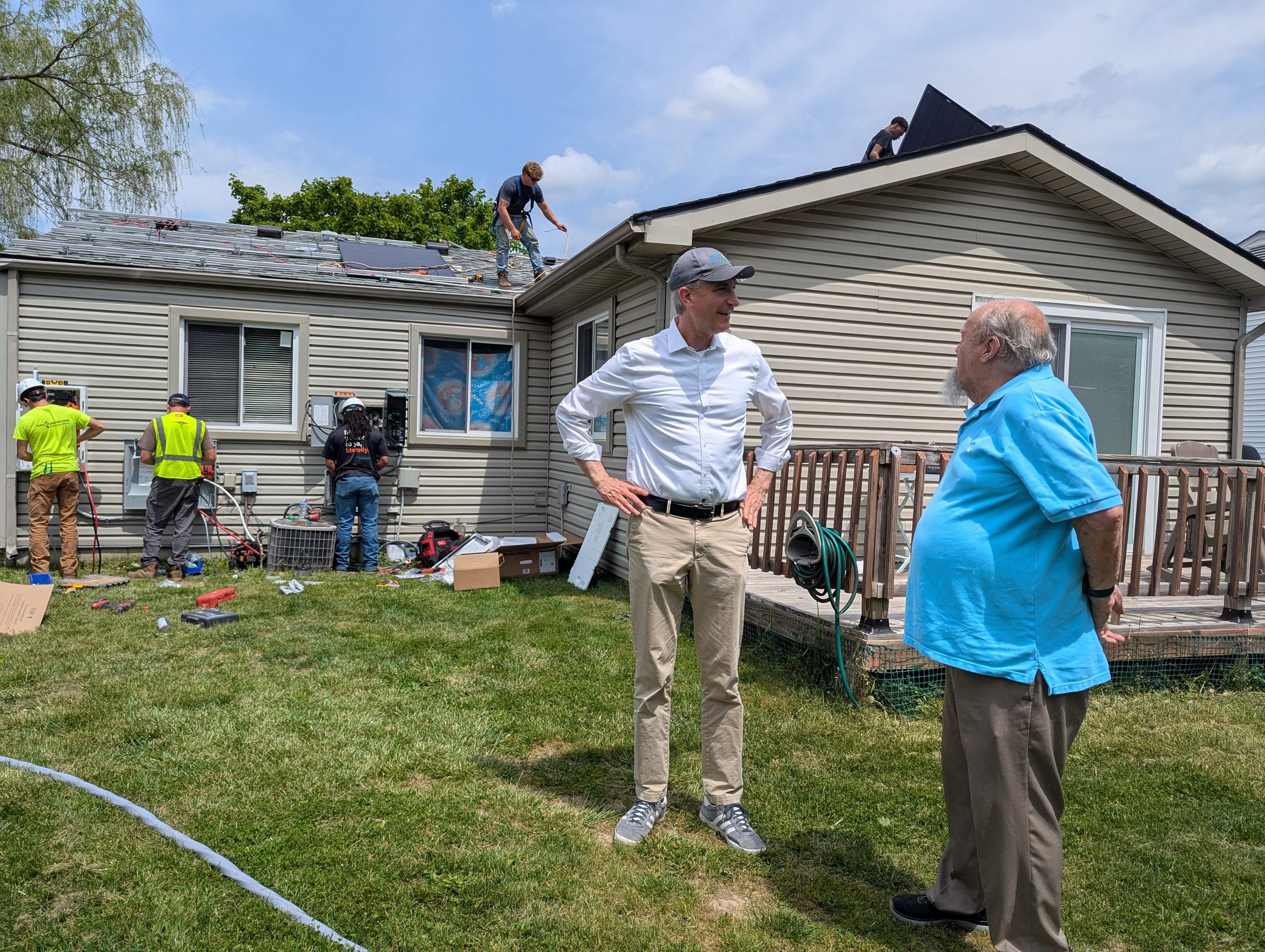
Ann Arbor is running an experiment in who owns the roof. The city's Sustainable Energy Utility, a municipal utility voters created in November 2024, began installing rooftop solar and home batteries in the Bryant neighborhood on May 18, 2026, with a plan to reach about 100 homes before the pilot concludes in 2026. Residents pay nothing upfront: the city finances, owns, installs, and maintains the systems, and participants pay roughly $600 a year for the service, against an estimated $700 to $1,000 a year in utility-bill savings, according to figures the utility's executive director gave Marketplace in a report published August 13, 2026.
The SEU is supplemental: households stay connected to DTE Energy's grid, and the city's own program pages are explicit that it replaces no one. What it adds is a second, locally owned layer: city-owned solar panels and a battery, with sizing the city says depends on the house (the home Marketplace profiled carries 10 panels). Home improvements needed for the installation, such as roof replacements and repairs, are included with the state grant support, per the city's announcement, and Mayor Christopher Taylor said some customers are also receiving no-cost windows, insulation, and appliances.
A utility that owns the hardware on your roof
The ownership structure is what the city itself leads with: its announcement calls the SEU a first-of-its-kind municipal energy utility, and the first-of-its-kind part is where the hardware sits, generation assets on private roofs, held by the utility, sold back as a service. "It's like any other utility. We own the generating assets, and residents buy the power or the service and the benefits of it," SEU executive director Shoshannah Lenski told Marketplace. The pilot runs on state grants, from the Michigan Public Service Commission and the Michigan Department of Labor and Economic Opportunity per the city's announcement, plus the city budget; Lenski says the long-term goal is for the utility to be self-funding through rates. The utility can also draw on enrolled batteries to lighten load on the grid during peaks, per Marketplace's report, which makes the fleet a small municipally run virtual power plant as it grows.
That structure reads differently from the incentive programs states are building for privately owned batteries, such as the 10-year performance payments New Jersey proposed in August 2026: those pay homeowners who can get a battery; Ann Arbor's model is for households that were never going to buy one.
The two-day outage that tested it
Bruce Schauer's Hemlock Drive house was the first install. In July 2026, during a heat wave, his neighborhood lost power for two days, and the new battery carried the house through, including the refrigerator holding his daughter's arthritis medication. "Our medicine was saved. Our food was saved. It was a godsend. It was amazing," his granddaughter April Adkins told Marketplace. Each battery holds enough to run a home for more than a day if the air conditioning stays off, per the same report, which also notes Michigan has some of the least reliable electricity in the country.
Who the pilot reaches
Bryant is a majority low-income neighborhood, and many of its residents are energy-burdened, spending up to a third of their income on utilities, according to Marketplace. About a fifth of the neighborhood's residents had signed up by mid-August 2026. The no-upfront-cost design also pulls in rental housing, a segment rooftop solar rarely touches: one landlord with 10 houses in Bryant told Marketplace she enrolled because neither she nor her tenants pay anything upfront. Residents elsewhere in the city can register interest at the SEU's site; the city says installations beyond Bryant are expected to begin in 2027.
Outlook
The pilot's real test is arithmetic at scale. The roughly $600-a-year service charge against $700 to $1,000 in estimated savings is the city's own math, and the stated goal of a rate-funded, self-sustaining utility depends on it holding once grant money is no longer covering roofs and insulation. The city's published timeline points to citywide expansion starting in 2027, so the Bryant results, sign-up rates, actual bill savings, and how often those batteries earn their keep in outages, will land just as the SEU asks a much larger pool of households to opt in.
⚠ The Outlook extrapolates from the city's published pilot timeline and cost figures and from the SEU executive director's stated self-funding goal, as reported by Marketplace.
Sources
Primary
- Ann Arbor Sustainable Energy Utility marks milestone with first installations in Bryant neighborhood · City of Ann Arbor
Supporting
- Free solar panels and home batteries? Ann Arbor's trying it out · Marketplace (American Public Media)
- About the SEU · City of Ann Arbor
Copies of cited sources are retained where available. If a link no longer resolves, request a copy at contact@theduckcurve.com.