 The Duck Curve
#china
China proposes export controls on 12 solar manufacturing technologies
China's Ministry of Commerce and Ministry of Science and Technology proposed on October 16, 2026 to add 12 polysilicon, wafer and cell technologies to the country's export-control catalogue, which would ban exports of perovskite and tandem production technology above set size and efficiency thresholds and require licenses for advanced TOPCon, heterojunction and ingot-pulling processes. Comments close November 15; exporters must register transfers of the listed technologies and equipment in the meantime.
Ember: national 2030 storage targets reach 822 GW, 45% short of pledge
Ember said on October 15, 2026 that national 2030 energy storage targets sum to 822 GW, up 190% since COP29 but 45% short of the 1,500 GW pledge, with China (460 GW) and the EU (200 GW) over 80% of it. Storage additions hit a record 118 GW in 2025; the targets need 78 GW a year to 2030.
Tianwan 7 reaches the grid, Mochovce 4 waits, Poland orders AP1000 parts
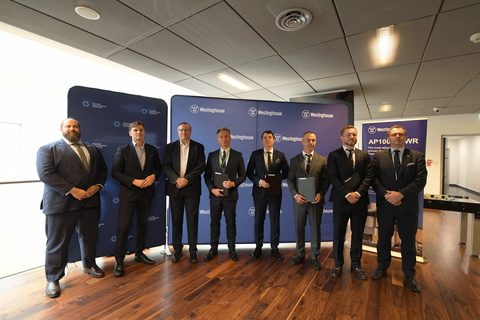
Tianwan 7, a VVER-1200 in Jiangsu, sent its first power to China's grid on October 8, 2026, CNNC said; Slovakia's Mochovce 4 missed its October 13 grid connection while part of its technical tests is repeated. Poland's PEJ told Westinghouse to start ordering six long-lead nuclear-island components for its first AP1000, Westinghouse placed conditional module orders with four Polish suppliers, and PEJ and PGE split work on a second plant.
Ember estimates EVs in oil importers displaced $20bn of crude, March-August
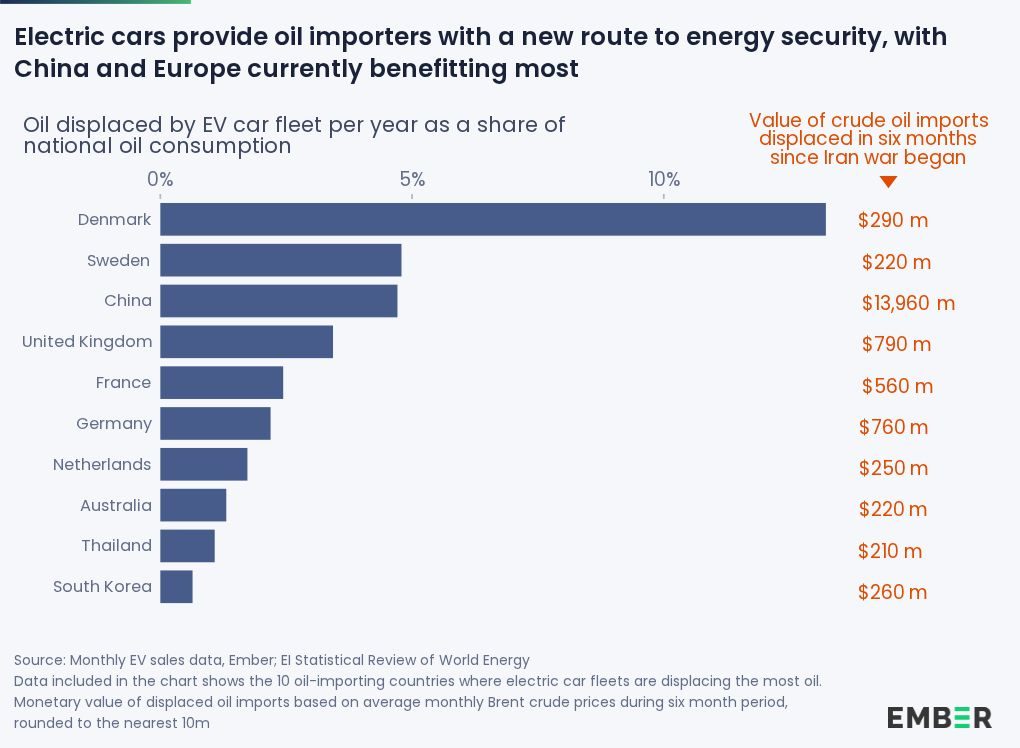
Ember estimated on October 14, 2026 that electric car fleets in oil-importing countries displaced 200 million barrels of crude oil, worth $20 billion, from March to August 2026 during the Hormuz energy crisis, led by China at $14 billion and EU member states at $3.1 billion. The figure is a gross counterfactual estimate. Of the 56 countries in Ember's new EV sales tracker, 49 now have a higher battery electric share of sales than the US.
EU sees China hybrid exports cut by over half; Beijing says they can grow
EU trade commissioner Maroš Šefčovič said on October 9 that an understanding to moderate Chinese hybrid and plug-in hybrid exports to the EU opens the prospect of cutting them by more than half. China's Commerce Ministry says the arrangement builds upward from the 302,000 hybrids the EU imported from China in 2025. The final decision lies at the European Council on October 15–16.
China cuts EV export VAT rebate from 13% to 9% from April 2027
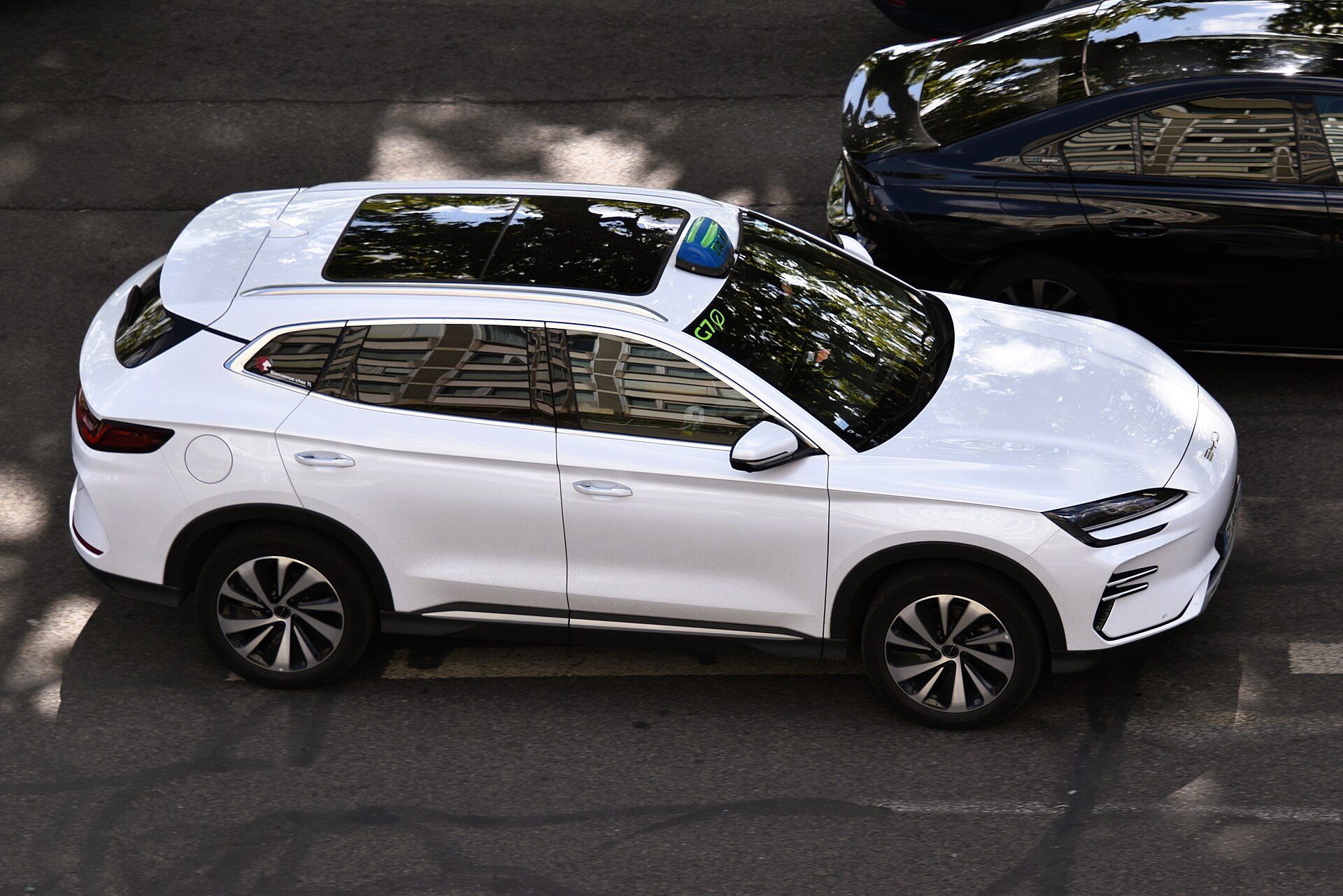
China's Ministry of Finance and State Taxation Administration will lower the export VAT rebate on new energy vehicles from 13% to 9% from April 1, 2027, covering electric-only and plug-in hybrid passenger vehicles, electric-only buses and goods vehicles, and electric short-distance tractors and carts.
Australian BEV share eases to 24.2% in September on FCAI's count
Battery-electric vehicles took 24.2% of Australia's new vehicle market in September 2026, the Federal Chamber of Automotive Industries said on October 6, below the record 24.9% it reported for August and up from 11.3% in September 2025. The Driven counts 26,087 EVs against 26,018 petrol cars, a second straight month ahead of petrol.
Geely agrees to take 30% of NIO Power for Yiyi Power plus RMB640 million
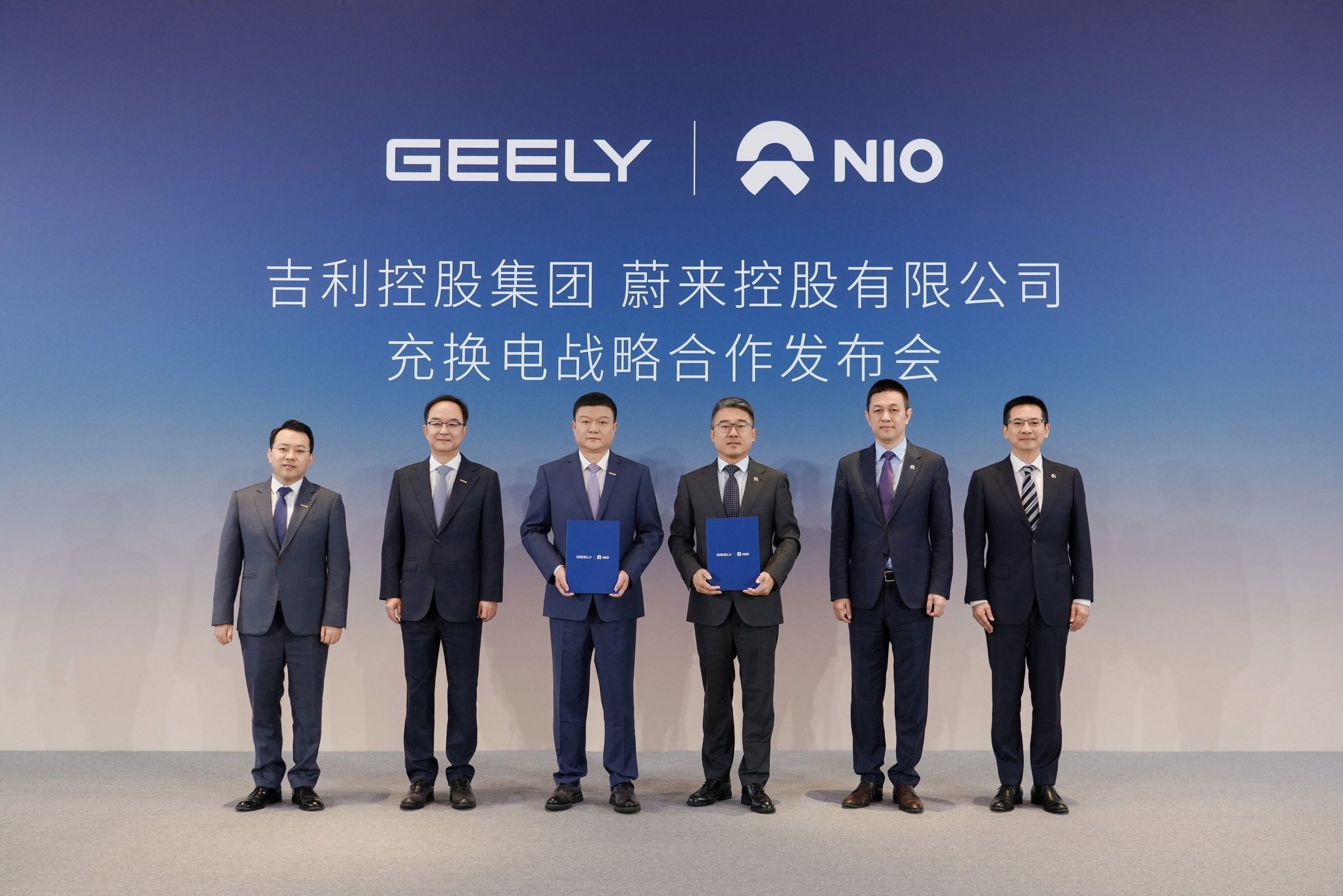
NIO Inc. said in a Hong Kong Stock Exchange filing on September 28, 2026 that, subject to closing conditions, a Geely Holding Group subsidiary will subscribe for newly issued equity of NIO Power with its 100% stake in Yiyi Power plus RMB640 million in cash, holding 30.0% at completion at a post-money valuation of approximately RMB16 billion; NIO China keeps a controlling 63.6%. Under the same conditions, NIO China will take 10.0% of Geely's charging arm, Haohan Energy. The filing calls plans for battery swapping on Geely consumer-facing models and commercial mobility businesses preliminary.
Geely says new station peaks at 2,250 kW, test cars took 4.5 minutes to 70%
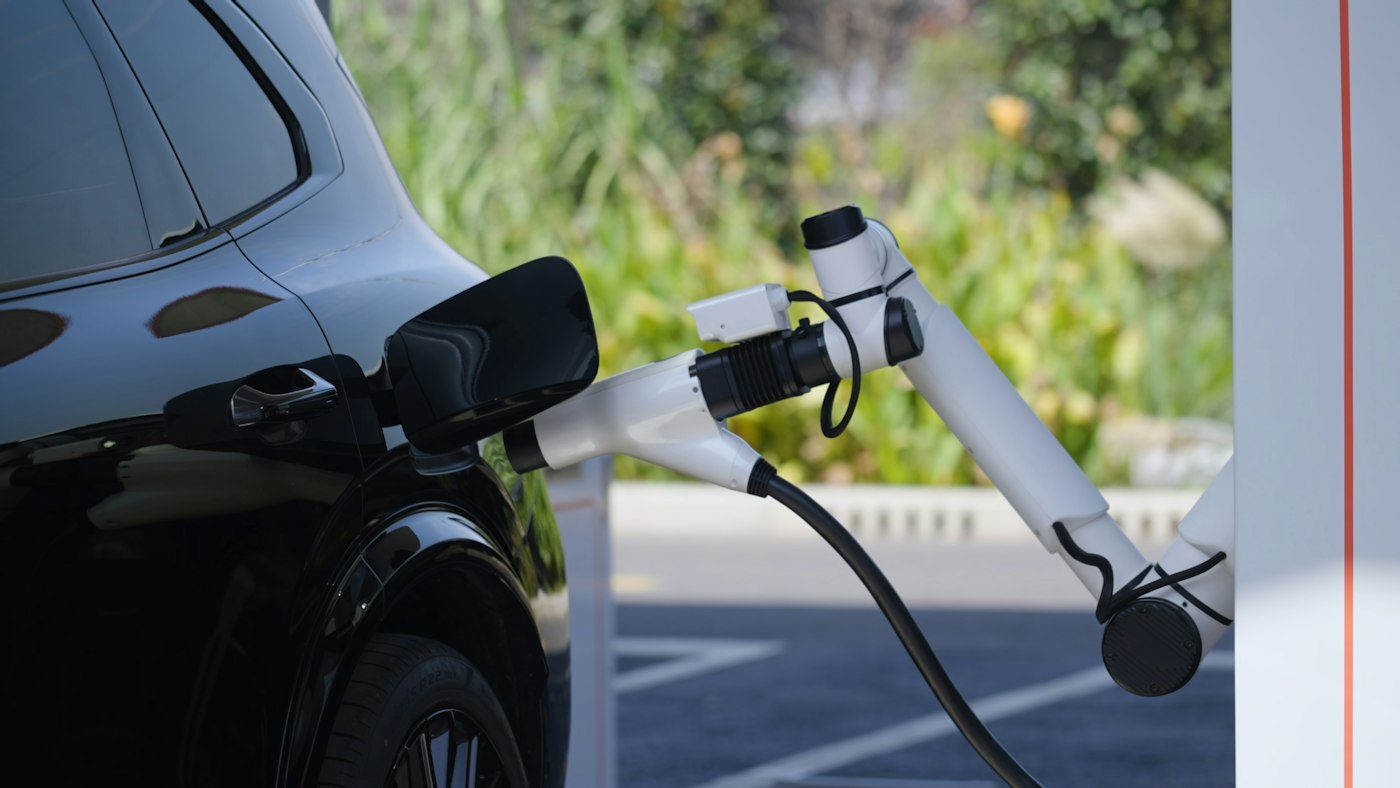
Geely Auto Group said on September 23, 2026 it introduced Geely Smart Charging, an AI-managed charging system, alongside a fifth-generation Geely Smart Charging Station it says delivers peak charging power of up to 2,250 kW. In tests it calls real-world, the battery used in the Lynk & Co 10 and Zeekr 001 charged from 10% to 70% in 4 minutes 30 seconds and from 10% to 97% in 8 minutes 40 seconds. The release names no pack capacity, test temperature or price; CnEVPost puts BYD's flash charger at a maximum of 1,500 kW per connector and its network at 11,586 stations in China as of September 24.
CNNC proposes fusion engineering platform, unit signs ITER memorandum
China National Nuclear Corporation said on September 16, 2026 that at its September 15 side event at the 70th IAEA General Conference it proposed a new international cooperation platform for fusion engineering, released an HL-3 tokamak progress report and joint experimental plan, and that China Fusion Energy Co and ITER signed a memorandum of cooperation. World Nuclear News reports the event was told HL-3, open to international cooperation since 2024, reached an ion temperature of 120 million degrees Celsius in 2025 and plans deuterium-tritium burning-plasma experiments in 2027.
DICP's 250-kW system co-produces hydrogen and fresh water from seawater
A Dalian Institute of Chemical Physics team reports in Nature Energy, published September 15, 2026, a 250-kW system that couples alkaline water electrolysis with low-temperature seawater distillation driven by the electrolyser's waste heat: 48 Nm³/h of hydrogen and 31.6 kg/h of fresh water, with a 14.4% improvement in system electrical efficiency relative to alkaline electrolysis of fresh water alone, per the abstract. The institute's September 16 release says the 250-kW unit was completed in August 2024 and has run stably for more than 40 days.
Ember: coal power has stalled in 17 of the 26 Chinese regions it tracks
Ember's China Energy Transition Review 2026, published September 8, 2026, says coal generation plateaued or turned flat between 2021 and 2025 in 17 of the 26 provincial-level regions it tracks, together holding more than half of China's thermal capacity, and that thermal generation fell 0.7% in 2025 while electricity demand rose 5%. China's National Bureau of Statistics reports thermal generation down 0.7% and total coal consumption up 0.1% for 2025. Ember says battery storage overtook pumped hydro in installed capacity by the end of 2024 and grew 84% in 2025.

ProLogium says its 381 Wh/kg solid-state cell is in mass production
ProLogium Technology said on September 2, 2026 that its Gen 3.5 Lithium Ceramic Battery is in mass production at its Taoke Gigafactory in Taoyuan, Taiwan, citing a third-party TÜV report showing a 185.4 Ah cell at 381 Wh/kg and 903 Wh/L and a UL Solutions weight-loss test under China's GB/T 43568-2026 from which ProLogium concludes the cell can be classified as all-solid-state. The release gives no production volume and names no customer for the Gen 3.5 cell.
Australia's battery-electric sales hit a record 24.9% share in August
Battery-electric vehicles took 24.9% of Australia's new vehicle market in August 2026, with 27,089 sold across all reporting sources, the highest number in any month, according to the Federal Chamber of Automotive Industries' September 3 release; The Driven calls the share the best on record, above 23.5% in June. The Electric Vehicle Council puts BEVs plus plug-in hybrids at 36% of the market with the Tesla Model Y the best-selling vehicle at 6,414, and The Driven's tally has petrol cars at 25,824 and diesels at 23,608, both below the BEV count.
China starts taxing lithium-ion batteries at 2%, solar cells next
China began collecting a 2% consumption tax on lithium-ion, lithium primary, nickel-metal hydride, mercury-free primary, and vanadium flow batteries on September 1, 2026, returning to the statutory 4% on September 1, 2027, under a July 16 announcement from the finance ministry, customs, and tax administration. Solar cells join at 2% in April 2027; sodium-ion, solid-state, and fuel cells are exempt through 2028.