 The Duck Curve
Tianwan 7 reaches the grid, Mochovce 4 waits, Poland orders AP1000 parts
Slovenské elektrárne put off Mochovce 4's October 13 grid connection to repeat part of its technical tests, and Poland split the groundwork for its second nuclear plant between PEJ and PGE.
Two VVER reactors, one in China and one in Slovakia, were at the threshold of the grid in the week to October 13, 2026, and only one crossed it. Poland, meanwhile, started buying hardware for its first AP1000 before signing the contract to build it, and assigned the groundwork for a second plant.
Tianwan 7 sends its first power to China's grid
Tianwan unit 7 in Jiangsu province delivered its first electricity to the grid on October 8, 2026, China National Nuclear Corporation said. The unit is a 1,265 MW VVER-1200, and China Energy News calls it the first VVER-1200 unit to start construction in China. The connection came just over a week after the reactor first went critical, World Nuclear News reported.
To get there, operator Jiangsu Nuclear Power and its partners completed reactor protection logic verification, reactor criticality, turbine run-up and a generator short-circuit test, CNNC says. A series of tests now follows to confirm the unit meets the conditions for commercial operation, which CNNC expects to begin within 2026. The site is already large: units 1 to 6 have generated more than 550 TWh, and with all eight units running it will pass 9 GW of capacity and 70 TWh a year, according to CNNC.
It was a busy week for the VVER-1200. Three days after Tianwan 7 synchronised, Rooppur 1 in Bangladesh, another VVER-1200, reached criticality on October 11.
Mochovce 4 misses its grid date
Slovakia's Mochovce 4 was set to join the grid on October 13 and did not. During primary voltage tests on the unit's generator, a non-standard response turned up in the voltage measurement circuits on the non-nuclear part of the plant, and Slovenské elektrárne decided to repeat part of the technical tests, the company said that day, calling the repeat standard procedure in commissioning. The press conference planned to mark the grid connection did not take place. The company says the event has no effect on nuclear safety; it set no new date, saying only that it expected to reach the milestone within days.
The setback is on the non-nuclear part of the equipment, found during generator voltage tests. The 471 MW VVER-440/V213 unit entered power start-up on September 21 after approval from Slovakia's Nuclear Regulatory Authority, Slovenské elektrárne said at the time. Under that plan, the turbine generators synchronise with the grid at 20% reactor power, output then steps through 35%, 55%, 75% and 90%, and the final tests before commercial operation, including a 144-hour run, take place at 100%.
Poland's first AP1000 starts ordering parts before its contract
On October 8, Polskie Elektrownie Jądrowe (PEJ) commissioned Westinghouse to begin ordering long-lead items for the first AP1000 unit at Lubiatowo-Kopalino, PEJ said. The order covers six key nuclear-island components, including the reactor containment vessel and its associated structural modules. The work covers technical documentation, quality and supervision plans, choosing and contracting suppliers, and the material orders needed to start production; making the finished components and delivering them to site falls under a later order that PEJ plans to place under the construction contract.
That contract is still being negotiated. PEJ and the Westinghouse-Bechtel consortium agreed its main commercial terms in September and aim to finalize the remaining terms by year-end, Westinghouse said on September 23. Ordering now buys "time for further detailed negotiations on the EPC contract, without the pressure that the lack of an LLI order would affect the project schedule," Wojciech Wrochna, a secretary of state at the Ministry of Energy, said in the English edition of the release. PEJ has already ordered the first long-lead items for which Bechtel is responsible, and puts the first unit's start-up in 2036.
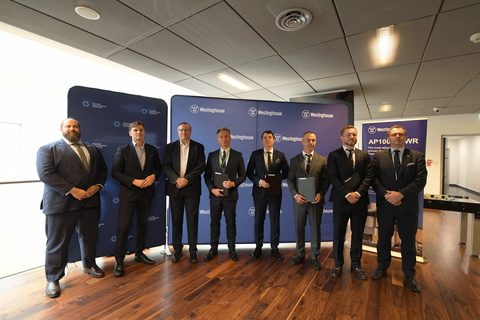
Polish module suppliers followed five days later, on conditions. On October 13, Westinghouse placed conditional purchase orders with four companies for safety-related modules for the first unit, and says it will award each company the full project scope upon NQA-1 certification and the successful fabrication of pre-production qualification mockups. The scopes: the CA02 walls module for Mostostal Kielce, the CA03 module for Energomontaż-Północ Gdynia, the CA05 walls module for Mostostal Krakow and the CA20 floors module for FAMAK. The CA02 and CA03 modules are part of the in-containment refueling water storage tank.
Project Power, the US-Korea framework for six AP1000s and two APR1400s, also puts long-lead items first: the two governments agreed to cooperate on a $10 billion advance by the end of 2026 "aimed primarily at the immediate purchasing of long-lead items," which Seoul says still needs a commercial reasonableness review and a report to the National Assembly. And on October 14 the NRC published a direct final rule to renew the AP1000 design certification with a revision based on Vogtle Units 3 and 4.
Poland divides the work on a second plant
Poland's Ministry of Energy, PEJ and PGE signed an agreement on October 13 that splits preparation of the country's second nuclear power plant, PEJ said. PEJ will be the investor and coordinate the project; PGE will prepare preliminary feasibility studies with potential technology suppliers and analyse the sites under consideration for PEJ. Bełchatów and Konin are the preferred locations, with a final decision to follow the research and analyses needed to confirm the investment is feasible. The document implements the assumptions of the updated Polish Nuclear Power Programme, which the Council of Ministers adopted on September 29, 2026.
The second plant has sites in mind but no reactor yet. A competitive dialogue to choose a technology supplier and partner is under way, with participants representing the United States, France and Canada, and the programme plans to select a strategic partner and technology in 2027, start construction around 2032 and start up the first unit around 2040, about four years after the first plant's first unit is due.
Sources
Primary
- PEJ i Westinghouse rozpoczynają proces zamawiania kluczowych komponentów dla pierwszej elektrowni jądrowej w Polsce · Polskie Elektrownie Jądrowe
- 首次并网成功!(Tianwan unit 7 first grid connection) · China National Nuclear Corporation (CNNC official account, via Tencent News)
- Ministerstwo Energii, PEJ i PGE podpisały porozumienie w sprawie drugiej elektrowni jądrowej · Polskie Elektrownie Jądrowe
- Westinghouse Places Conditional Purchase Orders with Polish Suppliers for First AP1000 Unit at Lubiatowo-Kopalino · Westinghouse Electric Company
- Slovenské elektrárne odložili dnešné prifázovanie 4. bloku Mochoviec · Slovenské elektrárne
Supporting
- Mochovce 4 recieves regulatory approval. Slovenské elektrárne begins power start-up · Slovenské elektrárne
- Westinghouse-Bechtel and PEJ Agree on Main Commercial Terms to Deliver First Polish Nuclear Power Plant · Westinghouse Electric Company
- China's Tianwan 7 connected to the grid · World Nuclear News
- PEJ and Westinghouse Begin Long-Lead Item Procurement Process for Poland's First Nuclear Power Plant · Westinghouse Electric Company
- 田湾核电7号机组首次并网成功 · China Energy News (中国能源新闻网)
Copies of cited sources are retained where available. If a link no longer resolves, request a copy at contact@theduckcurve.com.