 The Duck Curve
Ember estimates EVs in oil importers displaced $20bn of crude, March-August
China's fleet accounts for $14 billion and the EU's for $3.1 billion, while BEVs took 6% of US light-duty sales in January to August and 49 of the 56 countries Ember tracks are ahead of the US.
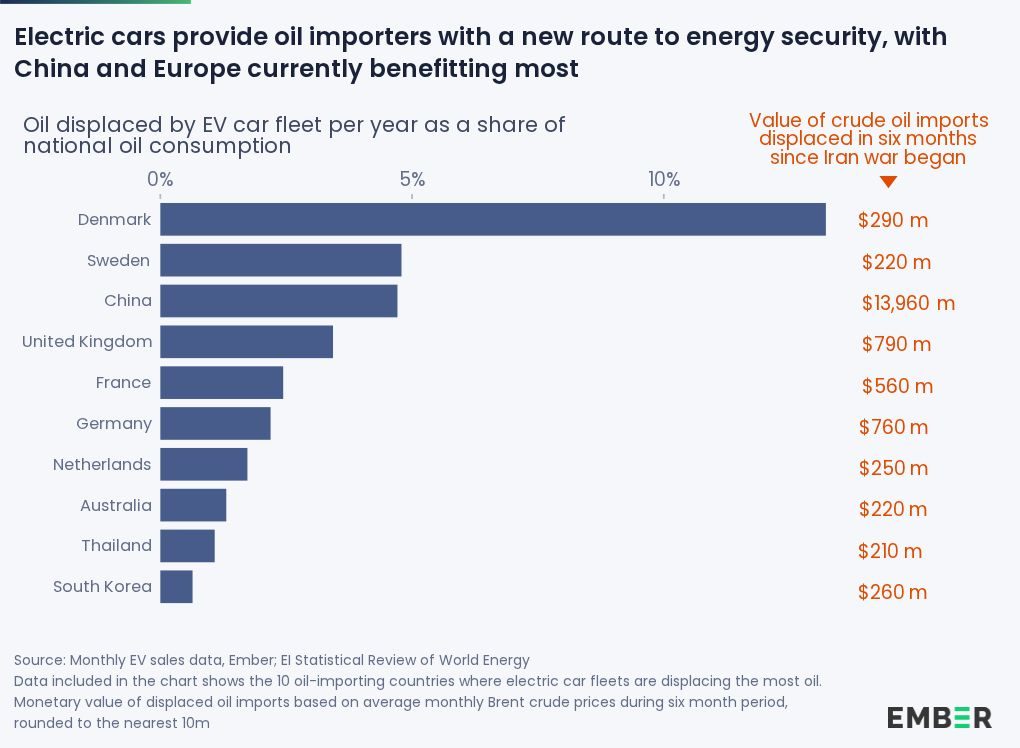
Electric car fleets in oil-importing countries displaced an estimated 200 million barrels of crude oil, worth $20 billion, between March and August 2026, the first six months of what the think tank Ember calls the Hormuz energy crisis: the disruption to fossil fuel supplies through the Strait of Hormuz that followed "the start of the US-Israel war with Iran," in Ember's words. Ember published the estimate on October 14. China's fleet accounts for $14 billion of that and EU member states for $3.1 billion. The same analysis finds that 49 of the 56 countries Ember tracks now have a higher battery electric (BEV) sales share than the United States.
The numbers arrive with Ember's new monthly EV sales tracker, which covers 56 countries that together account for over 90% of electric car sales, according to Ember's release. BEVs carry most of the displacement, $16.5 billion of the $20 billion, and plug-in hybrids supply the rest. Part of the reason, Ember says, is real-world evidence that plug-in hybrid drivers rely on the combustion engine more than manufacturers claim.
Where the barrels went
China's $14 billion is approximately three quarters of the oil demand displaced by electric cars across all oil-importing countries, in Ember's words. Inside the EU, Germany led at around $760 million and France followed at around $560 million. The United Kingdom, outside the bloc, displaced around $790 million, more than Germany. Members of the Association of Southeast Asian Nations displaced around $560 million combined, led by Thailand and Viet Nam.
Measured against consumption rather than dollars, the order changes. Denmark's electric car fleet as of August 2026 displaces 6.4 million barrels of oil a year, equivalent to 13% of the country's 2025 oil consumption, Ember says, which makes it Europe's clear frontrunner on that measure. Its chart puts Denmark's six-month value at $290 million, about 2% of China's by our arithmetic.
The dollar figure rides on the oil price. Brent averaged about $98 a barrel over March to August by our arithmetic from the EIA's monthly Brent spot price series, against $70.89 in February. Ember values each month's displaced barrels at that month's average Brent price and sums the six months. Its window closes before September, when Brent averaged $114.16, second in 2026 only to April's $117.29, and Ember expects the figures to rise over the rest of the year.
A counterfactual, not a customs tally
The $20 billion is modeled. Ember's methodology assumes each electric car replaced a typical non-electric car driven the same distance, with country-specific mileage and fuel economy. Plug-in hybrids are credited with 35% of their distance on electricity, 55% in China. The petroleum fuel avoided is converted to crude-oil equivalent with a 9% uplift for the oil used to extract, refine and transport it.
So the $20 billion is the crude that oil-importing countries' electric cars would otherwise have needed, priced at Brent, and it is gross: the fuel used to generate their charging electricity is not subtracted. Ember headlines it as money saved. The fleets behind it are Ember's own estimates, built from year-end fleet data plus registrations since, and its world figures are scaled up from the economies in the dataset.
"Every electric car on the road reduces exposure to volatile oil markets, and as fleets grow, so does the protection against future supply shocks," said Euan Graham, senior energy analyst at Ember.
The US falls behind
The United States, which rolled back federal support for electric vehicles in 2025, saw BEVs fall to 6% of light-duty vehicle sales in the first eight months of 2026, Ember says. Fifteen countries overtook it on BEV sales share for the first time this year, including Brazil, India, Italy, Malaysia and New Zealand. India, at a 2% BEV share in 2024, has had a higher BEV share than the US in every month since April. That is the same 6% of new vehicle sales the EIA gave battery electrics for the first half of 2026, in a July analysis drawing on Omdia estimates (our report on US EV electricity use). The federal clean vehicle credits ended on September 30, 2025.
The US share also counts pickups. Ember's US series, from Argonne National Laboratory, covers all light-duty vehicles, SUVs and vans included, while most of the tracker's country series count car sales; the methodology notes that shares are more comparable across countries than totals.
Globally, BEV sales rose 11% year on year in the first eight months of 2026 and reached 18% of new car sales, up from 16% in the same period of 2025, while plug-in hybrid sales fell 12% and combustion car sales 6%. Excluding the US and China, BEV sales grew an estimated 45%.
Fuel prices pushed some markets directly: India, Chile, Australia and New Zealand all saw sharp increases in BEV share after March 2026, Ember says. Australia's BEVs took 24.2% of the market in September on FCAI's count (Australian BEV share eases to 24.2% in September on FCAI's count). The same price signal shows up in European heating, where the heat pump association named the post-Hormuz oil and gas price rise among likely drivers of an 11% rise in first-half residential heat pump sales (EHPA: residential heat pump sales rose 11% in 12 European countries).
Elsewhere, Ember credits policies set before the crisis: France's social leasing scheme lifted its BEV share above 30% for the first time, and South Korea's BEV sales doubled year on year after a strategy introduced at the end of 2025 added support for domestic EV adoption. Japan, long a slow adopter, saw its BEV sales double in 2026 following a new January policy that helps buyers with the upfront costs of EVs.
Sources
Primary
Supporting
- Europe Brent Spot Price FOB, monthly · U.S. Energy Information Administration
- Electric cars have saved oil-importing countries $20bn since the start of the Hormuz energy crisis · Ember
- EV Sales Data Tracker · Ember
- Monthly EV sales: methodology · Ember
Copies of cited sources are retained where available. If a link no longer resolves, request a copy at contact@theduckcurve.com.