 The Duck Curve
Geely says new station peaks at 2,250 kW, test cars took 4.5 minutes to 70%
The release credits an AI model built with StepFun and a cooling chain that starts at the station's storage battery; it gives no pack size, test conditions, price or rollout date, and does not say whether the peak figure is per connector.
Geely Auto Group said on September 23, 2026 in a release datelined Ningbo, China, that it introduced Geely Smart Charging, a charging system managed by an AI model, alongside a fifth-generation Geely Smart Charging Station that it says delivers peak charging power of up to 2,250 kW. In what the release calls real-world tests, the battery used in the Lynk & Co 10 and Zeekr 001 charged from 10% to 70% in 4 minutes 30 seconds and from 10% to 97% in 8 minutes 40 seconds, which Geely calls its fastest production-ready charging performance to date. The group says it develops and manufactures passenger vehicles under the Geely, Lynk & Co and Zeekr brands.
What the release specifies, and what it leaves out
At the center is Xingrui PowerMind, described as a smart energy AI model developed jointly by Geely Auto Group and StepFun, which the release says coordinates "the vehicle, battery, charging station, cloud, grid and energy storage system." The release says the technology uses algorithms to predict battery temperatures up to 30 seconds ahead and adjust charging power dynamically, rather than reacting only after temperatures rise, and that the system is designed to keep the battery's average charging temperature below 55°C while limiting its peak to below 65°C. On the average figure the release's bullet summary speaks differently from its body: the bullet reads "AI thermal management maintains average battery temperature of 55°C and limit peak temperature to under 65°C during fast charging," so the average is stated as maintained and as a point where the body states a design target below 55°C; the peak figure reads the same in both. Cooling runs through what the release calls an end-to-end five-point liquid-cooling system covering the charging station's energy-storage battery, the charging pile, the cable, the charging port and the battery pack, which the bullet summary, and only the bullet summary, calls an industry first. Those two mentions of storage, as a system PowerMind coordinates and as the first link in the cooling chain, are the release's only account of how a 2,250 kW draw is buffered, and it gives no capacity for it.
Geely also says the system can create a charging strategy tailored to each vehicle and battery, with PowerMind adjusting peak current, cooling intensity and charging duration in real time, and pairs it with what it calls lithium-ion pulse restoration: micro-pulse currents meant to reactivate lithium ions accumulated at the negative electrode during repeated fast charging. The body says the combination "is able to increase battery cycle life by 20%"; the bullet summary says "up to 20%." A low-rate home-charging strategy is meant to gradually repair fast-charging degradation. The release says the Shendun Golden Battery, developed for ultra-fast charging and high performance, supports a peak charging rate of 12C, and that a Next-Gen Ultra Short Blade Battery, which the bullets aim at affordable models, uses Geely-developed laser welding for cell tabs and covers, cuts heat during charging by 10% and raises its peak charging rate to 6C. The timed-test sentence sits in the Shendun paragraph but does not name the battery; CnEVPost's report from the launch states the identification outright, saying the test cars were equipped with the Shendun Golden Battery.
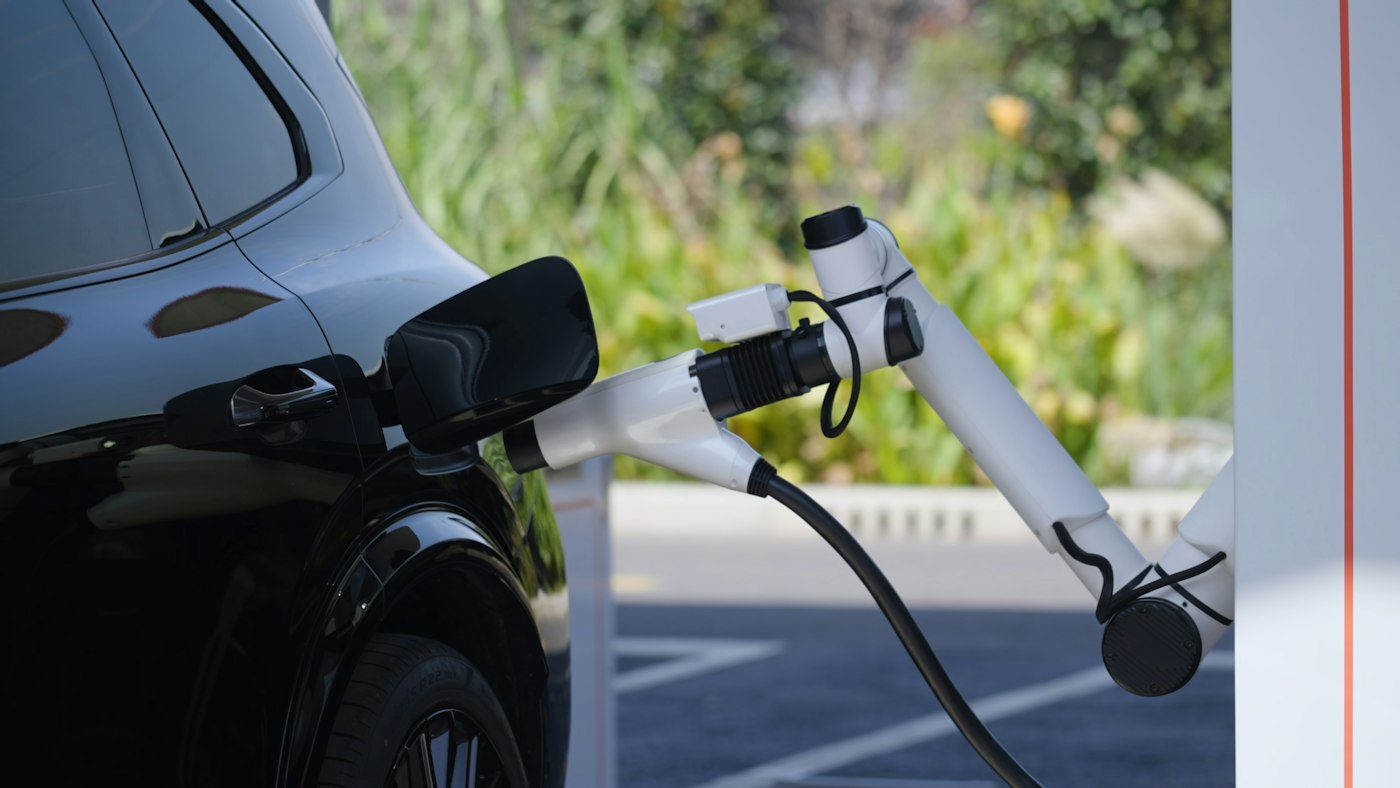
The release does not name the vehicle battery's capacity, the power delivered during the timed tests, the ambient or battery temperature at which they ran, whether 2,250 kW is a per-connector figure, a price, a rollout date, a station count, or whether the stations will take other brands' cars. The 2,250 kW is a power figure, and without a pack size it cannot be converted to the C-rate the 12C claim describes (kW vs kWh). The four images published with the release show a robotic arm plugging a connector into a car, a station housing bearing Chinese characters, a cutaway drive unit beside a connector on a stand and a tablet showing an 80% ring, and a cutaway battery pack; the release's text gives no specification for the arm, and the page's footer says its images and videos are for illustrative purposes only.
Where it lands against BYD
CnEVPost, reporting on the launch on September 23, put the numbers against BYD's: the 1,500 kW maximum single-gun output of the flash charging pile BYD unveiled in March, which CnEVPost says was the highest among mass-produced chargers globally when it launched, and the 5 minutes from 10% to 70% and 9 minutes from 10% to 97% that BYD claims for its second-generation Blade Battery paired with that pile "at normal temperatures." The outlet also reports a Hongqi test disclosed in July at 3 minutes 41 seconds from 10% to 70%, with no mass-production timeline given at the time; CnEVPost's September reports give the month of the pile's unveiling and of the Hongqi test without a year. It also reports a Sunwoda plan for 10,000 megawatt-level flash charging stations by the end of 2027. CnEVPost's BYD figure is a per-connector maximum; Geely's release does not say whether its 2,250 kW is per connector or per station, so the two headline numbers may not be measured on the same basis.
The network is where BYD is ahead by its own count. CnEVPost reported on September 24 that BYD announced on its official Weibo account the completion of its 2,000th highway flash charging station in China, meeting the highway portion of the plan it announced on March 5 about three months before that plan's year-end deadline; per the same report, BYD had built 11,586 flash charging stations in China across 341 cities as of September 24, against a target of 20,000 by the end of 2026. CnEVPost adds that the network is open to other brands' electric vehicles but that actual charging power depends on each vehicle's capabilities and not all models reach the speeds BYD advertises; in figures BYD released on August 28, owners of other brands were nearly one-third of the more than 1.83 million users served. Geely's release names no station count and no rollout date for its fifth-generation station.
Set side by side, the two headline numbers cannot be compared on what the documents state. BYD's 1,500 kW is a per-connector maximum and its 5-minute time is for a battery paired with that charger, both per CnEVPost; Geely's release gives its 2,250 kW as a peak without saying whether it is per connector or per station, and its times are for a battery its test sentence does not name. What the launch establishes so far is a company claim with two timed figures, a peak-power rating and a cooling architecture; the part of the announcement that would make it a charging network, the count, the price and the date, is the part Geely did not make.
Sources
Primary
- Geely Auto Group Introduces Ultra-Fast AI-Powered Geely Smart Charging · Geely Auto Group (newsroom.geely.com)
Supporting
- Geely takes on BYD with system charging EVs to 70% in 4.5 minutes · CnEVPost
- BYD reaches 2,000 highway flash charging stations, hitting target 3 months early · CnEVPost
Copies of every cited source are retained. If a link no longer resolves, request a copy at contact@theduckcurve.com.