 The Duck Curve
Honda and Taisei test in-road wireless charging built for 20-ton trucks
Taisei says the system is designed for up to 150 kW, but neither company reports a power level measured on the test road; a public expressway trial alongside a Toyota, Denso and Obayashi team is planned from fiscal 2027.
Honda and Taisei said on October 5, 2026 that Honda R&D, Taisei Corporation and Taisei Rotec have developed the underlying technology for a road that charges electric vehicles as they drive over it, with ground units and pavement built to withstand large vehicles with a gross vehicle weight of approximately 20 tons. Honda's release, datelined Tokyo, describes a magnetic coupling wireless power transfer road system tested on a test roadway at Taisei's T-FIELD/SATTE site, with public-road demonstrations planned from the Japanese 2027 fiscal year, which starts April 1, 2027. Taisei's own release says the system is designed for up to 150 kW-class power transfer, which it calls among the largest in-motion wireless systems in Japan. Neither release reports a power level or efficiency actually measured on the test road.
This is a test-road result, not a deployment. Honda pitches dynamic wireless charging as a way to cut how often EVs need charging at home or at stations, and says it will aim first at logistics and transportation. Taisei puts the case for heavy vehicles bluntly: big EVs carry large batteries that add weight and take a long time to charge, and power drawn from the road would let them cover long distances on smaller packs.
What the three companies built
The new piece is in the road. Each ground unit integrates the inverter and the coil, which Honda says is a first in the world; the footnote is more modest, the world's first such unit "publicly disclosed as of the end of September 2026," per Honda's own research. The units are fed over DC distribution, which Honda says simplifies the wiring in the embedded sections and cuts both the component count and the installation work. They are designed to drop into existing roads by milling out the pavement and embedding them, with measures for the uneven surfaces milling leaves behind.
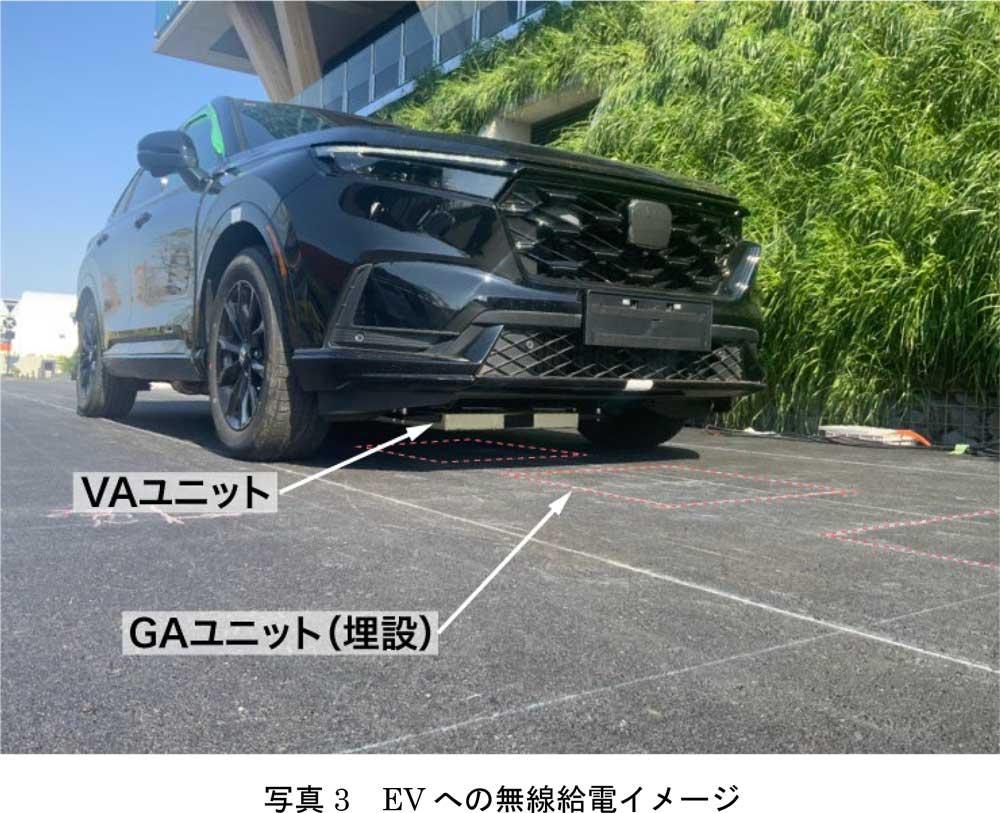
The work splits along company lines. Honda describes the system as three components: a DC power supply on the ground; a DC distribution-based ground assembly system that links multiple ground units (power transmitter units) embedded in the road over a DC connection; and a vehicle assembly unit (power receiver unit) installed on the vehicle. Taisei developed the power supply, Honda R&D the ground system and the vehicle system carrying the receiver, and Taisei Rotec the construction methods for the road. All three worked on pavement structure and durability testing, upgrade methods, and DC distribution and wireless power transfer testing.
The durability work so far happened on a machine. Taisei says it ran a bench test of 1 million wheel passes, counted as 49 kN equivalents, on T-FIELD/SATTE's wheel-load testing machine and confirmed the pavement could withstand long-term heavy-vehicle traffic. Taisei's footnote defines that 1 million as the number of passes before fatigue cracking on roads carrying 250 to under 1,000 heavy vehicles per direction per day. The one photograph Taisei published of a receiver parked over the buried ground units shows an SUV, not a truck.
Next: a driving test road, then the expressway
The next stage is a test drive roadway at Taisei's T-FIELD/TAMURA site in Tamura, Fukushima, which Honda says will be built starting in late 2026 and Taisei puts at the end of 2026. There the companies plan a long-term durability evaluation with actual vehicles running the same 1 million wheel loads, in-motion charging performance tests, and work on electromagnetic field leakage. The two releases stage the power test differently: Taisei lists in-motion charging experiments at up to 150 kW output among the Tamura work, while Honda places verification at up to 150 kW, aimed at large commercial vehicles, in the development that follows Tamura.
The public-road step was already on the calendar. East Nippon Expressway Company (NEXCO East) named the teams on May 26, 2026 for its Tateyama Project, which it calls Japan's first dynamic wireless power transfer trial on an expressway main line: roughly 300 meters of the E14 Tateyama Expressway near Kimitsu parking area in Chiba, with tests planned multiple times from fiscal 2027 and support from the University of Tokyo's Fujimoto-Shimizu Laboratory. Two teams, each handling its own vehicles, equipment and construction, are scheduled to take part: Honda R&D with Taisei, and Toyota, Denso and Obayashi. NEXCO East says the road coils transmit only when they detect an equipped vehicle passing over them, so an ordinary vehicle rolling across gets nothing.
That puts two automaker-and-contractor pairings on one short stretch of road. Before then, Honda says it will show the work at the Japan Mobility Show Bizweek, October 13 to 16, 2026, at Makuhari Messe in Chiba, and at the ITS World Congress, October 19 to 23, 2026, in Gangneung, South Korea.
For scale: 150 kW is a power rating, not an amount of energy (kW vs kWh), and what a truck gains depends on how long it spends over powered road. By our arithmetic a vehicle at 100 km/h crosses the roughly 300-meter Tateyama section in about 11 seconds. For comparison, Geely says its new passenger-car charging station peaks at up to 2,250 kW, though it does not say whether that figure is per connector or per station.
Sources
Primary
- Honda Develops Underlaying Technology for In-motion Wireless Charging of EVs, Including Large Commercial Vehicles · Honda Motor Co., Ltd.
Supporting
- 【E14】館山自動車道本線での走行中無線給電の実証実験に向けた参画企業が決定 · East Nippon Expressway Company (NEXCO East)
- 走行中EVへ非接触で大電力を供給する磁界結合方式無線給電道路システムを開発 · Taisei Corporation
Copies of cited sources are retained where available. If a link no longer resolves, request a copy at contact@theduckcurve.com.