 The Duck Curve
Tesla Semi launch event names customers, gives no production rate or price
Tesla Semi's September 24, 2026 post announces high-volume production; The Verge dates volume production to April 2026 and essentially hand-built PepsiCo pilot trucks to 2022, and lists PepsiCo, US Foods and DHL among customers named.
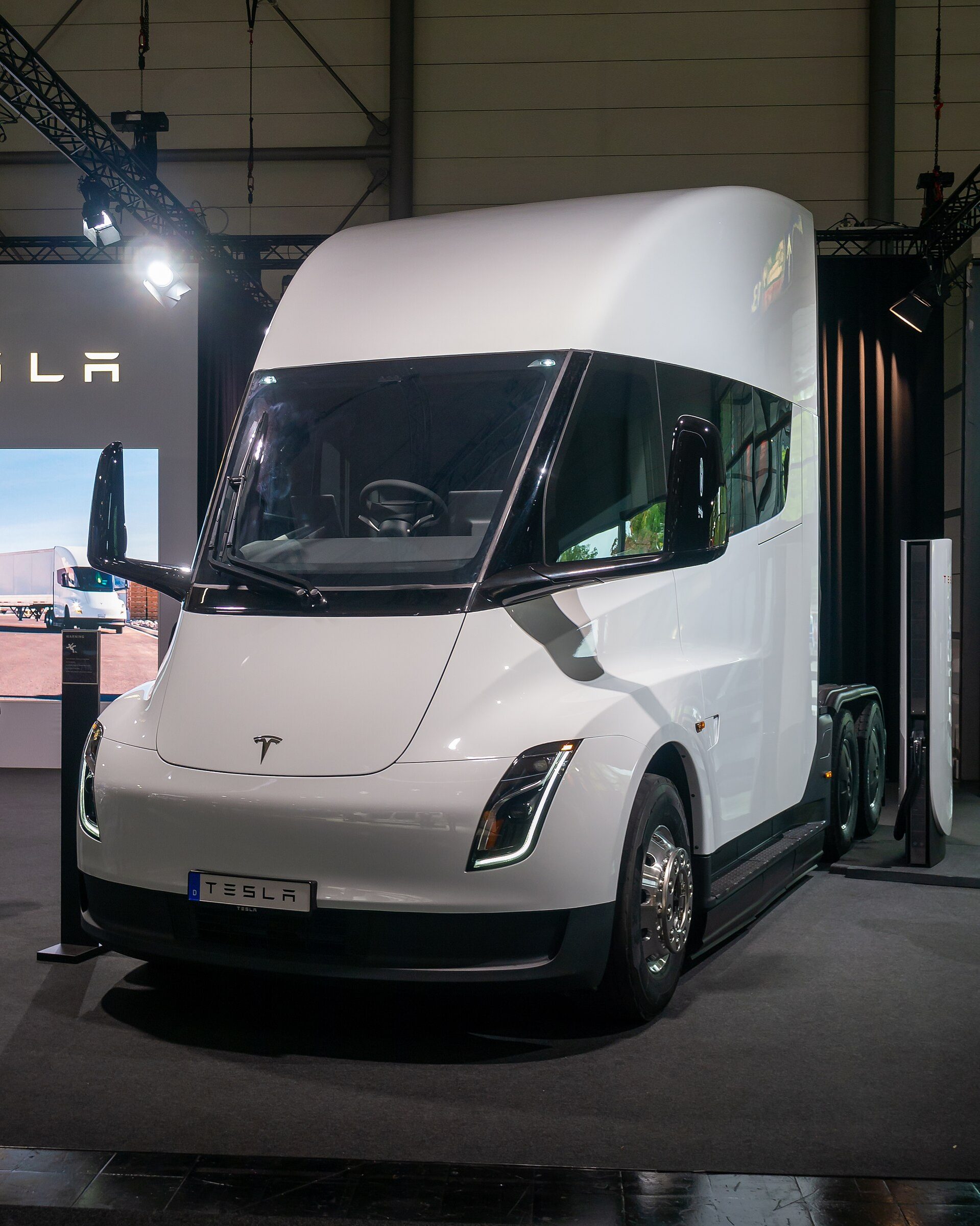
Tesla's Semi program account on X posted at 6:04 p.m. Pacific on September 24, 2026 two lines, "Semi is here" and "Today, we're launching high volume production," over a video, five minutes after linking the livestream of its Semi Rollout event at the company's Semi factory in Sparks, Nevada. The post carries no production rate, no delivery count and no price. The Duck Curve retrieved two of the account's posts, the 5:59 p.m. stream link and the 6:04 p.m. launch post; the broadcast at x.com/i/broadcasts/1vJpPNaYnYQJE and the further posts in the thread under the launch post were not reviewed, so every account here of what was said on stage, the customer list included, is The Verge's or Automotive World's.
The record already dated the milestone. The Verge's Andrew J. Hawkins opens his account of the event with the truck "finally in volume production as of April 2026" and writes that "in April, Tesla announced that the first Semi had rolled off the line at the new facility"; FreightWaves reported on September 18, 2026 that the Nevada plant "is already building trucks intended for customers"; and The Duck Curve's coverage of Einride's order put the start of high-volume manufacturing at the plant on April 29, 2026, per CleanTechnica (Einride to deploy 500 Tesla Semis). Deliveries have a history too: per The Verge, Tesla "delivered a handful of trucks to PepsiCo in 2022, but those units were essentially built by hand on a pilot line," and per Automotive World, PepsiCo "now runs dozens of Semis in daily regional service." Among what September 24 added: Tesla's own word for the state of the line, a customer list, and, per The Verge, that "first deliveries of the truck started" in the week of September 21, 2026.
Per The Verge, Tesla announced "a raft of new (and old) customers," among them PepsiCo, US Foods, DHL, WattEV, ABF, Einride, IMC and OK Produce. The company says the factory next to Gigafactory Nevada can build 50,000 trucks a year, or 1,000 per week, and, The Verge reports, "didn't reveal order numbers, nor did it update the price." Automotive World's Stewart Burnett reports the same gaps: Tesla reiterated 50,000 a year, roughly 1,000 a week, "but disclosed no official pricing or production volumes," and outside estimates, per Automotive World, which names none, put 2026 deliveries at 5,000 to 15,000 units.
Dan Priestley, Tesla's director of Semi truck engineering, said the 500-mile figure comes from fully loaded trucks, and Lars Moravy, vice president of engineering, said a truck carrying around 60,000 pounds "could potentially reach about 600 miles". Tesla says the fully loaded truck now consumes about 1,700 Wh per mile against an original target of 2,000; The Verge puts the pack at 822 kWh.
On charging, The Verge reports that Tesla's Megacharger delivers up to 1.2 MW per stall into that 822 kWh pack (see kW vs kWh), that Tesla says it will have more than 30 Semi charging stations representing over 200 megawatt-capable posts by the end of 2026, and that a Semi charging at one of the new Megawatt chargers during the event went from 3 to 60 percent in about 30 minutes. On uptime, The Verge writes that the company says its existing fleet has demonstrated more than 98 percent, "compared to an average 90–95 percent for diesel-powered class 8 trucks across the industry"; Automotive World reports the same claim against the same industry average and adds that "the automaker has a questionable record on internal data." Separately, Priestley, in a keynote at IAA Transportation 2026 in Hannover, put uptime in 2026 at 98 percent, per FreightWaves' Thomas Wasson, who also reported European deliveries targeted by the end of 2027 from trucks built in Nevada.
What the record held before the event
Tesla's Q2 2026 update, filed as an exhibit to its July 22, 2026 Form 8-K, said "Tesla Semi remains on track for production this year at our new factory in Nevada" and that "Tesla Semi and Megapack 3 remain on schedule for production starting in 2026." The same deck's installed annual manufacturing capacity table lists the Nevada Tesla Semi row with no capacity figure and the status "Commissioning," under a footnote that installed capacity is not the current production rate. The Semi account posted on August 24, 2026 the September 24 date for the inauguration.
On price, The Verge states the position three times, and two of the statements pull apart: in one sentence Tesla "didn't reveal order numbers, nor did it update the price of the Semi," and in another, after giving the 2017 figures as "a starting price of $150,000 for the 300-mile version and $180,000 for the 500-mile one," it writes that "Tesla never officially updated those prices until today," followed by Electrek's 2026 report of $290,000 quotes for the 500-mile truck; that "until today" reads as an update on September 24 that the first sentence, and a third ("Tesla didn't reveal order numbers or starting prices"), deny. The no-price claim in this article rests on Automotive World's "disclosed no official pricing or production volumes" and on Tesla's post.
The order book that met the launch is the one The Duck Curve has been tracking. Catalyst Mobility and the Smart Freight Centre said on September 22, 2026 that their ZET SCALE alliance had enabled an order for 2,500 battery-electric Class 8 trucks with Tesla as primary OEM, Kenworth, RIDE and Volvo as secondary OEMs, no split among the four stated and no delivery schedule (2,500 trucks ordered through ZET SCALE); the Semi account posted the same day that the 2,500 were Semis, a count the release does not make. Einride said on August 18, 2026 that it would deploy 500 Semis, phased in over 24 months from September 2026; per The Verge, IMC Logistics said in the week of September 21 that it would buy 50 for California drayage; and Käppeli Logistik AG ordered one with delivery planned for 2027 (Käppeli Logistik orders its first Tesla Semi).
Outlook
The Q2 update's operational summary reports production only as "Model 3/Y" and "Other models," 8,822 of the latter in Q2 2026 across every other vehicle, and its capacity table carries a Semi row with no figure; unless the Q3 2026 filing fills that row or adds a Semi line, the Q3 figures will not say how many trucks the Sparks line built. Among the orders The Duck Curve has covered, the sum is 3,051 trucks by our arithmetic: 2,500 through ZET SCALE, of which an unstated share are Semis, plus Einride's 500 over 24 months, IMC's 50 per The Verge, and Käppeli's one for 2027. A multi-year order book with an unknown Tesla share cannot be set against the 5,000-to-15,000 range of 2026 deliveries that Automotive World attributes to outside estimates, only against a production rate, which neither Tesla's post nor, per both outlets, the event supplied.
⚠ The Outlook extrapolates from Tesla Semi's September 24, 2026 post, Tesla's Q2 2026 update filed July 22, 2026 (its operational summary and capacity table), The Verge's and Automotive World's accounts of the September 24 event, and the ZET SCALE, Einride and Käppeli orders The Duck Curve has covered; the 3,051 sum is our arithmetic over those four orders.
Sources
Primary
- Tesla Semi (@tesla_semi) post on X: Semi is here, launching high volume production · Tesla Semi (@tesla_semi), Tesla's Semi program account on X
Supporting
- Tesla Q2 2026 Update (Exhibit 99.1 to Form 8-K filed July 22, 2026) · Tesla, Inc., via SEC EDGAR
- Tesla Semi (@tesla_semi) post on X: inauguration of new Semi factory in Nevada · Tesla Semi (@tesla_semi), Tesla's Semi program account on X
- Tesla targets end-2027 Europe deliveries for the Semi · FreightWaves
- Tesla Semi (@tesla_semi) post on X: Tesla selected as primary OEM for the ZET SCALE order · Tesla Semi (@tesla_semi), Tesla's Semi program account on X
- Tesla Semi (@tesla_semi) post on X: Semi Rollout, link to the livestream · Tesla Semi (@tesla_semi), Tesla's Semi program account on X
- Here's the Tesla Semi... again · The Verge
- Tesla begins Semi deliveries nine years after unveiling · Automotive World
Copies of every cited source are retained. If a link no longer resolves, request a copy at contact@theduckcurve.com.