 The Duck Curve
Oklo test reactor cleared, NSTX-U magnet lowered in, Omega raises $80M
Standard Nuclear's doubled backlog sits $0.3 million above its August figure, and Almaty now has a control room simulator for the Holtec SMR-300, whose Palisades units are still in NRC review.
Five nuclear stories from November 9 to 13, 2026: Oklo's Texas test reactor cleared its last DOE hold point, a TRISO fuel maker reported a backlog it had largely announced in August, an SMR control room opened in Kazakhstan as a simulator, PPPL's spherical tokamak got its central magnet, and a fuel-recycling startup raised $80 million.
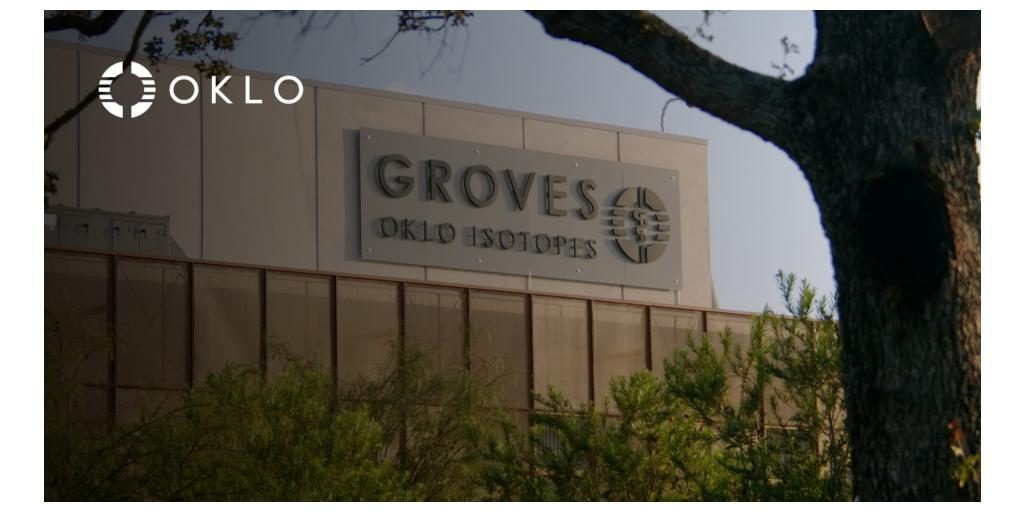
Oklo's Groves-1 clears its last DOE hold point
The Department of Energy has cleared the final operations hold point for Oklo's Groves Isotope Test Reactor (Groves-1) in Lockhart, Texas, moving it into a research, testing and training phase, Oklo said on November 11, 2026. The reactor went critical in August under DOE's Reactor Pilot Program, the first in the program to do so on private land, per Oklo.
Oklo's headline calls this clearance for "Unrestricted Operations." Unrestricted is relative: our August survey reported Groves authorized to a maximum of 100 watts, a test bed for Oklo's isotope business rather than a power reactor. Oklo plans to use it to train and qualify nuclear personnel for future deployments, to keep evaluating its control rod drive mechanisms, and for criticality and reactivity benchmarking that supports its isotope production, its design models and potentially light water reactors. During a recent startup, operators wore eye-tracking glasses to record what they looked at and for how long, data to improve the facility's human-machine interface. The results feed Groves-2 Forge, Oklo's planned isotope production and processing pilot, with lutetium-177 its first focus.
Standard Nuclear's backlog, doubled since June, is flat since August
Standard Nuclear's third-quarter results, filed with the SEC on November 12, 2026, lead with Total Contract Backlog that more than doubled to $577.2 million. The doubling is measured from $241.5 million at June 30. The company's August 26 second-quarter release had already put backlog at $576.9 million after giving effect to its August fuel supply agreement with Antares, so the quarter-end figure is $0.3 million above that, by our arithmetic. Of the $577.2 million, $119.6 million is funded backlog, $443.5 million is unexercised customer options and $14.1 million rests on memoranda of understanding, non-binding agreements and letters of intent. In the company's words, "Total Contract Backlog is not a measure of contracted revenue."
The news is the fuel plants. Standard Nuclear submitted the final safety analysis for its Oak Ridge, Tennessee, facility to DOE on November 6, with its Idaho twin to follow, and targets DOE authorization to operate both in February 2027. Each starts at up to one metric ton of uranium a year and is designed to scale to 2.5. Third-quarter revenue was $6.0 million, against a net loss of $13.1 million. The completed TRISO core for Radiant's Kaleidos microreactor returns as a highlight, though the August release had already reported its balance delivered after June 30. After DOE's October approval of Kaleidos's safety analysis, the new release says, DOE's readiness review, fueling and the test campaign come next.
A Holtec SMR control room opens in Almaty
The United States and Kazakhstan opened a small modular reactor simulator classroom at the Institute of Nuclear Physics in Almaty, the US Embassy said on November 13, 2026. It replicates the main control room of Holtec's SMR-300. Holtec designed it, Curtiss-Wright developed and installed it and is training institute staff to operate it, and the International Science and Technology Center integrated the project. The State Department paid for it through its FIRST program, which Kazakhstan joined in 2022.
The two governments plan for the simulator to anchor a regional SMR training center for nuclear professionals and future reactor operators from Kazakhstan and across Central Asia. The simulator is ahead of the reactor: in the US, the NRC is still reviewing part one of an application for two SMR-300 units at Palisades in Michigan.
PPPL lowers NSTX-U's central magnet into place
Crews at Princeton Plasma Physics Laboratory hoisted the completed central magnet assembly over the National Spherical Torus Experiment-Upgrade on October 27 and lowered it into the machine, the lab said on November 10, 2026. The assembly passed through an opening with clearances of a quarter of an inch. Its core is the 20-foot magnet bundle delivered in June, which carries the toroidal field magnets that confine the plasma and the ohmic heating magnets that help heat it.
Next, crews measure the assembly's position with lasers and center it using shifting and tilting mechanisms in its base, a step scheduled for November; with that done and the vacuum seals confirmed tight, insertion is finished. Cooling water hoses and copper bus bars follow, and PPPL expects final machine assembly by early 2027, with operations later that year. NSTX-U is the largest spherical tokamak in the US. Across the Atlantic, UKAEA said on November 3 it had lowered a 12-tonne beam box into position for MAST Upgrade, also a spherical tokamak.
Project Omega raises $80 million to recycle used fuel
Project Omega has raised an $80 million Series A led by B Capital, with noa VC and 645 Ventures participating, for its work to close the US nuclear fuel cycle, it said on November 9, 2026. The money goes to its X Series products and to beginning construction of its nuclear fuel recycling facility, which the release's subhead describes as a pilot facility for isotope recovery and feedstock production; it gives no site. Omega's pyroprocessing, it says, recovers isotopes such as strontium-90, does not separate pure plutonium, and can reduce nuclear waste volume by up to 90%.
The first products are not reactor fuel. Omega's initial focus is long-duration power sources, including radiovoltaic systems that convert radioactive decay directly into electricity for equipment such as sensors and spacecraft. Its X Series, already launched, integrates battery storage and generators with a control system that "will allow for solar and wind power initially and then allow for isotope power in the future." In the fuel recycler's first product line, the isotopes come later.
Sources
Primary
- Project Omega Raises $80 Million to Build Nuclear Refineries for the Next Industrial Revolution · Project Omega
- PPPL's major fusion experiment nears completion · Princeton Plasma Physics Laboratory
- Oklo's Groves-1 to Begin Research and Demonstration Phase after being Cleared by U.S. Department of Energy for Unrestricted Operations · Oklo Inc. (Business Wire)
- Standard Nuclear Reports Third Quarter and Year-to-Date 2026 Results (Form 8-K, Exhibit 99.1) · Standard Nuclear via SEC EDGAR
- United States and Kazakhstan Launch American Small Modular Reactor Simulator Training Center in Almaty · U.S. Embassy & Consulate in Kazakhstan
Supporting
- Standard Nuclear Reports Second Quarter and Year-to-Date 2026 Results (Form 8-K, Exhibit 99.1) · Standard Nuclear via SEC EDGAR
Copies of cited sources are retained where available. If a link no longer resolves, request a copy at contact@theduckcurve.com.