 The Duck Curve
MAST Upgrade gets a 12-tonne beam box to double its neutral beam heating
The box will hold two more neutral beam injectors, taking UKAEA's spherical tokamak from 4.4 MW to 8.8 MW of beam heating for experiments due to begin in 2028.
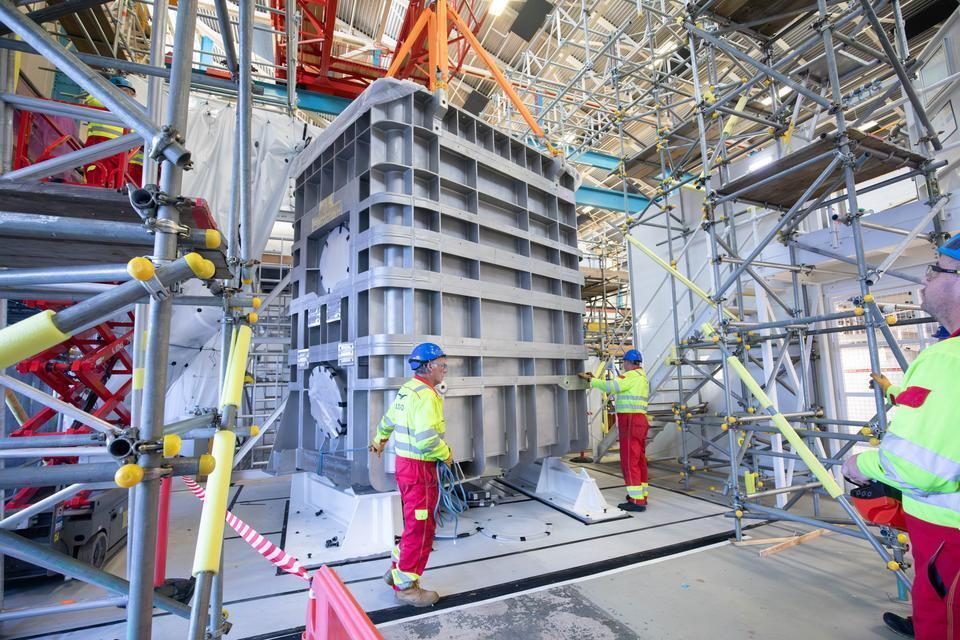
The UK Atomic Energy Authority has lowered a 12-tonne steel vessel into position for MAST Upgrade, the UK's flagship fusion machine at UKAEA's Culham Campus, UKAEA and the Department for Energy Security and Net Zero said on November 3, 2026. The "double beam box" will house two more neutral beam injectors, doubling the spherical tokamak's neutral beam heating power from 4.4 MW to 8.8 MW. UKAEA expects the hotter plasma conditions to double from 30 million to 60 million degrees Celsius.
A neutral beam injector heats a plasma by firing high-energy neutral atoms into it, and the box has a double-decker layout with room for two. Completed with its lid, the vessel will weigh around 15 tonnes and hold 20 cubic metres. It is built from 316L stainless steel, a grade the release says offers good vacuum compatibility, essential for the ultra-high vacuum the vessel has to hold. UKAEA's release also gives the vessel in African elephants (roughly two and a half) and bathtubs (about 130).
Nothing will fire from it soon. All major hardware is expected to be manufactured and fitted inside the vessel by the end of autumn 2027, and the vessel will then be commissioned for scientific experiments due to begin in 2028. The other engineering upgrades underway include a cryopump to control the pressure inside the box, the beam line module that forms the neutral beam and injects it into the plasma, and the positive ion neutral injectors themselves. Some of the kit is secondhand: the list also includes power supply equipment transferred and repurposed from the Joint European Torus (JET), which UKAEA is decommissioning.
The extra heat tests the plasma and its exhaust together. MAST Upgrade is the first tokamak to use a highly optimised Super-X divertor, the system that takes the particles and heat ejected from the plasma and directs them onto surfaces inside the machine, and UKAEA says earlier experiments with it reduced the heat load on parts of the divertor by a factor of ten. The stakes are commercial: in a power plant, UKAEA says, intense power loads could damage divertor components that would then need replacing every few years, which would make it difficult for fusion to compete on cost. Andrew Thornton, head of MAST Upgrade operations at UKAEA, said the team will study the stability of higher-pressure plasmas "while testing how the MAST Upgrade exhaust system copes with these hotter, higher-performance plasmas."
The machine has already been pushed on pressure. Its fifth series of experiments ran through 2025 and 2026, produced more than 1,100 fusion plasmas and reached the highest pressure ever achieved in MAST Upgrade without the plasma destabilising, UKAEA said on August 6, 2026. The team also found that injecting small amounts of nitrogen into the plasma edge makes it emit a large fraction of the exhaust power as light before the heat reaches the walls and divertor. UKAEA expects that impurity-assisted method to be essential in a power plant, "where even Super-X geometry alone would leave heat loads too high."
A second heating system arrives alongside the beams: an electron Bernstein wave (EBW) microwave system that will provide an additional 1.6 MW, per the August release, using a technology planned for STEP, the UK's prototype fusion power plant to be based in West Burton in Nottinghamshire. That release expected the enhancement programme to conclude in 2027, with a sixth series of experiments focused on STEP-relevant research planned for 2028. STEP itself targets first operations in the 2040s, per UK Fusion Energy, the UKAEA Group company delivering it, as we reported when it joined the MTC; its 2025/26 annual report put its misses at four of 21 corporate performance measures.
MAST Upgrade's data travels beyond STEP too. It is one of the two compact spherical tokamaks, with NSTX-U in New Jersey, whose experiments would train the same AI models if UKAEA and the Princeton Plasma Physics Laboratory link their supercomputers, as they agreed to explore during UK Fusion Week.
Sources
Primary
- Giant 12-tonne box lowered into place for fusion upgrade · UK Atomic Energy Authority and Department for Energy Security and Net Zero (GOV.UK)
Supporting
- Under Pressure: Record plasma for UK flagship machine · UK Atomic Energy Authority (GOV.UK)
- MAST Upgrade: The world's largest operational spherical tokamak · UK Atomic Energy Authority
Copies of cited sources are retained where available. If a link no longer resolves, request a copy at contact@theduckcurve.com.