 The Duck Curve
LA Metro board approves 220 electric buses from ENC, gates 1,600 options
ENC's $337.7 million bid outscored New Flyer's and RIDE Mobility's, and two outlets report the board vote as 10-1; a Bass amendment makes each option tranche of up to 300 buses a board decision and reserves a right to rebid.
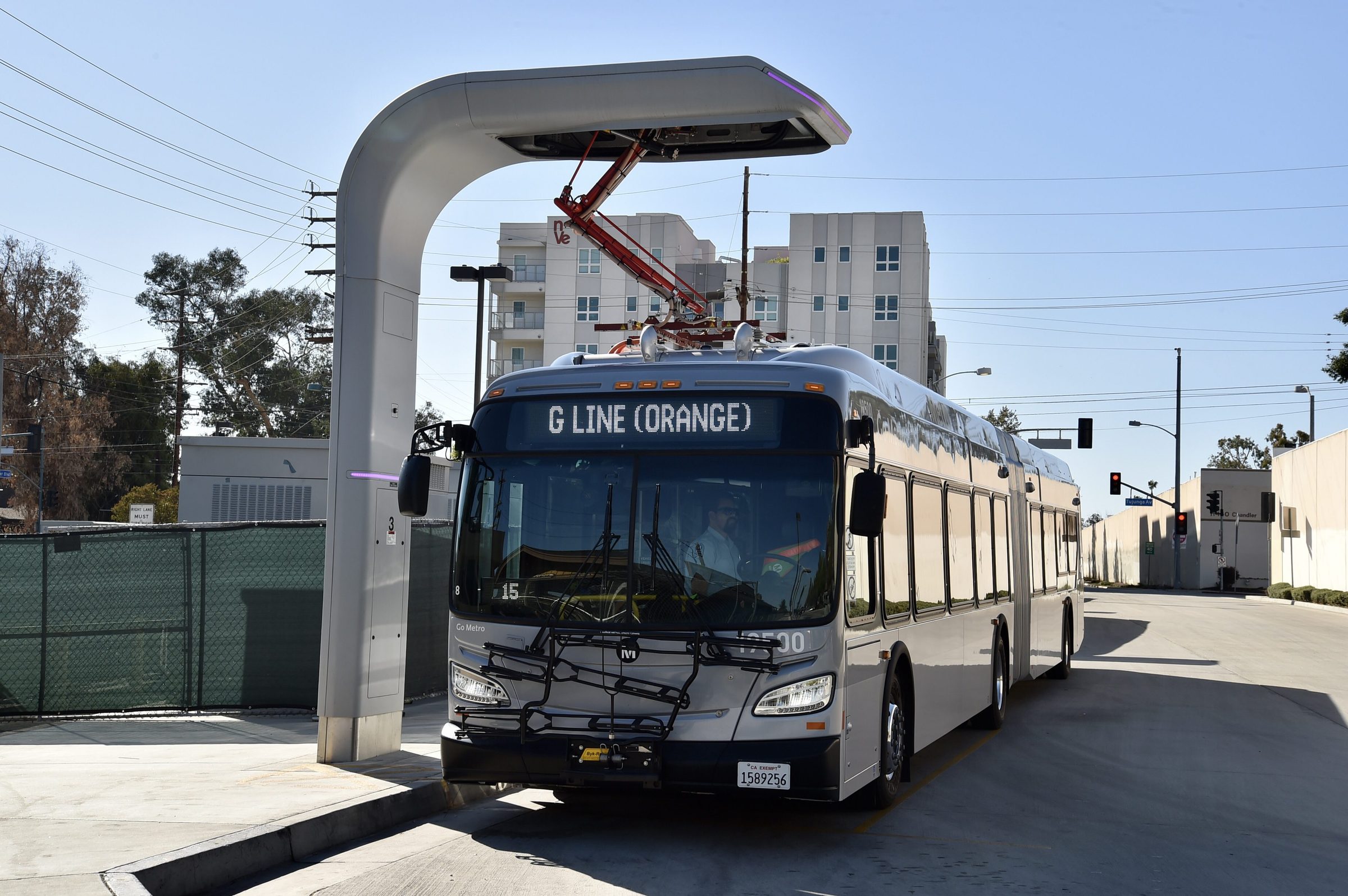
The Los Angeles County Metropolitan Transportation Authority's board on September 24, 2026 authorized its chief executive to award Contract No. OP118576(2)000 to ElDorado National (California), Inc. (ENC) for the manufacturing and delivery of 220 battery electric buses at $337,698,727.58 "for the base contract, including taxes and delivery," according to the board report for file 2026-0577. The same action raises the life-of-project budget for Capital Project 201078 by $382,355,185 to $434,355,185. MyNewsLA and the Los Angeles Daily News both report the vote as 10-1, with Supervisor Janice Hahn opposed.
The report says the 220 buses "will be assigned primarily to Divisions 9 (El Monte) and 18 (Carson)," that deliveries "will begin in Spring 2028," and that the range "is estimated at 174-250 miles on a single charge." On depot charging, Metro's July 2026 program update says "Electrification of Division 9 (El Monte) will be complete in late 2026, and design is underway for Divisions 18 (Carson) and 7 (West Hollywood)." Depot charging has its own story, as at First Student's Brooklyn facilities.
The amendment, the objections and the scores
The revised report carries a "BASS AMENDMENT"; MyNewsLA identifies its sponsor as Metro Board Chair and Los Angeles Mayor Karen Bass, and Streetsblog LA says Bass and Katy Yaroslavsky, whom MyNewsLA identifies as a Metro Director and L.A. City Councilwoman, "shepherded" it. It directs the CEO to award the base contract, requires that the exercise of any option beyond the 220-bus base order "be subject to Board approval," and structures the remaining 1,600 option vehicles "in increments not to exceed 300 BEBs." It adds that "The Board reserves the right to not exercise any option and to rebid the first option and any subsequent options presented." Each option request must include an evaluation of delivery timelines (aligned with fleet replacement, depot electrification, infrastructure readiness and CNG retirement schedules), of the delivered buses' reliability, range, efficiency and technical performance in revenue service, and of U.S. Employment Program compliance.
Hahn's objection, per MyNewsLA, was to "signing an agreement with a non-union company that has only built 16 electric buses"; the Daily News reports Hahn putting New Flyer's count at 1,500, describes New Flyer, in a clause it frames as what staff said, as "a company with a plant in Torrance that has built a lot more electric buses in a union shop," and adds that ENC has produced more than 10,000 transit vehicles since 1975, a figure MyNewsLA attributes to Metro officials. The procurement summary says ENC proposes to build the order at its Riverside plant, New Flyer at its Anniston, Alabama facility and RIDE Mobility at its Lancaster, California facility. MyNewsLA quotes her: "I know that Metro can't legally require to bid this as union, but it's still disappointing to me." Per MyNewsLA, United Auto Workers Region 6 organizer Robert Ankerman said "We support this initial contract going to El Dorado to create more jobs in Southern California" while raising working conditions at the plant and urging Metro "to fix its scoring process so that bids are fairly evaluated, including appropriate support collective bargaining agreements," and a UAW local president, John Lozano, encouraged approval; per the Daily News, some UAW representatives raised low wages and poor conditions, "a charge many ENC workers who spoke at the meeting said was not true," and the company "said it is open to discussions about union representation."
The procurement summary says the request for proposals was issued December 22, 2025 and that three proposals arrived on March 6, 2026: ENC, New Flyer of America Inc. and RIDE Mobility, LLC, described as "the U.S. subsidiary of Build Your Dreams (BYD)." On the 1,000-point scale ENC scored 833.92, New Flyer 769.26 and RIDE 633.57. ENC took the full 200 price points at $337,698,727.58 against New Flyer's $402,195,890.19 and RIDE's $374,093,055.59.
The widest per-factor gap between the two leaders, by The Duck Curve's subtraction, was the 50-point U.S. Employment Program factor, which the summary splits 25 qualitative and 25 quantitative. ENC scored 37.29 (21.40 plus 15.89) on a total dollar commitment of $107,387,488; RIDE scored 36.50 (11.50 plus 25.00, the maximum quantitative score) on the highest commitment, $169,003,115; New Flyer scored 5.50 (5.50 plus 0) on a commitment the presentation's table gives as $0, having "expressly stated that it was not making commitments for New Hires or Retained Workers"; the summary says partial credit was given on the wage and fringe-benefit criteria "based on the labor agreements that were provided as part of the proposal." An unnamed proposer's protest and appeal were denied by September 10, 2026, per the report.
The manufacturer, the fleet, the mandates and the money
The board report's account of ENC: 554 buses sold to Metro under a 2017 CNG contract, and, in January 2024, an announcement by parent REV Group that it intended to cease operations at ENC. Rivaz Inc. announced on October 18, 2024 that it had acquired ENC; the procurement summary says ENC paused operations in late 2024 and restarted production and deliveries in April 2025.
In an interview published September 23, 2026 by Sustainable Bus, ENC vice president of transit sales John Obert said Rivaz has put more than $50 million into the plant, equipment and workforce since October 2024 and that the company is "ramping toward our planned capacity of 800 to 1,000 buses a year."
The July 2026 update says "Metro currently owns 140 ZEBs (representing 6.46% of the total bus fleet)," with nine BYD K9MD buses in production for 2026 delivery and up to 40 buses through the Washington State contract targeting delivery by the end of fiscal 2027. Streetsblog and the Daily News both put the fleet at about 2,000 buses; Streetsblog says the purchase takes the electric share from about 7 percent to over 20 percent, and the Daily News reports Earthjustice saying Metro is "on track to electrify 20% of its fleet." The update also says Metro electrified the G Line in 2021 and that, as of that July 2026 report, the line "has accumulated more than six million miles" of zero-emission service.
The report dates Metro's zero-emission plan to Motion 50 in July 2017, a 2030 transition it says was contingent on cost and performance parity with CNG buses and on charging advances; the July 2026 update dates a staff plan for a 100% zero-emission fleet "no later than 2035" to September 2024. The board report says the California Air Resources Board's Innovative Clean Transit regulation requires, for large agencies, zero-emission shares of bus purchases of 25% by 2023, 50% by 2026 and 100% by 2029, and says that "Metro has met all state-mandated program requirements a decade earlier than the ICT mandate of 2029"; the July 2026 update's version is "Metro has met all state-mandated program requirements."
The staff presentation says a delay would risk "$168,200,050 in state funds that require a contract award before the end of February," a deadline whose year the slide does not give and which the September 24 award precedes; by The Duck Curve's addition, the "TIRCP 2022" line of $142,693,050 and the "SCCP FY 23" line of $25,507,000 in the expenditure plan's 220-bus funding table sum to exactly that figure.
Sources
Primary
- Board Report, File 2026-0577: Bus Acquisition of 220 Forty-Foot Battery Electric Buses (Revised, Regular Board Meeting September 24, 2026) · Los Angeles County Metropolitan Transportation Authority (Metro), via Legistar
Supporting
- Board Report, File 2025-0436: Zero Emission Bus (ZEB) Program Update (Operations, Safety, and Customer Experience Committee, July 16, 2026) · Los Angeles County Metropolitan Transportation Authority (Metro), via Legistar
- John Obert, ENC: rebuilding US bus production with a multi-propulsion approach, targeting capacity of 800–1,000 buses a year · Sustainable Bus
- Presentation: Bus Acquisition of 220 Forty-Foot Battery Electric Buses (BEBs), Regular Board Meeting September 24, 2026 · Los Angeles County Metropolitan Transportation Authority (Metro), via Legistar
- Attachment B - Procurement Summary, Bus Acquisition of 40' Battery Electric Buses / OP118576(2)000 · Los Angeles County Metropolitan Transportation Authority (Metro), via Legistar
- Attachment D - Expenditure and Funding Plan, CP 201078 · Los Angeles County Metropolitan Transportation Authority (Metro), via Legistar
- LA Metro Authorizes $338M for the Purchase of 220 Electric Buses · MyNewsLA.com
- Metro Board September 2026 Update: Electric Buses, Open Streets, Bike-Share, and More · Streetsblog Los Angeles
- In race to reach 50% zero-emission buses by Olympics, Metro will buy 220 e-buses, options for more · Los Angeles Daily News (SCNG)
Copies of every cited source are retained. If a link no longer resolves, request a copy at contact@theduckcurve.com.