 The Duck Curve
Ford's $28,350 Fathom moves the home backup inverter into the truck
Ford expects the Fathom's Home Power Station to cost about half its first-generation charger and its backup panel at least 60% less than its first-generation backup hardware; it has given no prices yet.
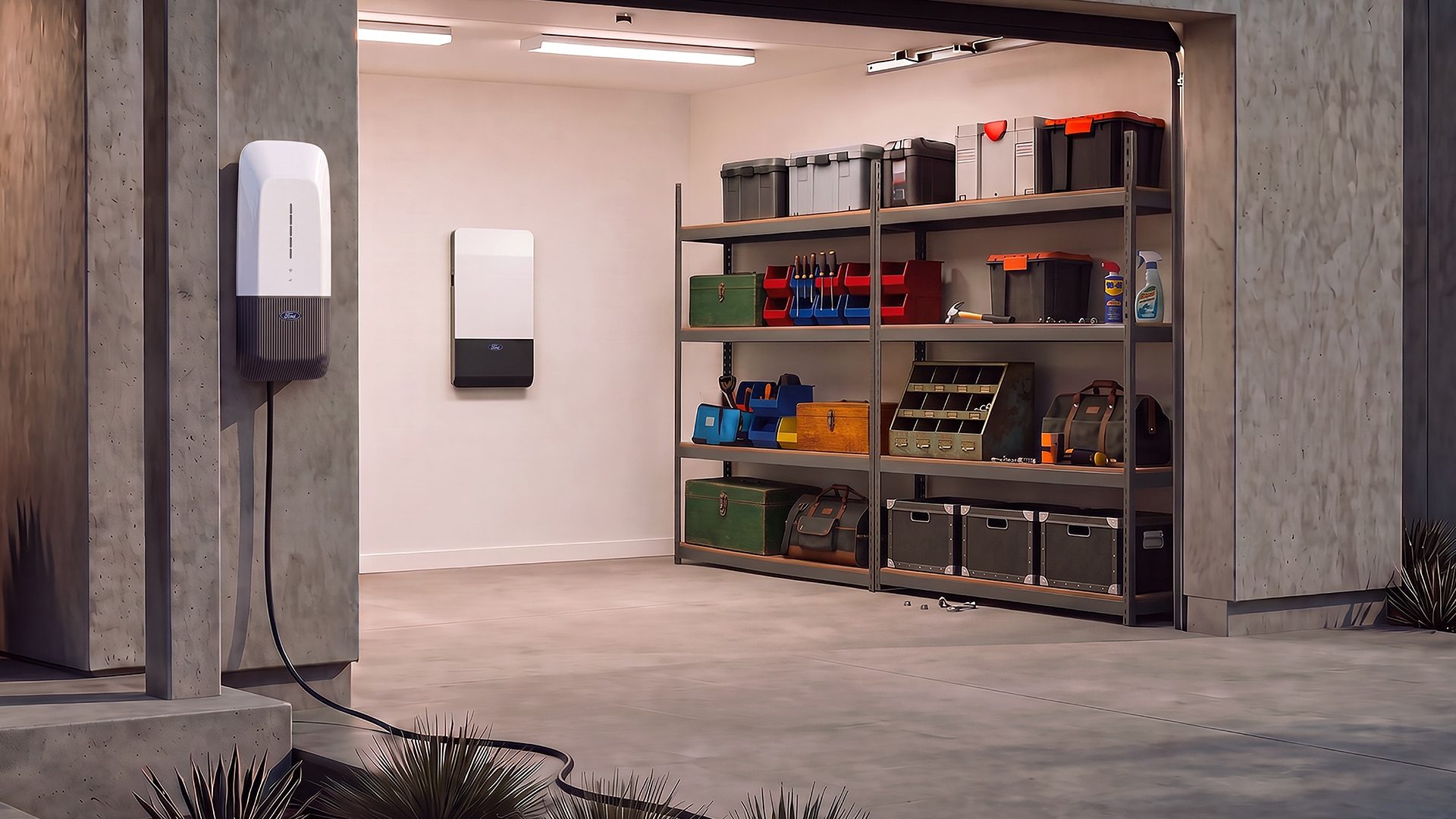
Ford's cheapest electric truck will carry its own home inverter. The Fathom, which Ford says will start at $28,350 MSRP in 2027, "does not need a separate wall-mounted inverter to supply over a projected 10 kW of AC power to a home," Ford said on October 27, 2026. The wall hardware that remains is expected to cost about half as much as Ford's first-generation bidirectional charger, and the backup panel at least 60% less than its first-generation backup hardware.
Ford calls the Fathom the first EV from a U.S. automaker with an MSRP below $30,000 to skip the wall-mounted inverter at that output, in a companion post for utilities by Dave McCreadie, Ford's director of grid and energy services. The inverter sits in the truck's E-box, one of the vehicle's five main modules, part of bidirectional hardware and software for the Universal EV Platform that Ford says it started "from a clean sheet" after acquiring the startup Auto Motive Power in 2023. Ten kilowatts is a power rating, not a measure of energy, and Ford has not said how long a full battery will keep a house running, Fortune reports; the company says it will share that closer to launch.
The wall units serving onboard-inverter cars got a standalone certification path only in 2026: UL Solutions opened a certification program in September for chargers that work with onboard-inverter cars built to SAE J3072, under a UL 1741 supplement released in May. Ford's post describes a system designed to meet all applicable UL 1741 requirements and IEEE 1547 interconnection standards, talking to the charger over SAE J3068 (with LIN-CP), a standard developed at the University of Delaware that Ford says also helps reduce the cost of the Fathom's charger.
What the boxes cost
Owners get two modes. Home Power Management charges the truck when electricity is cheaper and runs the house from it when electricity is more expensive; its only hardware is Ford's Home Power Station, along with what Ford calls "an active plan or trial." The post's footnote spells it out: the mode "requires available Ford Home Power Station, utility approval and an active Ford trial or plan." Home Backup Power, for outages, adds the Ford Home Backup Power Panel. Neither Ford post puts a dollar figure on either box; a Ford spokesperson told Fortune the company isn't sharing exact numbers yet.
The first generation is easy to price, on Fortune's reading that it means the F-150 Lightning's kit. Backup on the Lightning took two pieces: the Charge Station Pro, which Ford's home-charging page lists at $1,310, and the Home Integration System, $3,895 in Sunrun's store. Half of $1,310 puts the Home Power Station near $655, by our arithmetic. Ford's posts tie the 60% to the panel without saying what "first-generation home backup hardware" covers, so the panel's ceiling depends on it: if it means the Home Integration System, 40% of $3,895 caps the panel near $1,560, also by our arithmetic. Fortune heard a broader claim from a Ford spokesperson: the backup setup will cost "about 60% less than the first-gen version." Counting both first-generation boxes ($5,205), Fortune put the Fathom's backup hardware as a whole, station and panel together, at about $2,080. The written posts say "at least" and the panel; the spokesperson said "about" and the setup. Fortune adds that neither of the spokesperson's figures includes installation.
The benchmark charger is one Sunrun's store says "Ford is no longer selling," though Ford's charging page still prices it and says buyers and lessees of new Ford EVs are eligible for one free, with complimentary standard installation, under the Ford Power Promise. Ford's discount, in other words, is measured against a charger its own page was offering eligible new EV buyers at no charge on October 27.
Tesla took the other route on October 6, when it turned on Powershare home backup for new Model 3 and Model Y: the cars can back up a house, but only one that already has a Powerwall 3. Ford's list for backup names two Ford boxes and no home battery. "We see it as a compelling reason to buy Fathom," the spokesperson told Fortune when asked how Ford makes money from the feature.
The utility question
Cheaper boxes only help where the utility lets them connect. McCreadie writes that there are more than 3,000 utilities across the U.S. and Canada "with largely unique interconnection processes," written primarily for rooftop solar and stationary batteries, which do not drive away. Ford formed a working group in July 2026 with American Electric Power, BC Hydro, Consumers Energy, Exelon, and Pacific Gas and Electric Co. "to help define scalable interconnection processes well before Fathom hits the road."
For an owner who only wants the lights on in an outage, the utility's role is still unsettled. Ford's own footnote says the backup mode "may require utility notice or approval"; the working group's first principle is that interconnection "should not be required for EV customers who only use their EV for charging or isolated backup power," only for running the truck in parallel with the grid. The other two call for updating interconnection procedures, and regulations where necessary, to incorporate the latest bidirectional standards for both DC and AC systems, and for utilities, regulators and carmakers to update the rules together.
McCreadie also points at utility programs such as virtual power plants. PG&E, one of the five, already runs a vehicle-to-everything program that pays up to $4,500 per home; Fortune reports that Ford cited it as an example but did not say the Fathom would qualify, and that enrollment closes June 30, 2027.
Preorders begin in early 2027, according to Ford's Fathom page, which adds that the $28,350 MSRP excludes dealer documentation fees and a $1,595 destination and delivery fee. Neither figure covers the wall hardware.
Sources
Primary
- Your Electric Truck Can Power Your Home. Ford Fathom Makes It More Affordable. · Ford Motor Company (Ford From the Road)
- Bidirectional EVs at a New Scale: Working With Utilities to Get Interconnection Ready · Ford Motor Company (Ford From the Road)
Supporting
- Ford's $28,000 electric truck can power your house. Here's roughly what that will cost · Fortune
- EV Home Charging Benefits · Ford Motor Company
- Sunrun Home Integration System · Sunrun
- Introducing Fathom · Ford Motor Company
Copies of cited sources are retained where available. If a link no longer resolves, request a copy at contact@theduckcurve.com.