 The Duck Curve
Ember: 2026 battery additions could shift over a third of new solar output
Solar met a record 10% of global electricity in H1 2026; on the average day it covered over a quarter of demand at midday and near zero at night.
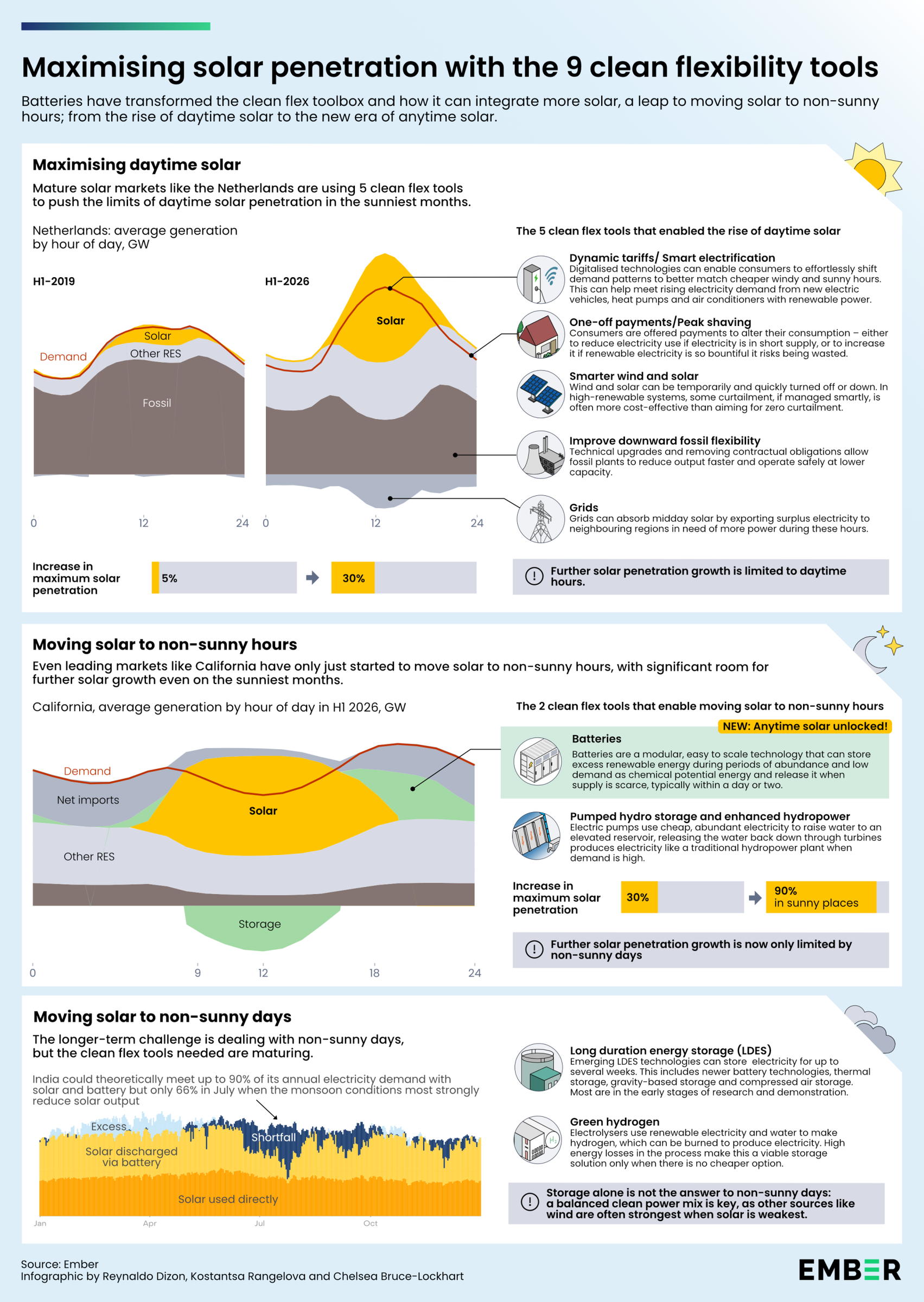
Solar met a record 10% of global electricity in the first half of 2026 but delivered almost all of it in the middle of the day, according to a report Ember published on August 12. The think tank estimates that the 459 GWh of battery additions it expects worldwide in 2026, up 50% from 307 GWh in 2025, could shift up to 34% of this year's new daily solar generation into non-sunny hours (a figure based on H1 2026 solar growth), up from 18% in 2025 and 4% in 2021.
The global average day in H1 2026 looked like this, per Ember's hourly data: solar met over a quarter of electricity demand between 11 am and 2 pm, then fell to near zero between 8 pm and 5 am. That midday bulge and evening cliff is the duck curve gone global. In markets where solar supplied over 20% of electricity for the half, it covered more than half of midday demand on the average day: Chile met 71% of demand at noon, the Netherlands 58% at 1 pm, Germany 55% at noon, all falling to near zero by 9 pm.
Fossil keeps the night shift
The report's India and EU chapters show what the cliff means for fossil generation. In India, solar pushed average fossil output at 1 pm down to 125 GW in H1 2026, about 10 GW below the same hour in H1 2023. After sunset the trend reverses: average fossil generation between 5 pm and 7 am rose 22 GW over the same period, to 168 GW, and the swing between the 1 pm low and the 7 pm peak of 174 GW now stands at nearly 50 GW, which Ember equates to the output of more than 70 modern coal units. The EU cut average midday fossil output by 16 GW between H1 2023 and H1 2026 while its evening peak fell just 5 GW.
Ember reads the strain as a limit on solar itself: negative prices, curtailment, and falling capture rates are spreading in the most saturated midday markets, and EU solar installations fell 0.7% to 65.1 GW in 2025, the first decline in a decade.
A ceiling, not a forecast
The report is explicit that its 34% figure is a theoretical ceiling that assumes every new battery shifts solar. By BNEF's primary-application classification, cited by Ember, 74% of batteries installed in 2025 were for energy shifting, up from 47% in 2020, and many fleets run well below their potential: China's standalone batteries averaged 299 cycles in 2025, up from 146 in 2022 but under the roughly 350 cycles Ember calls international best practice, while co-located units averaged 199.
The economics behind the buildout have moved fast. Global average installed battery costs fell 95% between 2010 and 2025, from $2,634/kWh to $140/kWh, per figures the report cites, and around a quarter of new utility-scale solar capacity deployed globally in 2025 was co-located with batteries.
Bulgaria, Chile, and California lead
The countries with the most new 2025 storage relative to their own new solar were Bulgaria, with enough to shift 77% of its new daily solar generation, Chile at 76%, and Australia at 60%. Bulgaria went from almost no batteries in 2023 to around 3 GWh added in 2025 and 8.6 GWh installed by May 2026. Chile added 4 GWh in 2025, more than doubling its fleet to 7.6 GWh.
The US added 58 GWh in 2025, enough to shift around a quarter of its new solar generation; the EU's 27 GWh covered 16%, below the 18% global average, though Ember notes EU grid operators' scenarios project installed battery capacity growing fourfold between 2025 and 2030. The US buildout also gained a policy variable after the report's publication: Executive Order 14420, signed August 26 and covered in The Duck Curve's earlier reporting, set up determination-gated prohibitions on foreign-produced battery energy storage systems serving the bulk power system.
The leaders' evening data shows the shift arriving. Solar plus batteries met over a quarter of California's electricity demand between 7 and 9 pm on the average day in H1 2026, up from 6.8% in H1 2023. Bulgaria's solar-plus-batteries covered nearly a quarter (24%) of evening demand, and Chile's over 10%, in countries where solar contributed virtually nothing in the evening in H1 2023.
Sources
Primary
Supporting
- Declaring a National Emergency to Secure the United States Bulk-Power System (Executive Order 14420) · The White House
Copies of cited sources are retained where available. If a link no longer resolves, request a copy at contact@theduckcurve.com.