 The Duck Curve
Australia commissioned more grid battery capacity in H1 2026 than in 2025
Nine batteries totalling 2,295 MW and 7,132 MWh beat 2025's twelve, the Clean Energy Council says; solar drove 2.6 GW of new commitments while storage commitments slipped below a year earlier.
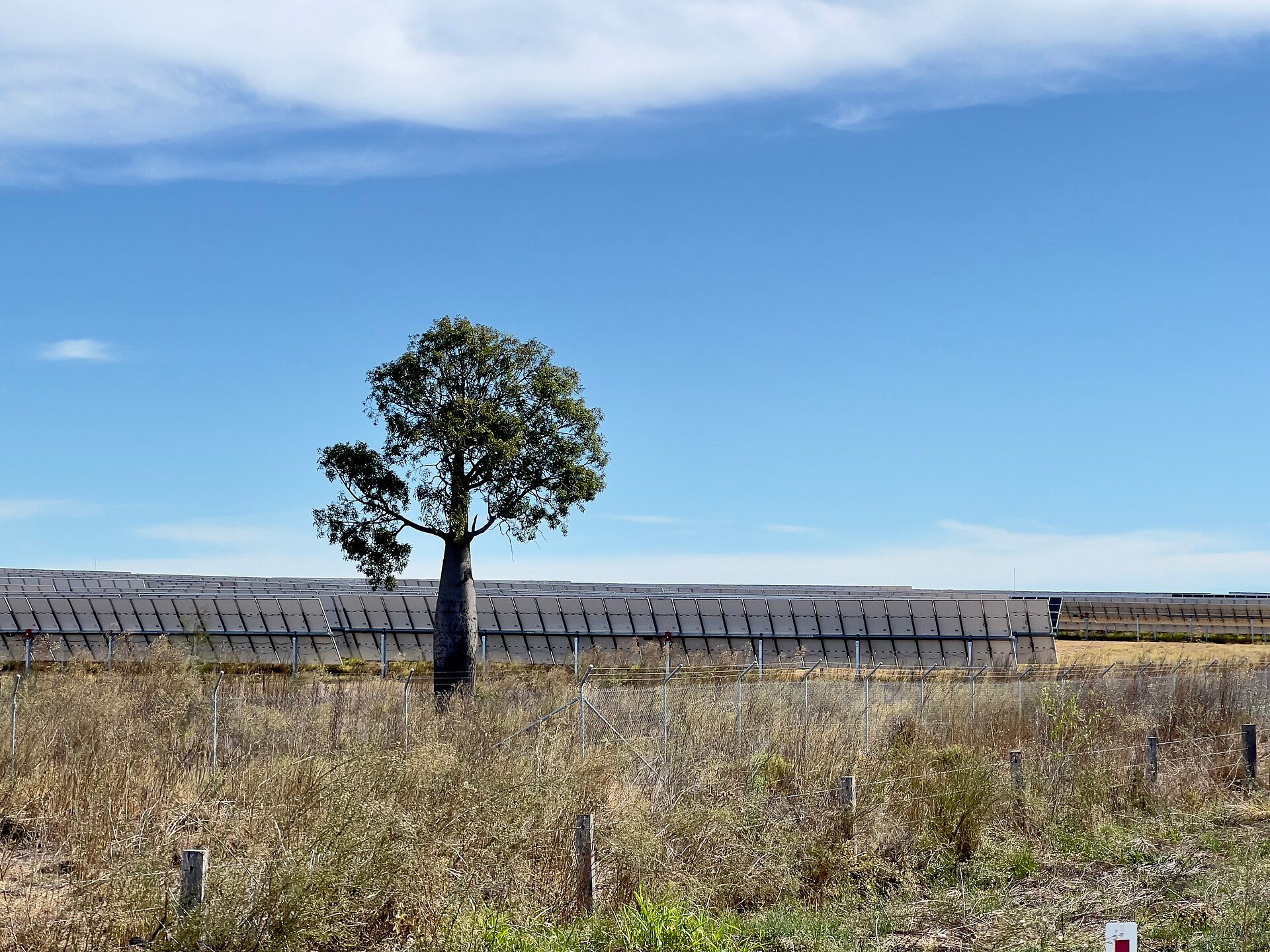
Nine utility-scale batteries totalling 2,295 MW and 7,132 MWh were commissioned in Australia in the first half of 2026, more power and more energy capacity than the 12 projects (1,972 MW and 5,124 MWh) commissioned across all of 2025, according to the Clean Energy Council's (CEC) Bi-annual investment report for January to June 2026, released October 26. The report values the nine at $4.3 billion (Australian dollars throughout), against $2.2 billion for the whole of 2025.
Fewer batteries carried more storage because each one is bigger and runs longer. The average battery commissioned in 2026 holds 792 MWh, up from 427 MWh in 2025, and average duration rose from 2.6 to 3.5 hours of output at full power (the gap between those two units is the subject of our kW vs kWh explainer). The largest was Western Australia's Collie BESS. By the CEC's count, more than three-quarters of all utility-scale storage energy capacity commissioned in Australia since 2017 came online in the past 18 months.
The record rests on a strict definition. The CEC counts a battery as commissioned only once it is "fully completed and operational," which includes passing commissioning tests signed off by AEMO and the network service provider and reaching AEMO scheduled capacity. AEMO's Quarterly Energy Dynamics Q2 2026 counts the earlier step: batteries totalling 4,640 MW and 12,353 MWh began commissioning in the National Electricity Market (NEM) in the twelve months to June, and installed capacity, counting projects still in commissioning, passed 9,000 MW. The two tallies measure different stages over different areas, since the NEM excludes Western Australia, so they are not interchangeable.
Solar drives commitments as storage holds steady
More generation reached financial close in the six months than in all of 2025, the report finds: 12 projects totalling 2,623 MW, against 2,283 MW for the full year. Eleven of the 12 were solar farms or solar hybrids, solar made up 92 per cent of the capacity, and the only wind farm was Western Australia's 133 MW Nullagine Wind Project, 5 per cent of the total. The largest was Western Australia's 690 MW Turner River Solar Hub, and the report puts more than half of the new generation capacity in that state.
The CEC's media release is headlined "Clean energy investment surges, Australian energy security strengthens." The report's own rolling measure is more restrained: the 12-month average for generation reaching financial close rose to 952 MW in the June quarter, from 585 MW in the March quarter, but remained below the 1,050 MW of a year earlier.
Storage commitments slipped. Thirteen storage projects totalling 1,602 MW and 6,523 MWh reached financial close in the half, below the 6.6 GWh of the first half of 2025 and the 6.8 GWh of the second, although the report calls the June quarter's 6.3 GWh a record, which by our arithmetic leaves about 0.2 GWh for the March quarter. Government underwriting did much of the work: five projects backed by the federal Capacity Investment Scheme (CIS) reached financial close, accounting for 71 per cent of the new storage energy capacity (1,131 MW and 4,293 MWh) and 37 per cent of the new generation capacity (980 MW). Of the 113 projects awarded CIS agreements to date, 25 have reached financial close, the report says.
On the generation side, five projects totalling 1,410 MW and worth more than $2.8 billion were commissioned in the half, led by the 756 MW first stage of Victoria's Golden Plains Wind Farm, which the report calls the largest operating onshore wind farm in Australia. Behind them sit 141 projects worth about $32.5 billion at financial close or under construction. Their storage component, 12.6 GW and 35 GWh, exceeds their 11.7 GW of generation. Queensland holds the largest share of the investment ($9.6 billion) and of the generation capacity (4.5 GW), and New South Wales the largest storage pipeline (4.3 GW and 11.2 GWh).
The price claim is AEMO's
CEC chief executive Jackie Trad tied the build-out to bills in the release: "An increase in renewable generation and storage is already putting downward pressure on power prices, with wholesale electricity prices averaging $74 per megawatt-hour in the June quarter, down nearly 50 per cent on the same period in 2025." The figure is AEMO's, cited in the report's footnotes: the NEM-average wholesale spot price in the second quarter of 2026 was $74/MWh, down $66/MWh, or 47 per cent, from a year earlier and the lowest second-quarter average since 2020. It covers the NEM only, so Collie and the rest of Western Australia's batteries sit outside it.
AEMO says more renewable generation, higher grid-scale battery discharge during peak periods and lower evening peak demand contributed to the fall. Battery discharge in the 4pm to 9pm evening peak rose 1,066 MW (228 per cent) year on year, and battery charging and discharging set prices in 36 per cent of dispatch intervals, up from 17 per cent. The fall is a year-on-year one: the same average was up $1/MWh on the March quarter, and monthly averages climbed through the quarter, from $58/MWh in April to $85/MWh in June.
AEMO's figures for the following quarter, July to September, which we covered on October 24, had grid batteries supplying more of the NEM's evening-peak generation than gas for the first time in any quarter, with average wholesale prices down 27 per cent year on year to $63/MWh.
Wind is where the pipeline is thin. Looking ahead, the CEC writes, "confidence appears to be softening, particularly for onshore wind, with investors naming approvals and transmission as their biggest obstacles." It also says that a possible cancellation of the VNI West transmission line reopens a decision that renewable zones in western Victoria and southern New South Wales depend on. It adds that more wind projects reached financial close after June, which the next edition will count.
Sources
Primary
- Bi-annual investment report: Large-scale renewable generation and storage, January-June 2026 · Clean Energy Council
Supporting
- Quarterly Energy Dynamics Q2 2026 · Australian Energy Market Operator
- Clean energy investment surges, Australian energy security strengthens · Clean Energy Council
Copies of cited sources are retained where available. If a link no longer resolves, request a copy at contact@theduckcurve.com.