 The Duck Curve
Grid batteries topped gas at the NEM evening peak in Q3, AEMO says
Batteries set NEM spot prices in 48% of dispatch intervals, up from 18% a year earlier, and wholesale prices fell 27% to A$63/MWh; battery revenue fell on lost FCAS income even as arbitrage earnings rose.
Grid-scale batteries supplied 8.0% of evening-peak generation in Australia's National Electricity Market (NEM) from July to September 2026, more than gas-fired generation at 5.1%, the first time that has happened in any quarter, according to AEMO's Quarterly Energy Dynamics Q3 2026. The batteries charged 13.4 GWh a day on average between 10am and 4pm and discharged 10.9 GWh between 4pm and 9pm, against 3.7 GWh and 3.2 GWh in the same quarter of 2025.
They also set the price more often than anything else. Battery charging or discharging set the NEM spot price in 48% of dispatch intervals, up from 18% a year earlier, which makes batteries the market's most frequent price-setting technology. Average wholesale prices fell 27% year on year to $63/MWh (Australian dollars throughout), the lowest third-quarter average since 2021, and were lower in every region, from $56/MWh in Victoria and Tasmania to $74/MWh in New South Wales. AEMO released the report on October 23.
AEMO chief executive Daniel Westerman had previewed the battery figures at the AFR Energy and Climate Summit on October 13, describing daytime absorption of "more than 13 gigawatt hours" as "nearly triple" the year before. The report's phrase is "more than tripled." For once, the preview undersold the result. The report also confirms the jump of around 360 MW in demand at 11am that Westerman described in the same speech (our roundup): average five-minute total demand across the NEM rose 360 MW between 11:00 and 11:05, led by Victoria (+151 MW), New South Wales (+114 MW) and Queensland (+111 MW).
A bigger fleet, less offloading, less gas
AEMO ties the tripling directly to the build-out. Grid-scale batteries totalling 4,375 MW and 12,628 MWh began commissioning in the twelve months to September, 860 MW and 2,970 MWh of them in the quarter, and installed capacity, counting projects still commissioning, passed 10 GW and 23 GWh. "Reflecting this rapid expansion," the report says, energy shifted by the batteries more than tripled.
Batteries charge at midday, when solar is plentiful, and discharge after sunset, and the report traces the effect at both ends of the day. Grid-scale solar's economic offloading in response to low prices fell 54% to an average 149 MW, or 5.9% of available solar output, down from 15.7%. Negative or zero prices occurred in 14.4% of dispatch intervals, 4.5 percentage points fewer than a year earlier, and AEMO says that where wind and solar typically set prices at negative levels, battery charging was more likely to set them at positive levels. Grid solar's volume-weighted average price rose from $26/MWh to $34/MWh.
At the other end of the day, gas-fired generation fell 34% to its lowest third-quarter average since 2000, and averaged 1,385 MW during the evening peak, down 50%. Battery discharge set the price in 60% of evening-peak intervals, up 34 percentage points.
A cheaper trade for the batteries themselves
The batteries are, by our reading, competing away the spread they exist to capture. AEMO's NEM-wide battery price spread fell from $123/MWh to $59/MWh. Estimated grid-scale battery revenue fell $21.0 million to $90.9 million for the quarter, mainly because contingency frequency control ancillary services (FCAS) revenue fell back from unusually high levels in the third quarter of 2025, when planned outages on the Heywood interconnector raised the need for local FCAS; FCAS revenue fell 96%, or $51.6 million, to $2.1 million, nearly all of it in South Australia.
Arbitrage earnings rose despite the overall decline, to $88.8 million net, with discharge revenue rising faster than charging costs, which went from $24.5 million to $60.8 million. The average price batteries earned when discharging fell $70/MWh to $98/MWh, while the price they paid to charge slipped from $34/MWh to $32/MWh. Lenders are still lining up: eleven banks back the $1.75 billion facility into which Akaysha Energy said on October 20 it had refinanced the debt on four Australian batteries (our roundup).
Rooftops set new lows for the grid
Distributed PV output, which AEMO ties to growth in rooftop solar installations, averaged a record 3,203 MW for a third quarter, up 372 MW (13%). That was slightly more than the growth in underlying demand, which reached a third-quarter high of 25,471 MW, so operational demand, the part met by the grid, slipped 55 MW to average 22,268 MW.
Warm spring days did the rest. NEM operational demand fell to an all-time low of 9,422 MW in the half-hour ending 12:30pm on Sunday, September 20, 244 MW below the previous record set in October 2025; Queensland set its own all-time low of 2,741 MW the same day, and South Australia a third-quarter minimum of -38 MW on September 19. That is the midday trough of the What is the duck curve? at its deepest yet.
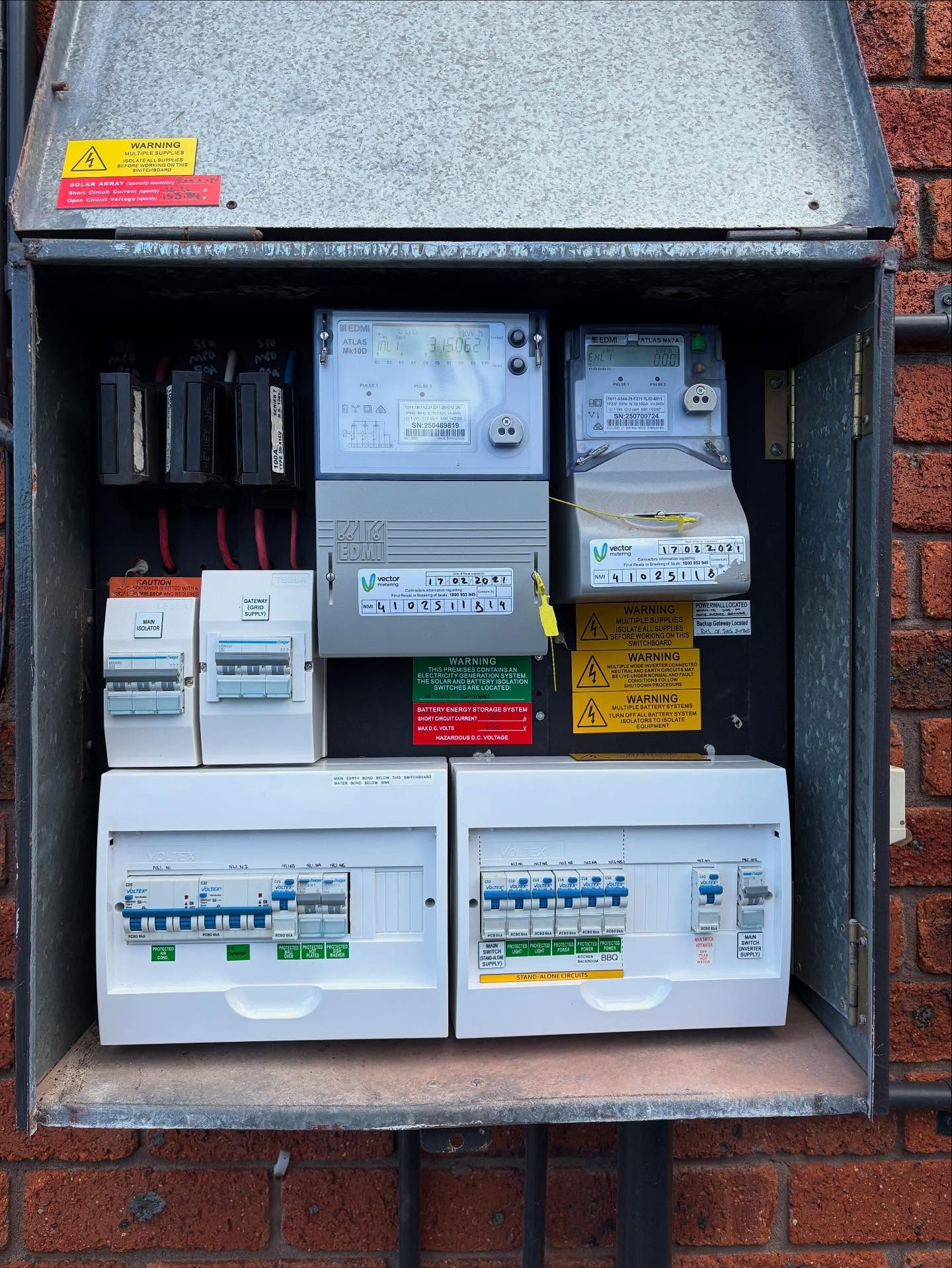
Home batteries are changing the evening end of that curve. In AEMO's sample of metering data from about 2.4 million NEM houses with rooftop solar, the roughly 0.5 million with a battery installed before July 1, 2026 imported 0.7 kW less from the grid on average during the 4pm to 9pm peak than solar-only homes, a 74% reduction. Westerman had put the figure at 70–75% on October 13. Cumulative battery capacity installed under the federal Cheaper Home Batteries Program reached 13,917 MWh across the NEM's regions by the end of September, counting installations with approved certificates, AEMO says, and the batteries are reshaping midday too: home battery charging, free or cheap midday tariffs, and industrial and data centre load lifted daytime operational demand, and daytime prices rose slightly in every mainland region.
Western Australia, on its separate grid, is the reminder that storage alone does not make power cheap. Battery charging there doubled and discharging rose 98%, and the average real-time price still rose 19% to $120.72/MWh, the highest quarterly average the Wholesale Electricity Market has recorded, as coal and wind availability fell.
Sources
Primary
- Quarterly Energy Dynamics Q3 2026 · Australian Energy Market Operator
Supporting
- AEMO CEO Speech at 2026 AFR Energy and Climate Summit · Australian Energy Market Operator
- Warmer weather, solar and batteries reshape energy markets · Australian Energy Market Operator
Copies of cited sources are retained where available. If a link no longer resolves, request a copy at contact@theduckcurve.com.