 The Duck Curve
Thailand approves 50,000-baht home solar grants for up to 1 million homes
The 50 billion baht program is paid from an energy-transition borrowing decree, takes systems of 5 to 10 kWp, and rules out the 200,000-baht solar tax deduction for anyone who takes the grant.
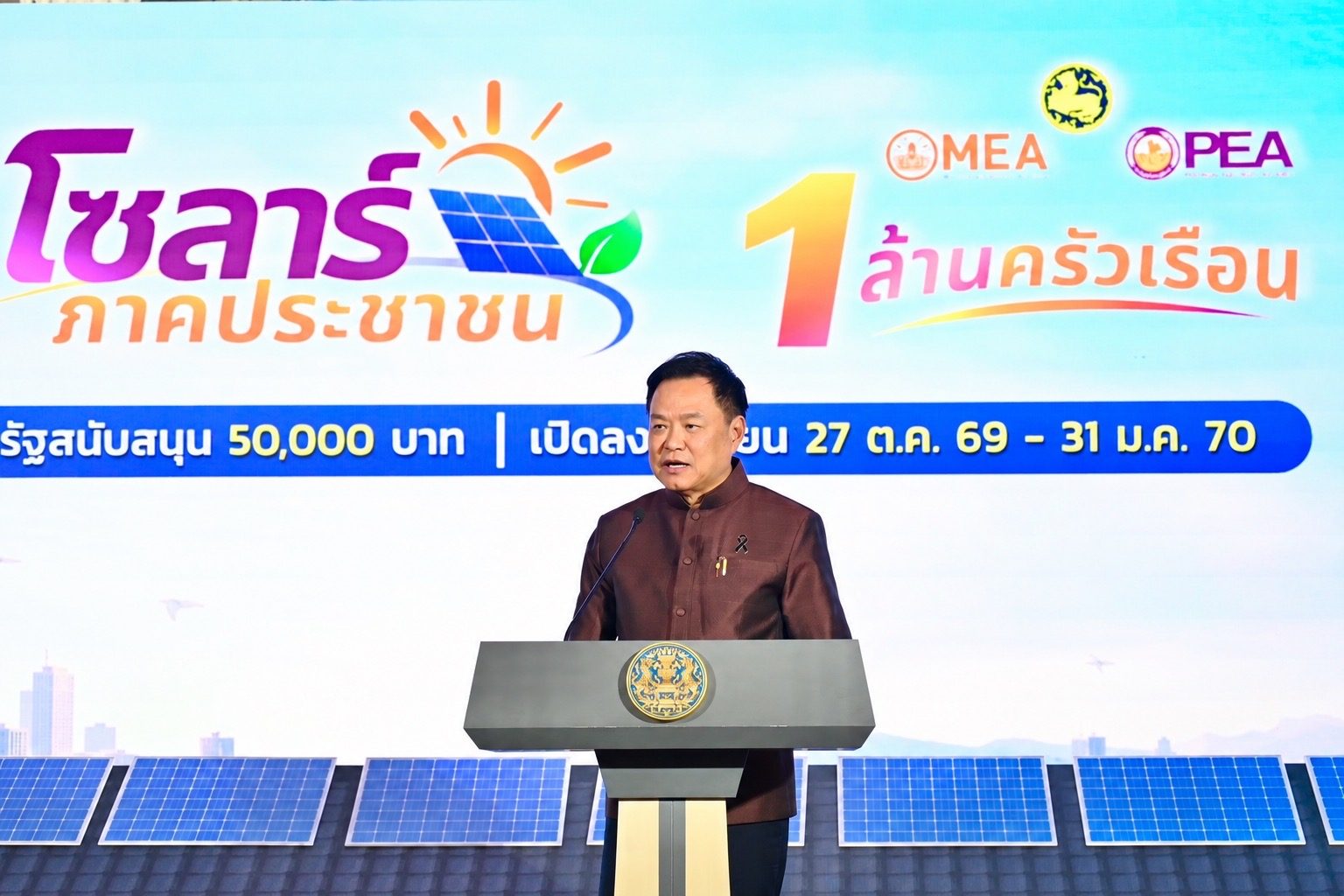
Thailand's cabinet on October 27, 2026 approved People's Solar, a program with a 50 billion baht budget that pays 50,000 baht toward the equipment and installation of a home solar system for up to 1 million households, and registration opened the same day. The two state distribution utilities, the Provincial Electricity Authority (PEA) and the Metropolitan Electricity Authority (MEA), take applications until January 31, 2027, PEA said in its launch release, and the grant runs to 1 million homes or until the approved budget is spent. At 50,000 baht a home, the two limits arrive together.
The money is borrowed. Ekkaphop Phianphiset, spokesperson for the Prime Minister's Office, said the cabinet approved the program under the 2026 emergency decree that lets the Finance Ministry borrow to deal with the energy crisis and drive the energy transition, InfoQuest reported. That decree authorizes 400 billion baht, and the household grants come out of its energy-transition part, Finance permanent secretary Lavaron Sangsnit said after the loan-screening board he chairs cleared the proposal, The Nation reported on October 20. The spokesperson's figures here are as InfoQuest reported them; we have not seen the cabinet's written resolution.
Deputy Prime Minister and Finance Minister Ekniti Nitithanprapas made the case on October 26, the day before the meeting. Fuel excise cuts and oil-fund support come out of the government's left and right pockets, he said, and with the budget already in deficit a tax cut only means borrowing more, so "today we'd rather give the borrowed money to the people," according to InfoQuest (our translation). He also said the screening committee had widened the program, first framed around rooftops, to cover ground-mounted panels and floating solar on ponds, because some homes have roofs not suited to an installation. By his account, the rooftop program no longer needs a roof.
Who qualifies
The grant follows the electricity meter. Applicants must be Thai nationals on the residential (type 1) tariff, and the name on the application must match the owner of the meter, one of eleven conditions in PEA's release. The new or added system must be at least 5 kWp and no more than 10 kWp per meter, not counting any solar already there, with at least panels and an inverter. Installation goes through MEA, PEA or a vendor registered with them, each person can claim once, and the tax invoice must be dated on or after registration opened. Owners must apply to connect by August 31, 2027 and be connected by September 30, 2027.
Two of the rules make the grant a choice rather than an extra. A household that takes it cannot also claim the 200,000 baht solar tax deduction under Royal Decree No. 805; Ekniti had pitched the deduction on October 26 as the route for homes that already have solar or do not want the grant. And holders of the state welfare card can apply, but in the release's wording do not claim electricity bill assistance for 20 years.
Participants can borrow from three state banks, the Government Savings Bank, the Government Housing Bank and the Bank for Agriculture and Agricultural Cooperatives, on each bank's own lending criteria, PEA said. The utilities will also swap participants' meters for smart meters at no charge to them, paid from another slice of the loan, Ekniti said.
What a home pays, and what the grid gets
The grant covers a minority of the bill. Prachachat's worked example puts a standard 5 kW rooftop system, the smallest the program accepts, at about 140,000 baht, leaving about 90,000 baht after the grant; it reports the state banks' loans at 2.5% for seven years, and says the 50,000 baht is paid to the installer once the utility has inspected and connected the system. Surplus power sold back to the utilities earns 2.20 baht a unit, InfoQuest reported. That is the price pv magazine reported for the net-billing scheme approved in April, which capped eligible systems at 5 kW per meter; the new grant starts at 5 kWp, and neither PEA's release nor the spokesperson's account says whether that export cap rises with it.
The cabinet approved more than panels. Alongside the 50 billion baht for People's Solar, the spokesperson listed 10,785 million baht to upgrade the smart grid, 10,811.6 million baht for smart meters and 972 million baht for the Labour Ministry to train solar installers, for a combined 72,568.6 million baht. The government expects the package to cut household power bills by about 24,000 million baht and to reduce purchases from the existing power system by about 6,323 million units (about 6.3 TWh) in the first year. A few paragraphs earlier, the same InfoQuest report's account of the launch, which Prime Minister Anutin Charnvirakul presided over at Government House, puts the program's savings at more than 24,500 million baht a year.
The scale matches the plan. One million homes at 5 to 10 kWp each would add 5 to 10 GW, by our arithmetic, and the draft Power Development Plan 2026 sets a target of up to 10 GW of rooftop solar, pv magazine reported in September. Thailand had about 3.3 GW of rooftop solar at the end of 2024, by the Department of Alternative Energy Development and Efficiency's count cited there.
India is the obvious comparison. Residential systems under its PM Surya Ghar scheme account for 14.9 GW across 5 million homes, per Ember, and the think tank is now arguing for a subsidy on home batteries so those homes export less (as we reported on October 22). Batteries appear nowhere in PEA's eleven conditions.
Sources
Primary
- PEA–MEA เปิดตัว “โซลาร์ภาคประชาชน” หนุนติดตั้งโซลาร์ 1 ล้านครัวเรือน ลดภาระค่าไฟฟ้า สนับสนุนพลังงานสะอาด · Provincial Electricity Authority (PEA)
Supporting
- Thailand paves the way for 10 GW of rooftop solar · pv magazine
- Thai screening board clears 50bn-baht solar plan with Cabinet review expected on Oct 26 · The Nation
- โซลาร์ภาคประชาชนเข้า ครม.พรุ่งนี้ เปิดลงทะเบียนทันที · InfoQuest
- สรุปเงื่อนไข-ขั้นตอนรับ 50,000 บาท "โซลาร์ภาคประชาชน" โครงการนี้เหมาะกับใครบ้าง? · Prachachat Turakij
- ครม.ไฟเขียว “โซลาร์ภาคประชาชน” อัดฉีดเงินอุดหนุน 1 ล้านครัวเรือน เปิดลงทะเบียน 27 ต.ค.69-31 ม.ค.70 · InfoQuest
Copies of cited sources are retained where available. If a link no longer resolves, request a copy at contact@theduckcurve.com.