 The Duck Curve
DOE selects 31 SPARK grid projects for $1.9 billion in federal funding
The Office of Electricity intends to help fund reconductoring and grid-technology projects it counts across 26 states, $5.25 billion in all with cost share; the program page expects awards from October 2026 to January 2027.
The US Department of Energy's Office of Electricity said on September 24, 2026 that it intends to help fund 31 grid-improvement projects across 26 states under Speed to Power through Accelerated Reconductoring and other Key Advanced Transmission Technology Upgrades (SPARK). The release puts the projects at $5.25 billion in total, $1.9 billion in federal funding and $3.35 billion in recipient cost share, and says the recipients are expected to reconductor or rebuild more than 1,500 miles of transmission lines, deploy grid-enhancing technologies across nearly 21,000 miles, and make over 23 gigawatts of additional electricity capacity available.
DOE's list of selected applications, a 23-page document dated September 2026, gives each project's prime applicant, project title, location, federal funds requested, total project value and a short narrative, and repeats on every page that the details "are derived from application materials and are subject to change pending finalization of formal financial assistance agreements." The SPARK program page lists the expected award date as October 2026 to January 2027. Summed by The Duck Curve from the document's 31 rows, the federal requests come to $1,893,241,306 and the total project values to $5,251,893,508; the difference, $3,358,652,202, is the cost share, $3.36 billion at the release's precision; the release's $3.35 billion is what its own rounded totals leave, $5.25 billion less $1.9 billion.
Where the money goes
The document sorts the selections into the funding notice's three topic areas. Topic Area 1, grid resilience, holds nine utilities in two size classes: four small ones (Arizona Electric Power Cooperative, Farmers' Electric Cooperative of New Mexico, Four County Electric Membership Corporation in North Carolina, and Kit Carson Electric Cooperative in Taos) and five large (Basin Electric Power Cooperative, PPL Electric Utilities, Puget Sound Energy, Rocky Mountain Power, and the Tennessee Valley Authority). Topic Area 2, smart grid, holds 18 selections, from Guam Power Authority's $10,619,597 request, the smallest on the list, to six entries listed at exactly $50,000,000 in federal funds: Alabama Power, American Electric Power Service Corporation, Centerpoint Energy Houston Electric, Duke Energy Carolinas, the New York Power Authority and Pacific Power.
Topic Area 3, the grid innovation program, for which the program page says states, combinations of two or more states, Indian tribes, units of local government and public utility commissions were eligible, has four selections that take $810,395,919 of the federal money by our sum, about 43% of the total. Two of them sit on the seam between the Eastern and Western Interconnections. The Colorado Energy Office's "CO to TX Western-Eastern Intertie Modernization Initiative" requests $250,000,000 against a total project value of $1,206,553,696, the largest on the list, to "modernize a critical interconnection point between the Western and Eastern interconnections through deployment of Advanced Transmission Technologies (ATTs) and targeted transmission line upgrades." The Oklahoma Office of Management and Enterprise Services' "Three Corners Connector" requests $250,000,000 of $832,174,719 for "a high-capacity transmission system link between the Southwest Power Pool (SPP) in Oklahoma and the Western Electricity Coordinating Council (WECC) in Colorado." The other two are the Public Utilities Commission of Ohio's "Ohio SPARK" program, at $135,982,043 federal, and the State of Indiana's Office of Energy Development, at $174,413,876 federal, whose project title puts reconductoring and advanced transmission technologies across the PJM–MISO seam.
The narratives are short and generic: by our count, 12 of the 31 use some form of the notice's phrase "advanced transmission technologies," capitalized or not, singular or plural, and nine call something "cutting-edge." Kit Carson's title places its reconductoring and dynamic line rating on the Questa–Taos 69 kV corridor in northern New Mexico; its narrative says only that it would upgrade lines and implement a line rating system. Only one of the 31 narratives names a conductor type: Orlando Utilities Commission's, which lists "high-temperature/low-sag conductors and dynamic line rating (DLR)." The release's 26 states: the prime locations in the document fall in 25 states plus Guam by our count, and several narratives span more states than their prime location.
The program, the RFI, and the conductor bill
SPARK is a round of the Grid Resilience and Innovation Partnerships program, funded through the Infrastructure Investment and Jobs Act. The program page says GRIP "was authorized to provide up to $10.5 billion in competitive funding over five years" and that the funding notice "was renamed" SPARK "to provide clarity with the program's updated emphasis." DOE's March 12, 2026 announcement of the opportunity said the previous two GRIP rounds covered fiscal 2022-2023 and 2023-2024 funding, and gave a calendar: concept papers due April 2, 2026, full applications May 20, 2026, and selections anticipated in August 2026. The program page's six-row key-dates table gives a different one: notice issued February 25, 2026, informational webinar March 4, 2026, concept papers March 18, 2026, applications May 5, 2026, selections September 2026, awards October 2026 to January 2027; the March release had said a webinar would be posted by March 20, 2026. The selections came on September 24, 2026.
DOE's stakeholder input page says the department launched the Speed to Power initiative on September 18, 2025 and issued a request for information with responses due November 21, 2025; it counts 369 responses and 238 unique projects, 85 of them transmission projects proposing 31.4 GW in service by 2030. Two of the themes the page lists as recurring in the submissions read like SPARK's brief: "Better Use of Existing Grid Infrastructure," glossed as reconductoring and advanced transmission technologies "often within existing rights-of-way," and "Regional & Interregional Coordination."
The House passed the High-Capacity Grid Act, H.R. 6633, by voice vote on September 15, 2026; as The Duck Curve reported, the House-passed text would have FERC require public utilities to use conductors in a best-available transmission conductor class for covered projects, including any major reconductoring of an existing conductor as the Commission determines, with four exemptions. The bill status record shows the bill received in the Senate on September 16, 2026 and referred to the Committee on Energy and Natural Resources, with no later action as of September 24, 2026. SPARK's documents name a kind of conductor, not a class: the program page lists "Reconductoring with advanced conductors" first among the kinds of projects it says OE prioritized, a list it introduces with "included," and says successful applications "highlighted how reconductoring and other Advanced Transmission Technologies (ATTs), as complementary technologies, expand transfer capability ... while utilizing existing rights of way." No designated conductor class appears on the page or in the selection document.
Outlook
The program page's table put selections in September 2026 and they came September 24, 2026; its award window, October 2026 to January 2027, is the next row, and if the table holds as it did for selections the agreements would be signed by January 2027. The March release's calendar, which anticipated August selections, is the one that slipped. Until agreements are signed, the 23 GW and the 21,000 miles are DOE's expectations of what applicants proposed, and the per-page footer says the details can change in negotiation.
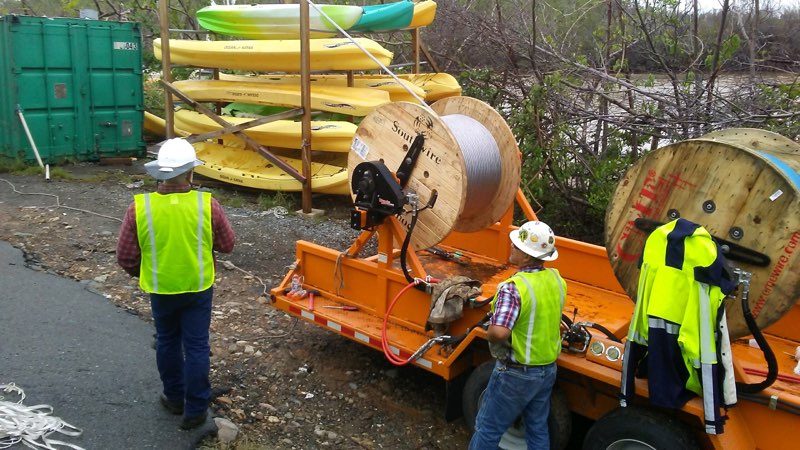
Hero: DOE-WAPA linemen reconductoring a 34.5 kV line on St. Thomas, US Virgin Islands, in a Western Area Power Administration photo posted in October 2017.
.jpg)
⚠ The Outlook extrapolates from the SPARK program page's key-dates table (selections September 2026, awards October 2026 to January 2027) and the March 12, 2026 announcement's earlier calendar, both cited above.
Sources
Primary
- Energy Department Announces Speed to Power Investments Across 26 States to Lower Electricity Costs and Improve Grid Reliability · U.S. Department of Energy, Office of Electricity
- Selected Applications for DE-FOA-0003580 (SPARK) · U.S. Department of Energy, Office of Electricity
Supporting
- File: Transmission conductor work, Oct. 16 (37526569240).jpg · Western Area Power Administration via Wikimedia Commons
- Energy Department Announces $1.9B Investment in Critical Grid Infrastructure to Reduce Electricity Costs · U.S. Department of Energy, Office of Electricity
- Bill status, H.R. 6633 (119th Congress) · Library of Congress via GovInfo bulk data
- Speed to Power: Stakeholder Input and DOE Actions · U.S. Department of Energy, Office of Electricity
- Speed to Power through Accelerated Reconductoring and other Key Advanced Transmission Technology Upgrades (SPARK) · U.S. Department of Energy, Office of Electricity
Copies of every cited source are retained. If a link no longer resolves, request a copy at contact@theduckcurve.com.