 The Duck Curve
UNSW and UtmoLight claim 23.5% record for a 676 cm² perovskite submodule
The certified stabilised result on a 30 x 30 cm device drops the usual nickel oxide layer; UNSW does not name the certifying lab or the benchmark it beat by 0.6 points.
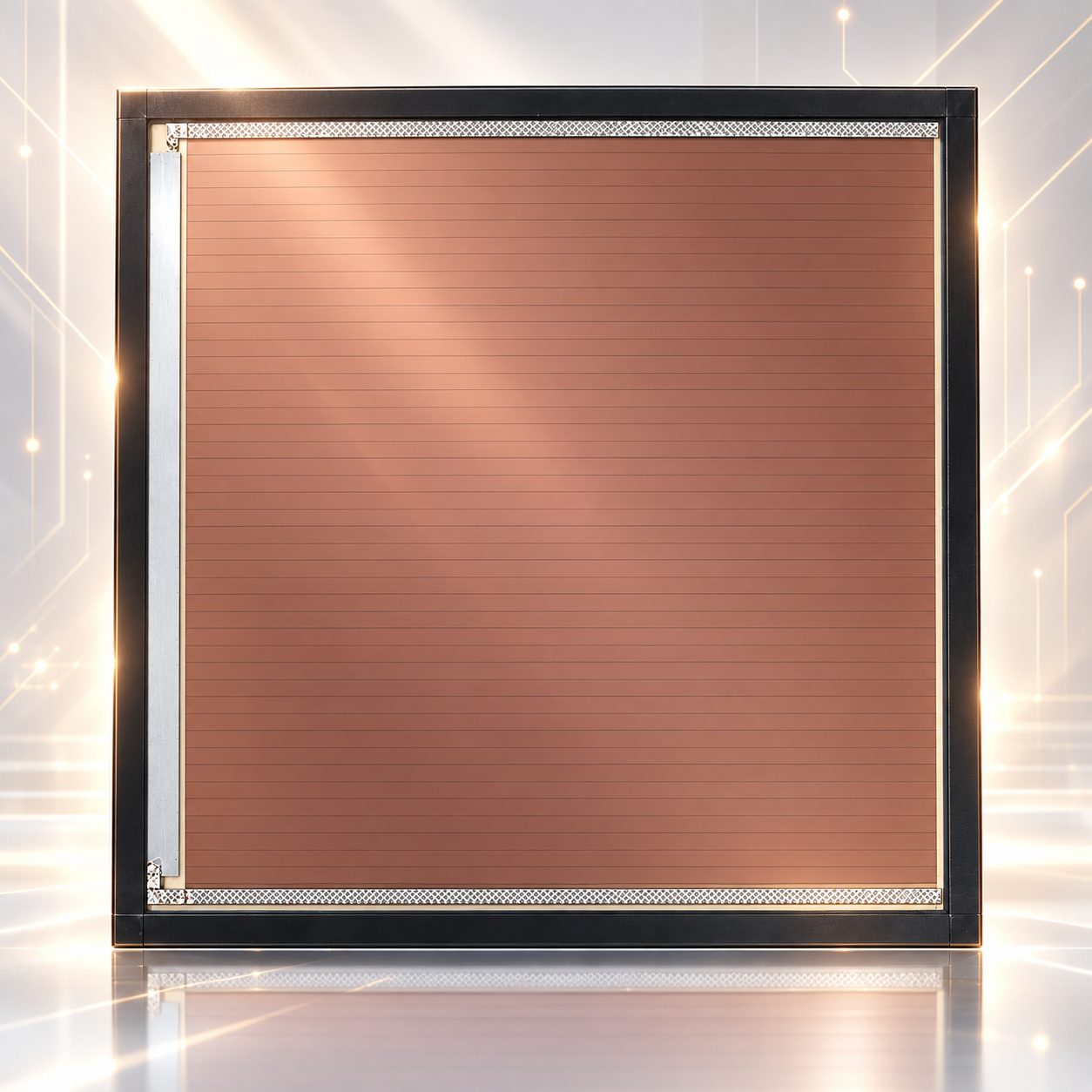
A 30 x 30 cm perovskite submodule built by engineers at UNSW Sydney and industry partner UtmoLight has reached a certified stabilised power conversion efficiency of 23.5%, which UNSW announced on October 7, 2026 as a world record for a large-area perovskite submodule, 0.6 percentage points above the previous benchmark. The device has an aperture area of 676 cm².
The number matters because of the area. UNSW says the result narrows the efficiency gap with small-area laboratory cells, which are typically only around 1 cm²; the submodule is about 676 times that size, by our arithmetic. At that size, the release says, makers need precise control over film uniformity, crystallisation, defects, interfaces and electrical interconnection, which is why moving from lab samples to modules "can be problematic." Scientia Professor Xiaojing Hao, who led the UNSW team, put it more plainly: "Materials that work exceptionally well in a small laboratory device do not necessarily behave in the same way under scaled-up processing conditions."
The record device also leaves a layer out. Perovskite cells commonly use nickel oxide, particularly at submodule size, to help prevent electrical short circuits, but UNSW says the oxide can react with the perovskite, adding to instability, and costs an extra manufacturing step. The team, which included Dr Zhen Li and Dr Ziyue Feng, used materials innovation and a different fabrication approach to eliminate the nickel oxide, with a hole-selective contact forming directly during fabrication rather than through a conventional layer-by-layer process.
UtmoLight brought the scale-up side, in Hao's account. "UtmoLight's expertise in large-area processing and module fabrication has been essential in translating our materials and device concepts into a high-performance submodule," Hao said. She credits the arrangement with letting the researchers check early whether an idea can be upscaled, "which means that we are not wasting our time on things that aren't feasible."
UNSW's release does not name the laboratory that certified the 23.5%, or the result it beat. By our arithmetic, a 0.6-point margin puts the previous benchmark at 22.9%.
Perovskite module records come in many sizes, and this one is precise about its own. In a Nature paper published August 12, 2026, a team from Nanjing University and Renshine Solar reported certified efficiencies of 24.0% on a perovskite module with an aperture area of 810 cm² and 22.0% on one with a total area of 0.72 m², and said its modules passed all International Electrotechnical Commission (IEC) 61215 reliability tests.
Corresponding author Ke Xiao told pv magazine that the 24.0% figure was confirmed by TÜV SÜD in China and that "This result represents a world record for this perovskite module format." So two groups have claimed world records for perovskite modules within two months, each for its own format: UNSW's for a stabilised result on a 676 cm² submodule, Nanjing's for an 810 cm² module that is larger and posts a higher certified number.
The submodule is not a rooftop panel. UNSW's next step is a full-scale module with a 2.8 m² area, which the release calls representative of commercial PV module dimensions, and the researchers hope to reach around 18-19% efficiency on it. That target sits 4.5 to 5.5 points below the submodule result, by our arithmetic, and the researchers acknowledge that efficiency, reproducibility and long-term stability all need further work before the technology can be widely deployed. Stability is the familiar caveat: the release notes that perovskite can degrade when exposed to moisture, heat and prolonged sunlight.
The longer-term use UNSW describes is a perovskite layer on top of existing silicon cells, a tandem that could let manufacturers raise module output without proportionately increasing module size. Hao was awarded $6.3 million by the Australian Renewable Energy Agency (ARENA) to continue her work on making perovskite-silicon panels more efficient and reliable, according to the release.
Sources
Primary
- UNSW leverages industry partnership to set large-scale perovskite PV efficiency world record · UNSW Sydney
Supporting
- Lead carboxylates passivation for metre-scale perovskite solar modules · Nature
- Chinese scientists achieve record-breaking 24.0% efficieny for large-area perovskite solar modules · pv magazine
Copies of cited sources are retained where available. If a link no longer resolves, request a copy at contact@theduckcurve.com.