 The Duck Curve
NASA's SR-1 Freedom reactor will shut down for the cruise to Mars
An October design review set a shorter boom and a closer reactor for the late-2028 launch; reactor output, run time and radiator count are still being evaluated.
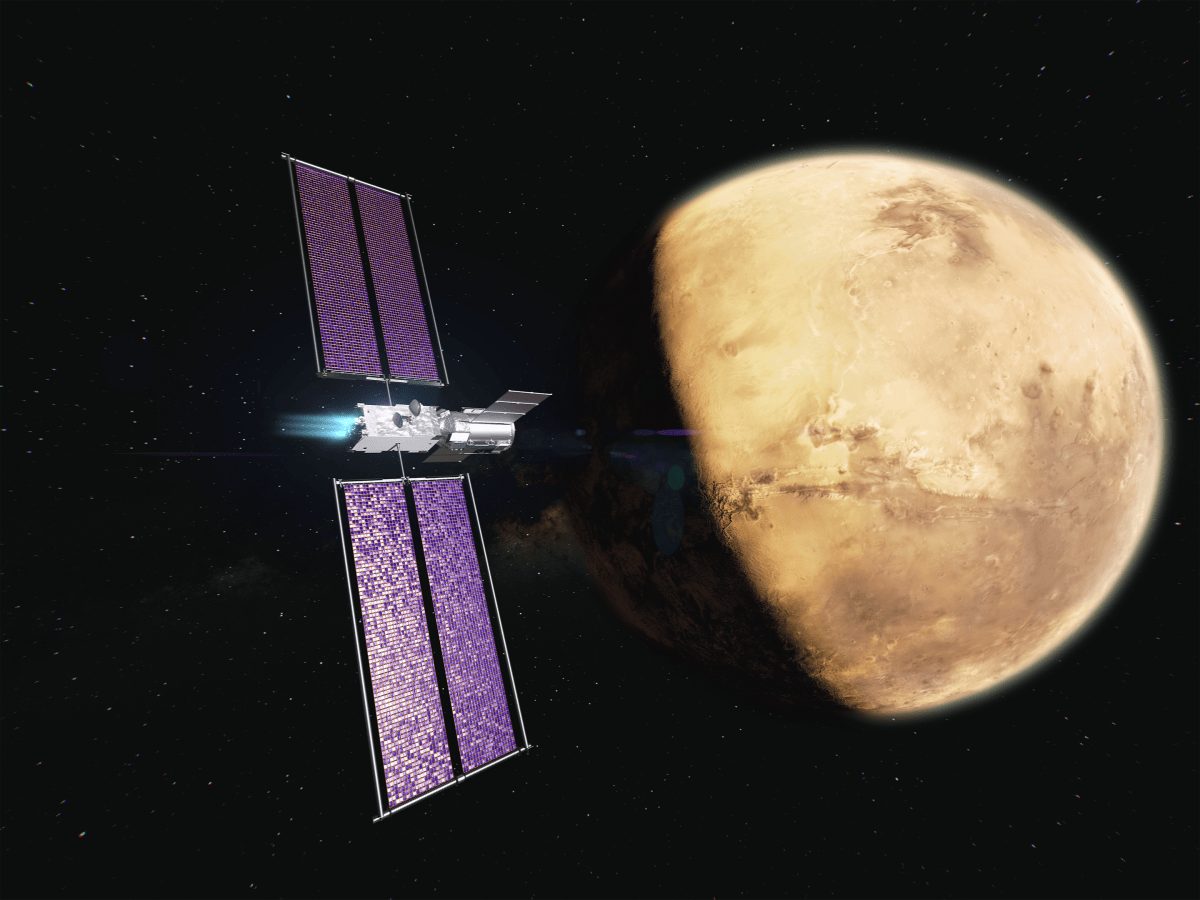
NASA's first nuclear-electric spacecraft will cruise to Mars on solar power. After a major design review in October, NASA says Space Reactor-1 (SR-1) Freedom will start its fission reactor once it has left Earth orbit, raise the power gradually, run it for an initial period and shut it down. Solar arrays then power the cruise, and the reactor restarts after the spacecraft has delivered the SkyFall capsule, carrying three helicopters, to Martian orbit. Launch is planned for late 2028, NASA said on November 24, 2026.
The review, held at NASA's Glenn Research Center in Cleveland with experts from NASA, the Department of Energy (DOE) and industry, fixed several parts of the design. The boom that separates the reactor from the spacecraft's main body, the Power and Propulsion Element, will be shorter than the one in early illustrations, which NASA says will reduce weight and simplify assembly. NASA and DOE experts also concluded that better shielding and spacecraft design will let the reactor operate closer to the rest of the craft while keeping the radiation protection the electronics and SkyFall need. NASA is also fitting the craft with larger X-band antenna dishes for the trip.
"This mission will be the first freight run on the railroad of the solar system, and the decisions we're making now are laying the tracks for every nuclear-powered spacecraft that follows," said Steve Sinacore, SR-1 Freedom's program director.
The agency is candid about the record SR-1 is meant to break. Over six decades, the fact sheet says, the United States invested more than $20 billion across dozens of space nuclear programs and flew one reactor, SNAP-10A, in 1965; it never left orbit.
The cruise plan changed; the power figure is open
In March, the reactor was meant to do the driving. When Administrator Jared Isaacman introduced the concept at NASA's Ignition event that month, NASA's Ignition fact sheet said SR-1 would start its reactor and power its electric thrusters within 48 hours of launch, then navigate to Mars using nuclear electric propulsion. It also gave the launch as December 2028; the new release says late 2028.
How much power the reactor will make is still undecided: the release lists the output power levels of the nuclear power module among the features teams are still evaluating, along with the number of radiator panels and how long the reactor will operate. NASA's documents describe the figure differently in the meantime. The March fact sheet promised Brayton power conversion delivering more than 20 kilowatts of electrical power, the mission page lists 20 kilowatts electric from a closed Brayton cycle system, and the infographic published with the new release says the reactor generates up to 20 kilowatts of electricity.
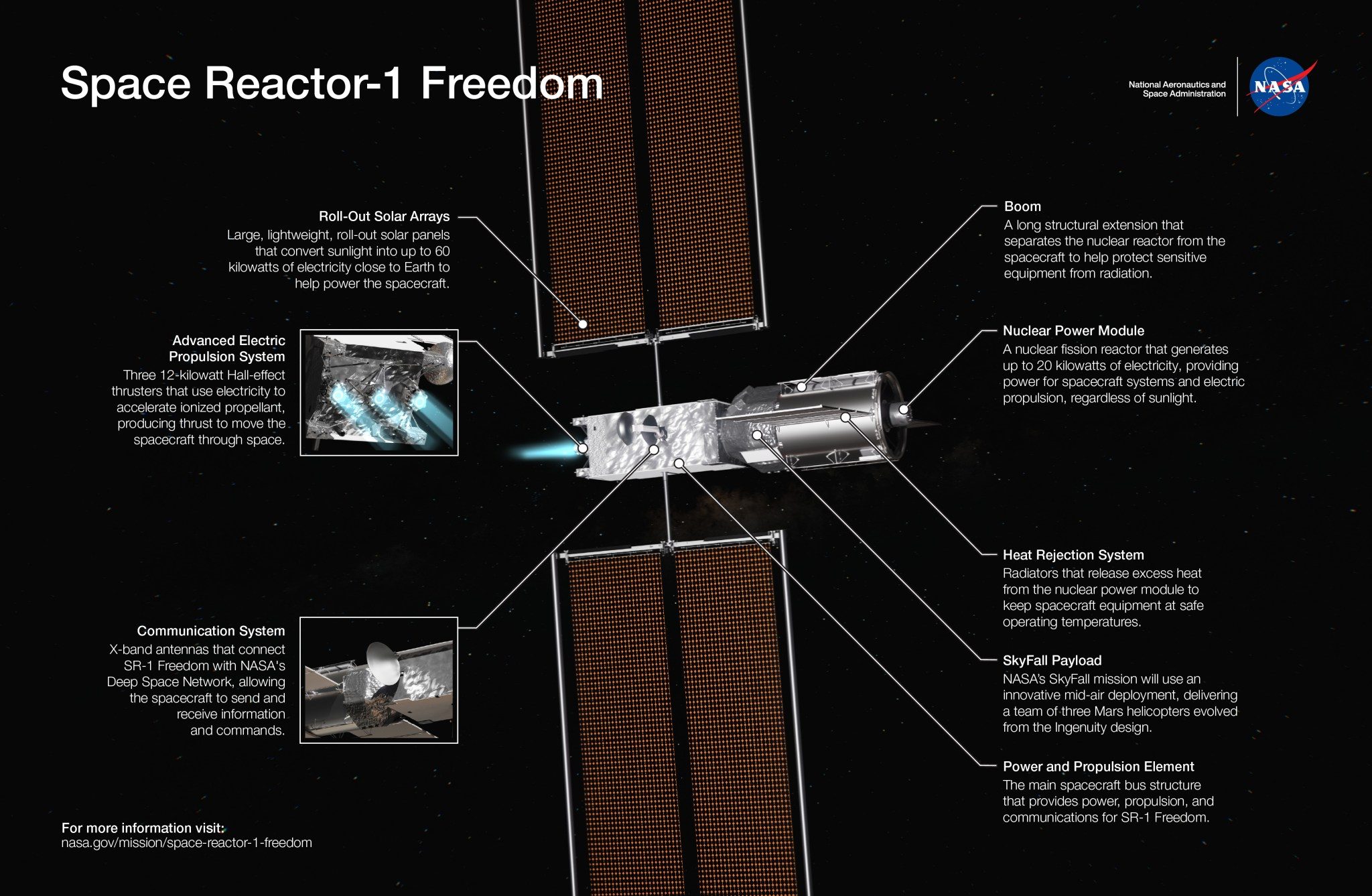
Close to Earth, the solar side is the larger one. The infographic rates the roll-out arrays at up to 60 kilowatts there, by our arithmetic three times the 20 kilowatts the mission page lists for the reactor, and the propulsion as three 12-kilowatt Hall-effect thrusters, which by the same arithmetic add up to 36 kilowatts. The spacecraft bus is reused hardware: the fact sheet describes the Power and Propulsion Element as a nearly built, NASA-developed bus, and the mission page credits it with generating 48 kilowatts of electrical power.
Fuel, radiators and the Moon reactor
SR-1's radiators have a builder before they have a count. NASA awarded a $39.3 million contract to Johns Hopkins University's Applied Physics Laboratory to develop the heat rejection system for the nuclear power module, including the flight hardware, the release says, and the lab is working with Advanced Cooling Technologies, which provides the heat pipe and composite radiator technologies. The number of radiator panels is still among the open design questions.
The fuel comes through DOE. On July 23, 2026, DOE made a conditional commitment of high-assay low-enriched uranium (HALEU) to NASA to support SR-1, the first time NASA had received one, and said its next step was to start contracting to allocate the material. DOE said then that HALEU was not available from domestic suppliers. The mission page lists HALEU as SR-1's fuel.
SR-1 is also the first step toward Lunar Reactor-1 (LR-1), a fission surface power system for NASA's Moon Base, the mission page says. NASA opened bidding on LR-1's design in November, asking for at least 20 kWe from a HALEU-fueled reactor with closed Brayton conversion, ready for launch by December 2030. Its 20 kWe minimum matches the 20 kilowatts NASA lists for SR-1 on its mission page.
Sources
Primary
Supporting
- America Underway in Space on Nuclear Power (Ignition fact sheet) · NASA
- Space Reactor-1 Freedom · NASA
- Energy Department to Distribute Third Round of HALEU to NASA and Radiant · U.S. Department of Energy, Office of Nuclear Energy
Copies of cited sources are retained where available. If a link no longer resolves, request a copy at contact@theduckcurve.com.