 The Duck Curve
LLNL and Pacific Fusion push Sirius pulser past 3,000 shots
The CRADA-funded reliability campaign moves the impedance-matched Marx generator toward the Department of Energy's TRL 5 benchmark for fusion-scale pulsed power.
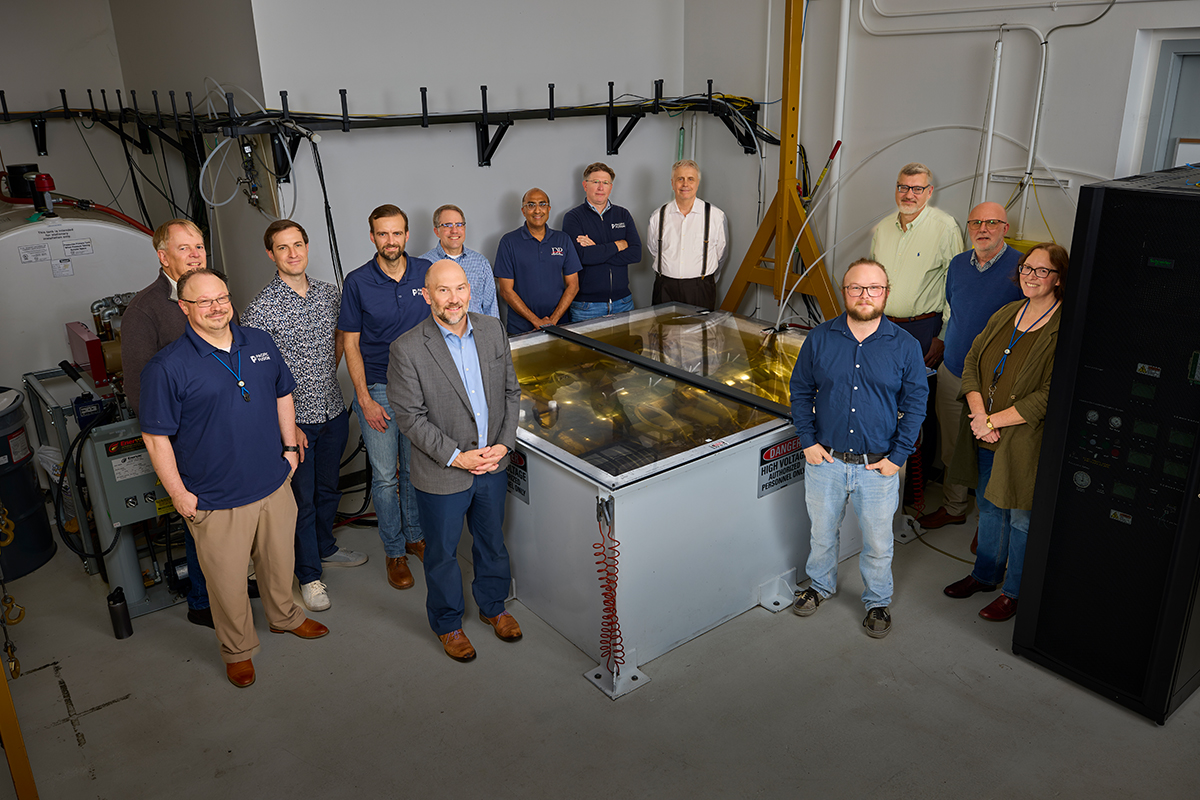
Lawrence Livermore National Laboratory and Pacific Fusion completed more than 3,000 full-power shots on the Sirius pulsed-power prototype by May 15, 2026, LLNL said in a July 16, 2026 report, with the four-stage machine delivering 60 gigawatts in a 100-nanosecond pulse at 95 percent energy efficiency. The campaign, run under a Cooperative Research and Development Agreement (CRADA) between the lab and the private fusion company, is meant to show that a new pulsed-power architecture can survive the repeated operation a commercial fusion driver would demand.
What Sirius is testing
Sirius is an impedance-matched Marx generator, or IMG: instead of stacking voltage from discharging capacitors the way conventional Marx banks do, it synchronizes electromagnetic waves onto a single transmission line in one step. Bill Stygar, the LLNL pulsed-power researcher who co-invented the IMG concept with Pacific Fusion co-founder Keith LeChien while both worked at Sandia National Laboratories, said the design point is longevity: a future accelerator built on the architecture "could need components capable of operating over long service lives, potentially at up to 100 shots per year for 30 years." Reaching 3,000 shots on Sirius is a proxy for that requirement. It also lets LLNL and Pacific Fusion evaluate designs that avoid sulfur hexafluoride, a potent pollutant used as an insulator in some conventional pulsed-power switches.
LLNL says the campaign moves Sirius from proof-of-concept toward Technology Readiness Level 5, a Department of Energy benchmark for demonstrating a system in a relevant test environment, up from TRL 4. Initial development of the prototype was funded by LLNL's Laboratory Directed Research and Development program between fiscal years 2020 and 2022, before Pacific Fusion's CRADA took over funding the reliability campaign.
A private company inside a national lab
The partnership is also a template. LLNL's Innovation and Partnerships Office structured the agreement as one of the lab's first CRADAs with a private inertial fusion energy company, and LLNL says that groundwork has since helped set up similar deals with other firms. Pacific Fusion, founded in 2023 and based in Fremont, California, is one of a wave of private fusion companies staffed heavily by former national-lab researchers; the company says most of its early team, including LeChien, came out of the labs. Kumar Raman, LLNL's project manager for Sirius, called the results "quite significant" for validating that the simpler, single-step IMG design can hold up under repeated use, something simulation alone cannot establish.
Scaling beyond Sirius
Pacific Fusion is not stopping at the four-stage Sirius scale. The company said in a companion July 17, 2026 post that it demonstrated a scaled prototype pulser in June 2026, roughly 11 times larger than Sirius, delivering about 440 gigawatts of peak power and 1.1 megavolts in an 80-nanosecond pulse, which it describes as the highest-power single-step pulsed-power driver built to date. A full-scale pulser prototype, about 40 times the size of Sirius, is under construction, with completion projected in the coming months.
Outlook
Pacific Fusion said in its July 17 post that it plans to break ground in August 2026 on what it describes as the world's first net-facility-gain, high-yield (100+ megajoule) fusion system, sited in Albuquerque, New Mexico. That groundbreaking has not been independently confirmed as of this writing, and the company's own timeline should be read as a plan rather than a completed event. Pacific Fusion also frames the CRADA model as a competitive necessity, citing an op-ed by former Sandia and Los Alamos lab directors and stating that Chinese government fusion funding has "eclipsed" United States fusion investment in recent years, a claim it attributes to unspecified public sources rather than a cited dataset. Both the Albuquerque timeline and the funding comparison are Pacific Fusion's own framing; the reliability numbers from the Sirius campaign itself, published jointly with LLNL, are the firmer marker of where the technology actually stands.
⚠ Outlook section is grounded in Pacific Fusion's own July 17, 2026 blog post: the planned August 2026 Albuquerque groundbreaking and the claim that Chinese government fusion funding has surpassed U.S. investment are the company's own framing, attributed here and flagged as unverified rather than presented as fact.
Sources
Primary
- LLNL, Pacific Fusion partnership advances next-generation pulsed-power technology · Lawrence Livermore National Laboratory
- The invention of Sirius and what we've learned from 3,000 shots at Lawrence Livermore National Laboratory · Pacific Fusion
Copies of cited sources are retained where available. If a link no longer resolves, request a copy at contact@theduckcurve.com.