 The Duck Curve
CATL's lithium-air numbers, checked against 15 years of published results
IBM tried the same chemistry in 2009 and shelved it by 2015, and the closest published lab result to CATL's claim has demonstrated 1,000 cycles at room temperature toward a 1,200 Wh/kg figure that's still a target, not a measurement.
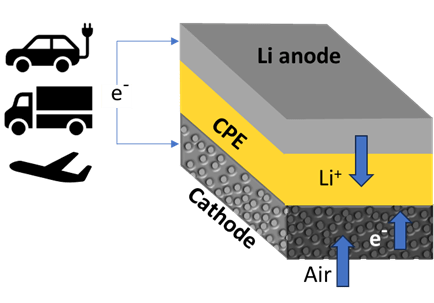
On May 30, 2026, at Beijing's 2026 Equipment Power Nation Forum, CATL chief scientist Wu Kai told the audience that lithium-air chemistry is the company's next long-term battery bet, positioned after sodium-ion (mass production this year) and solid-state (small-batch by 2027) on its technology roadmap. CATL's lab work has already topped 1,000 Wh/kg with 500 charge-discharge cycles, Wu said, according to Battery China's account of the talk. It's the highest-profile claim yet for a chemistry IBM tried and abandoned by 2015, and that the field's own review literature still calls a long way from practical.
The theoretical ceiling, and what CATL actually said
Lithium-air's appeal starts with a real number: chemists put the reaction's theoretical specific energy at roughly 3,458 Wh/kg if the oxygen the battery consumes is counted as part of the cell's mass, or as high as 11,140 Wh/kg if it isn't, since that oxygen is drawn from the surrounding air rather than carried onboard, the same way gasoline's roughly 12,000 to 13,000 Wh/kg figure counts only the fuel and not the air an engine also burns. Both numbers trace to a 2010 review co-authored by IBM Battery 500 Project director Winfried Wilcke in the Journal of Physical Chemistry Letters.
Wu Kai's own claim at the forum was narrower than that ceiling: 1,000 Wh/kg and 500 cycles, achieved in CATL's lab, no paper published. Neither Battery China's account nor a wire report carried on Ifeng and credited to Gasgoo attaches a theoretical figure to Wu's own words; both print 3,500 Wh/kg early in the piece, as general background on the chemistry, well before Wu's quote turns up near the end. The paragraph that actually sits closest to his quote is a different one, crediting Argonne National Laboratory and Illinois Institute of Technology with a separate 1,200 Wh/kg lab sample, the same figure this piece traces below and the one a reader skimming past the first sentence is more likely to blur into Wu's own claim. Huxiu's coverage does the same with 12,000 Wh/kg, comparing it to gasoline in its own follow-up sentence. Neither number matches the 2010 review precisely, 3,500 undershoots the oxygen-included figure and 12,000 overshoots the oxygen-excluded one, and no outlet we checked ties either one to a Wu Kai quote. The only figure that is CATL's own claim is the 1,000 Wh/kg, 500-cycle lab result.
From 93 percent efficient to 700 cycles in real air
IBM's Battery 500 Project, announced in 2009, aimed for a pack that could take an EV roughly 500 miles on a charge; PCWorld reported in 2012 that IBM's own scientists were then predicting a working prototype by 2013 and a commercial battery by 2020. Quartz reported in 2014 that Wilcke had a change of heart, shifting his attention to sodium chemistry, and that the Joint Center for Energy Storage Research concluded the penalty of the battery's gas-phase reactions had overwhelmed any energy density advantage.
Academic labs kept going. That same year, a University of Cambridge team led by Clare Grey published a lithium-oxygen cell in Science that ran at 93 percent round-trip efficiency for more than 2,000 cycles, achieved by adding lithium iodide to the electrolyte and switching the discharge product to lithium hydroxide. Cambridge's own announcement was explicit about the catch: the cell only cycled in pure oxygen, not the nitrogen, moisture, and carbon dioxide of real air, and "a practical lithium-air battery still remains at least a decade away." Eleven years later, that estimate hasn't been beaten.
The next material jump addressed a different problem: getting the battery to run on air instead of a gas cylinder. A team from the University of Illinois Chicago, Illinois Institute of Technology, and Argonne National Laboratory published a design in Nature in 2018 that protected the lithium anode with a lithium carbonate coating, paired it with a molybdenum disulfide cathode, and ran it for 700 cycles in a simulated atmosphere carrying the nitrogen, carbon dioxide, and water vapor a real cell would face (the university's own release rounded that to "750 cycles"; the paper's own figure is 700). Lead researcher Amin Salehi-Khojin's framing left no ambiguity about where the project stood: "we have more work to do in order to commercialize it."
Five years later, the same Argonne-linked group, publishing as Kondori et al. in Science in 2023, reported a cell using a solid ceramic-polymer electrolyte that drove a four-electron reaction to form lithium oxide directly. What the cell demonstrated was 1,000 charge-discharge cycles at room temperature. The 1,200 Wh/kg figure cited constantly in later coverage is not something the cell reached: the Department of Energy's own summary of the work states that "with further development, this lithium-air design could reach a record energy density of 1,200 watt-hours per kilogram," a design target in the researchers' own future-conditional phrasing, not a measured result from the reported cell.
Most recently, a joint Korea Institute of Science and Technology and Institute for Advanced Engineering team published a two-dimensional tungsten diselenide catalyst in Materials Science and Engineering: R that held up for 550 cycles at a 1C charge rate, an improvement in cost and stability over platinum and ruthenium oxide catalysts rather than a jump in energy density. The team's own framing pointed at future work, not a finished battery: next comes "technology transfer and commercialization research."
What the record doesn't show
None of the headline cycle counts above were run in ordinary air. Cambridge's own account of its 2015 result says the cell cycled only in pure oxygen, not the nitrogen, moisture, and carbon dioxide of real air. The 2018 Illinois Tech/Argonne paper's own abstract describes a simulated atmosphere carrying that nitrogen, carbon dioxide, and water vapor, even though the university's own release framed the same result as a "true natural-air environment," a more confident claim than the paper it was describing. The 2023 Kondori result is a single lab cell tested at room temperature, not a number demonstrated at the pack level, and its headline 1,200 Wh/kg figure is a target the design could reach, not something the cell measured. The 2026 catalyst result improves one component's cost and durability, not a cell's air tolerance. CATL's figure is a lab claim relayed through a conference talk, with no paper yet published to check the test conditions against.
CATL's number, and a different one that keeps showing up next to it
CATL's 1,000 Wh/kg and Argonne/Illinois Tech's 1,200 Wh/kg are close enough that they land in the same short writeups of Wu Kai's talk. Battery China's account states Wu's figure, then in a separate sentence credits a sample "jointly developed by Argonne National Laboratory and Illinois Institute of Technology" with 1,200 Wh/kg and more than 1,000 cycles. Huxiu does the same, attributing its 1,200 Wh/kg figure to the same two institutions rather than to CATL. CarNewsChina's English-language coverage cites the DOE/Argonne page for its 1,200 Wh/kg figure too, and does not attribute it to CATL, despite a headline that pairs CATL's name with the chemistry's 12,000 Wh/kg ceiling. Read past the first sentence, every account we checked keeps the two figures straight.
One further account doesn't hold up at all: a DoNews write-up posted two weeks after the forum, on June 15, 2026, carries a disclosure on the page that its content was generated by an AI model rather than reported. It's excluded here as a source for that reason, not cited for any of the figures above.
The startup betting on wearables first
The same Argonne-Illinois Tech lineage has also gone commercial. Larry Curtiss (Argonne) and Mohammad Asadi (Illinois Tech), co-authors on both the 2018 and 2023 papers, founded Air Energy alongside CEO Ben Drake, launching publicly through the University of Chicago's Polsky Center cleantech accelerator in November 2024. The company's own account of its technology claims "approximately three times the energy density and reduces weight by 300 percent" versus lithium-ion, a figure that doesn't parse: reducing anything's weight by more than 100 percent implies negative mass. Its plan called for wearable and small-drone prototypes in 2025 and a five-year path toward electric vehicles, personal electronics, and heavy-duty transport.
In June 2026, Air Energy announced a seed round led by Resolute Venture Partners, describing its technology as "DOE-validated" on the strength of Illinois Institute of Technology's selection as a partner in the Department of Energy's ARPA-E JOULES-1K program, which funds projects chasing 1,000 Wh/kg and 1,000 Wh/L at end of life. Selection for a funding program is not the same as an independent agency confirming a company hit its numbers, and the release names no specific test or dataset behind the "validated" label.
Claim versus record
| Claim | Source | What was actually shown |
|---|---|---|
| Theoretical ceiling, 3,458 to 11,140 Wh/kg depending on whether oxygen mass counts | Girishkumar et al., J. Phys. Chem. Lett., 2010 | A calculated limit; no cell has approached it |
| 500-mile EV pack, prototype targeted for 2013, commercial by 2020 | IBM Battery 500 Project, per 2012 PCWorld reporting | Program wound down by 2015, per Quartz's reporting on JCESR |
| 93% round-trip efficiency, 2,000+ cycles | Liu et al. (Grey group), Science, 2015 | Pure oxygen only; Cambridge's own release called a practical version "at least a decade away" |
| 700 cycles (press release: 750) in air-like atmosphere | Asadi et al., Nature, 2018 | Simulated, not ambient, air; researchers said commercialization work remained |
| 1,000 cycles at room temperature (demonstrated); 1,200 Wh/kg (design target) | Kondori et al., Science, 2023, via DOE summary | DOE's own account: cycles are what the cell achieved, 1,200 Wh/kg is what "further development ... could reach," not a measured result; single-cell figure, not a packaged battery; consistently reported elsewhere as already achieved and misattributed to CATL in secondary coverage of Wu Kai's forum remarks |
| 550 stable cycles at 1C, low-cost catalyst | Jeong, Lee et al. (KIST-IAE), Mater. Sci. Eng. R, 2026 | Catalyst-component improvement; team frames it as pre-commercialization research |
| 1,000 Wh/kg, 500 cycles achieved | Wu Kai / CATL, 2026 forum remarks, via Battery China and a Gasgoo wire report | Lab-stage, no paper published; CATL's only specific figure from the talk |
| 3,500 Wh/kg and 12,000 Wh/kg theoretical, printed alongside CATL coverage | Battery China, Ifeng/Gasgoo, and Huxiu's own background text | Restates the chemistry's known theoretical ceiling; not attributed to Wu Kai in any account checked |
| About 3x energy density, "reduces weight by 300%"; DOE-validated | Air Energy, 2024 launch and 2026 seed round | Company's own figures; "validated" refers to ARPA-E program selection, not an independent result check |
Outlook
The pattern across IBM's 2009 target, Cambridge's 2015 "decade away" caveat, the 2018 and 2023 academic results, and now CATL's and Air Energy's 2026 statements is one of steady technical progress paired with a commercialization horizon that keeps resetting rather than closing. If that pattern holds, the chemistry's most likely near-term home is where Air Energy itself is aiming first: small-format devices like wearables and drones, where lower cycle counts and controlled operating environments sidestep the ambient-air and system-level energy density problems visible across every result in this piece: pure oxygen in 2015, a simulated rather than literal atmosphere in 2018, a single lab cell rather than a pack in 2023. A pack that has to survive years of humid, carbon-dioxide-laden air inside a car is a different engineering problem than one built for a device that gets replaced or recharged in a controlled setting, and nothing in the current published record suggests that harder problem is closer to solved than it was in 2015.
The solid electrolyte at the center of the 2023 Kondori design belongs to the same broader materials shift The Duck Curve has covered from the manufacturing side: Anthro Energy's Kentucky electrolyte plant, though Anthro's polymer targets conventional lithium-ion cells rather than an oxygen-breathing chemistry.
⚠ This Outlook extrapolates from the repeated commercialization-timeline slippage documented in IBM's 2009-2015 Battery 500 history, Cambridge's 2015 'decade away' caveat, and the ambient-air and single-cell-versus-pack gaps documented in the cited 2018 Nature and 2023 Science results, plus Air Energy's own stated near-term target of small-format devices before EVs.
Sources
Primary
- Lithium-Air Battery: Promise and Challenges · Journal of Physical Chemistry Letters (ACS)
- Cycling Li-O2 batteries via LiOH formation and decomposition · Science
- A lithium-oxygen battery with a long cycle life in an air-like atmosphere · Nature
- A room temperature rechargeable Li2O-based lithium-air battery enabled by a solid electrolyte · Science
- Air Energy: Transforming Energy Storage with Solid-State Lithium-Air Batteries · Polsky Center for Entrepreneurship and Innovation, University of Chicago
- KIST-IAE joint research team breaks performance barriers in lithium-air batteries using newly developed two-dimensional catalyst · EurekAlert! (KIST/IAE)
- 3500Wh/kg!不是固态!宁德时代揭秘下一代电池竞争焦点 · 电池网 (Battery China)
- Air Energy Closes Seed Round to Scale DOE-Validated Solid-State Lithium-Air Battery · National Law Review (press release)
- JOULES-1K · ARPA-E, U.S. Department of Energy
Supporting
- IBM Develops a Lithium-Air Battery With a 500-Mile Range for Electric Cars · PCWorld
- Two big labs step back from the most promising next-generation battery · Quartz
- New design points a path to the 'ultimate' battery · University of Cambridge
- New design produces 'true' lithium-air battery · University of Illinois Chicago
- Innovative Lithium-Air Battery Design Poised to Increase Energy Storage · U.S. DOE Office of Science
- 聚焦"十五五"装备工业高质量发展路径 2026装备强国论坛开幕 · 中国工业新闻网 (China Industry News)
- 宁德时代布局锂空气电池:下一代电池技术路线确定,能量密度可媲美汽油 · Huxiu
- CATL sets sights on lithium-air technology with theoretical gasoline-level 12,000 Wh/kg energy density · CarNewsChina
- 3500Wh/kg!不是固态!宁德时代揭秘下一代电池竞争焦点 · 凤凰网 (ifeng.com), wire copy credited to 盖世汽车 (Gasgoo)
- 宁德时代披露锂空气电池进展:能量密度达1000Wh/kg,循环500次 · DoNews
Copies of cited sources are retained where available. If a link no longer resolves, request a copy at contact@theduckcurve.com.