 The Duck Curve
First six Megapacks installed at Hawaiian Electric's 40 MW Waena battery
The utility calls the 40 MW / 160 MWh system its first utility-developed battery; its release expects service in 2027, while HEI's quarterly report for June 30, 2026 lists a guaranteed commercial operation date of November 30, 2026.
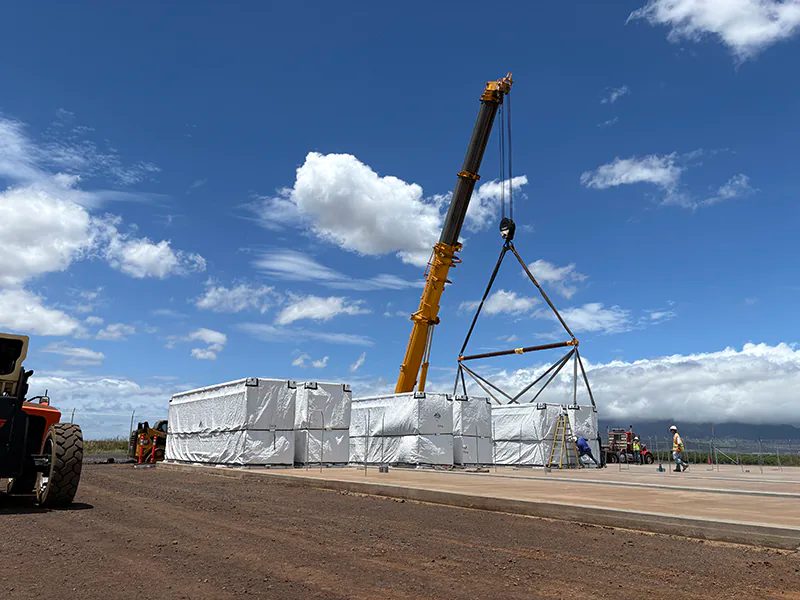
Hawaiian Electric said on September 21, 2026 that the first six Tesla Megapacks of its Waena Battery Energy Storage System have arrived and been installed at the project site along Pulehu Road in Central Maui, according to the utility's release. They are the first of 54 units that will make up a 40 MW / 160 MWh system, which the release says is expected to enter service in 2027 and describes as the island's first standalone load-shifting battery energy storage system and one of the largest in Hawaii.
The release says the batteries were delivered by semi-truck and lifted into place by crane in late August 2026, and that each is roughly the size of a 40-foot shipping container. The two same-day documents schedule different things. The release schedules the arrival of the remaining units, in phases, and gives the timing only as "over the coming months" from its September 21, 2026 dateline. A companion story on the utility's site, also dated September 21, schedules the completion of their installation, by the end of October 2026, after which it says crews will install transformers, control systems and other equipment before the system undergoes testing.
Shelley Takasato, manager of Generation Project Development for Hawaiian Electric, said in the release that the project "has been years in the making" and that seeing the batteries arrive brings the company "one step closer to providing Maui with a more renewable electric grid."
The release says the system will store excess energy and deliver it back to the grid when it is needed most, shifting output from solar and wind toward customer demand at night (the shape of that problem is the duck curve; the utility's development-team page lists the system as four-hour, and the power-versus-energy arithmetic is in kW vs kWh). It will also incorporate grid-forming technology, which the release says can help maintain grid stability as the island uses more variable resources. The companion story explains the term: conventional synchronous plants have historically helped maintain grid frequency and voltage during system disturbances, and grid-forming batteries can fill that role by emulating synchronous machines. It points to the Kapolei Energy Storage facility on Oahu, which it says also uses Tesla Megapacks with grid-forming technology and was developed by an independent power producer, whereas Waena is the company's first utility-developed battery energy storage project.
On Maui's renewable share the two documents frame the same number differently: the release says about 41% of Maui County's electricity comes from renewables as of its September 21, 2026 date, including more than 18,000 customer solar systems, while the story says more than 41% of the electricity generated for Maui County in 2025 came from renewable resources. The release ties the project to the company's plans to use renewable resources to generate 100% of electricity by 2045; the story frames that 2045 target as Hawaii's goal.
Hawaiian Electric's Renewable Project Status Board, last updated July 27, 2026, lists Waena BESS among projects approved by regulators with a 2027 estimated completion, alongside AES's Kuihelani Phase 2 Solar on Maui, 40 MW plus storage, at 2028. Nationally, utility-scale battery storage reached nearly 52 GW of nameplate capacity by the end of June 2026, per EIA data.
Timeline, cost and the plant it replaces
The project began as a utility self-build bid. According to the development-team page, the company submitted its own proposals in response to its August 2019 request for proposals, and two of five were selected on May 11, 2020: Waena on Maui and Keahole on Hawaii Island, the latter withdrawn in 2024. The PUC application was filed on September 8, 2020, opening Docket 2020-0132; the commission issued a Decision & Order for additional information on June 24, 2022, the company responded on August 22, 2022, and the project received final approval on December 22, 2023. A site blessing followed on November 25, 2025, and a December 17, 2025 release said construction would begin in January 2026.
The schedule and the price both moved. Maui Electric's September 2020 application put the total cost at $60.0 million, with construction to start in March 2022, an in-service date of April 2023 and a guaranteed commercial operations date of April 28, 2023, and proposed capping recovery of the project's capital cost at the $60.0 million bid amount. Per HEI's quarterly report for the period ended June 30, 2026, the PUC's December 2023 approval was for funds estimated at $82.1 million, recoverable under the Exceptional Project Recovery Mechanism, and in July 2025 the PUC authorized recovery of costs above the December 2023 amount "due to the uncertainty of changes in law," limited to the lesser of actual costs or 20% over the approved estimated capital costs. The approved estimate is about 37% above the application's figure, and the July 2025 ceiling works out to about $98.5 million; both are our arithmetic on the filed numbers. The report puts costs incurred as of June 30, 2026 at $27.2 million. The same report's table of Stage 2 projects lists the Maui Electric self-build row, 40 MW / 160 MWh, with a guaranteed commercial operation date of November 30, 2026, against the 2027 in-service expectation in the September 21, 2026 release; the filing's footnote that "project delays have resulted in guaranteed commercial operations date being missed" is attached to two purchase-agreement dates in that table and not to the self-build row.
The December 2025 release says the Waena BESS will enable the planned retirement of four generating units at the company's Kahului Power Plant, steam units it describes, as of December 17, 2025, as providing power and system stability on the island's transmission system, and that the battery will tie into the Waena Switchyard. It adds that, as of its December 17, 2025 date, four contracts for variable and firm renewable energy and associated battery projects on Maui had been approved by the PUC and were in various stages of negotiation with the company.
The switchyard came first. Per HEI's annual report for 2024, the PUC approved the Waena Switchyard and synchronous condenser project in November 2021 at an estimated $38.8 million, the switchyard was placed in service on October 25, 2023, and Maui Electric received a one-year extension from the State of Hawaii Department of Health to the mandatory retirement of Kahului Power Plant, so that "there is now flexibility to operate the units until the end of 2028." The conversion of two Kahului units to synchronous condensers, the report says, will be performed after the retirement of Units 3 and 4.
Sources
Primary
- Waena battery storage project hits key milestone, will strengthen Maui grid and support renewables · Hawaiian Electric
Supporting
- Application of Maui Electric Company, Ltd. for Approval to Commit Funds in Excess of $2,500,000 for the Purchase and Installation of Item MZ.005002, Waena Battery Energy Storage System Project, and to Recover Costs through the Major Project Interim Recovery Adjustment Mechanism (Docket 2020-0132) · Maui Electric Company / Hawaii Public Utilities Commission (copy hosted by Hawaiian Electric)
- Hawaiian Electric Industries, Inc. Form 10-K for the fiscal year ended December 31, 2024 · Hawaiian Electric Industries / SEC EDGAR
- Hawaiian Electric to begin construction of first standalone load-shifting battery energy storage system on Maui · Hawaiian Electric
- Hawaiian Electric Industries, Inc. Form 10-Q for the quarterly period ended June 30, 2026 · Hawaiian Electric Industries / SEC EDGAR
- Waena Battery Project: First Tesla Megapacks arrive, bringing Maui closer to a more renewable grid · Hawaiian Electric (Powering Hawaii's Future)
- Development Team Projects · Hawaiian Electric
- Renewable Project Status Board · Hawaiian Electric
Copies of every cited source are retained. If a link no longer resolves, request a copy at contact@theduckcurve.com.