 The Duck Curve
EU BEV share hits 22.7% year to date; ABS AiP for a 151 MWh boxship
SWITCH Maritime has a Coast Guard design basis for a 150-passenger hydrogen ferry, and Dunsky has convened a Canadian alliance to take vehicle-grid integration past pilots.
EU battery-electric share reaches 22.7% for the year
Battery-electric cars took 22.7% of new EU car registrations in the first nine months of 2026, up from 16.1% a year earlier, ACEA reported on October 22. That is 1,931,465 cars, in a total market that grew 5.7%. Hybrids (full and mild) remain the most popular powertrain at 36.3%, plug-in hybrids took 10.1%, and petrol and diesel together fell to 28.2% from 36.9%.
September ran ahead of the year. The release's tables put the year's battery-electric total 48.5% above January-September 2025, and show 290,117 battery-electric registrations for September alone, up 72.9%, in a market that grew 9.3% to 971,048 cars. By our arithmetic that is just under 30% of the month's registrations. Benchmark Mineral Intelligence had already called September Europe's strongest EV month on record.
The country table holds one surprise. ACEA says three of the four largest EU battery-electric markets grew strongly, France (+79.1%), Germany (+58.1%) and Denmark (+40.3%), with Belgium up a more moderate 15.7%. Denmark is the fourth: its 124,049 battery-electric registrations for the year beat Italy's 101,716 and Spain's 100,508.
Hanwha Power's 151 MWh containership design gets ABS approval in principle
Hanwha Power has received approval in principle (AiP) from the American Bureau of Shipping for a 1,700 TEU battery-powered containership design, the company said on October 22, at a certificate ceremony at the MHE conference in Bergen, Norway. Containerized battery units holding about 151 MWh of energy are the vessel's primary propulsion source, charged from port infrastructure, and can be handled and stowed like cargo containers. Hanwha pitches the design at short-sea and regional container transport, and says it has also completed the basic design of a 1,000 TEU battery-powered vessel.
An AiP is an early step on paper, not a ship. Under ABS's rules for novel concepts, it is a statement that a concept design complies with the intent of ABS rules or appropriate codes even though the design may not yet be fully evolved, subject to conditions to be addressed in final design. It is the second of four milestones on the way to class approval, and ABS issues it with an approval road map of the conditions the client should satisfy to reach final class approval. The release names no buyer or shipyard.
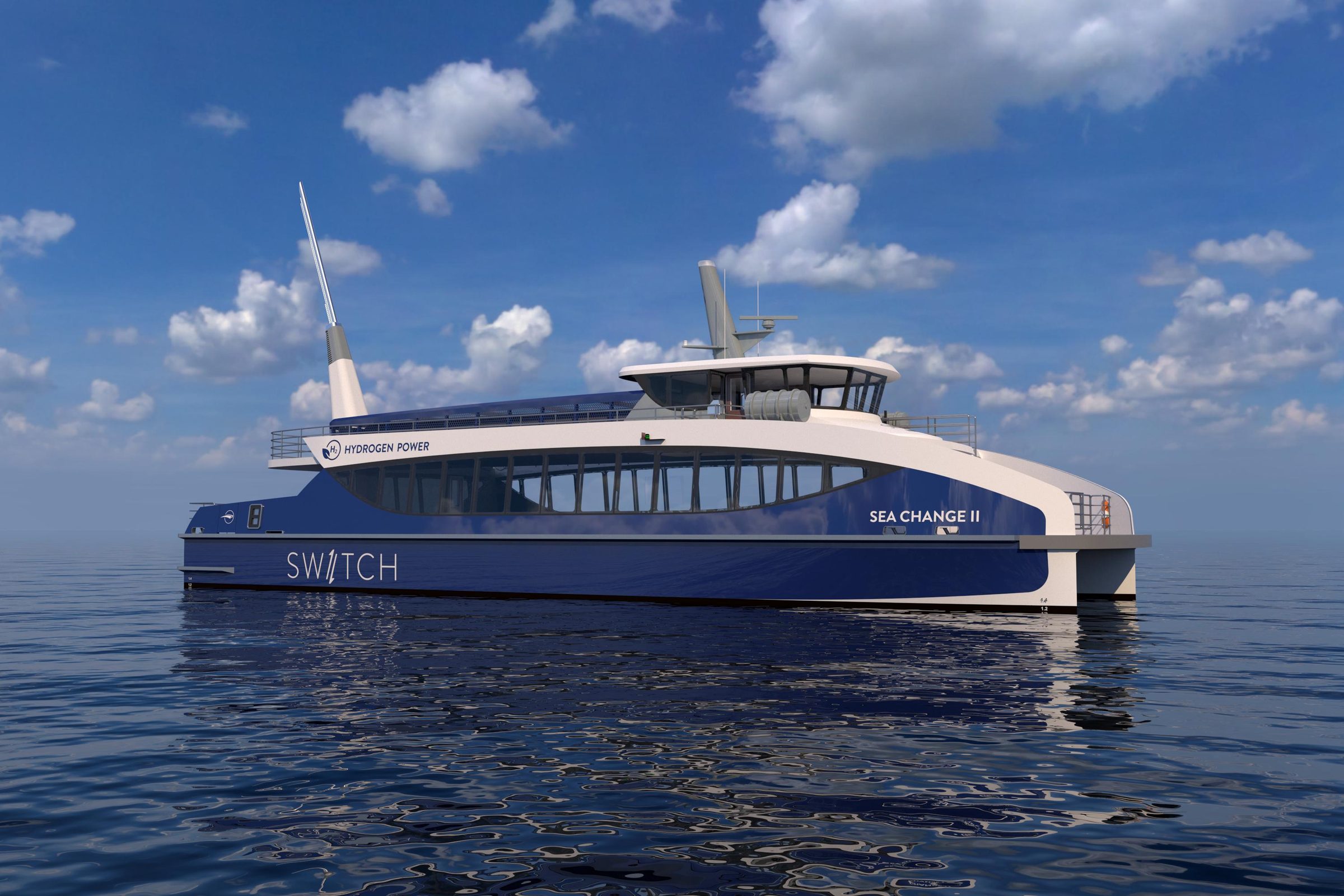
SWITCH Maritime gets a Coast Guard design basis for a hydrogen ferry
SWITCH Maritime has signed a design basis agreement with the US Coast Guard for the SWITCH-150, a 150-passenger hydrogen fuel cell-electric ferry, the company announced on October 21. Subchapter T, the Coast Guard's rules for passenger vessels carrying 150 or fewer, includes no guidance or regulation specifically tailored to hydrogen fuel cell propulsion and hydrogen storage, so Switch and the Coast Guard built a framework demonstrating sufficient equivalency in safety and risk mitigation. Switch says the International Maritime Organization's interim hydrogen guidelines, approved in May 2026, served as a foundation. The first SWITCH-150 is intended to operate in New York City from the Brooklyn Navy Yard, with development backed by a $2 million NYSERDA grant.
Switch pitches the ferry against battery-electric boats: it needs only mobile hydrogen refueling equipment and no investment in shoreside charging infrastructure or power grid upgrades. Port charging is exactly what Hanwha's containership is built around. In Switch's telling, the agreement gives the company and the Coast Guard a defined framework to inform construction, commissioning and operation. Switch's first vessel, the Sea Change, got its design basis agreement in 2020 and its Certificate of Inspection, which cleared it for commercial operation, in 2024.
Hydrogen's other maritime route, as ammonia, passed its own marker on October 13, when Energy China bunkered 1,000 tonnes of green ammonia ship to ship at Zhoushan.
Dunsky convenes a Canadian alliance to take vehicle-grid integration past pilots
Dunsky Energy + Climate Advisors launched the Canadian Vehicle-Grid Integration Alliance on October 20, the Montréal consultancy announced, to align the standards, investment pathways and deployment practices needed to scale vehicle-grid integration (VGI) across Canada and move it from isolated pilots toward scalable, investable utility offerings. Initial partners and strategic collaborators include BC Hydro, Manitoba Hydro, Alectra, the governments of Canada and Nova Scotia, Electric Mobility Canada and the Vehicle-Grid Integration Council, with General Motors Canada supporting. Electric Autonomy lists BC Hydro, Manitoba Hydro, Alectra and Nova Scotia's government among the funding partners.
As Electric Autonomy explains, VGI covers managed charging, which lets utilities control when EVs draw power, and bidirectional charging, which lets a parked EV send electricity back. Working sessions start in fall 2026 on three areas: market alignment, standards and interoperability; investment and regulatory pathways; and coordinated deployment and customer experience. The release also promised a VGI Knowledge Centre for the fall, developed in a project led by Electric Mobility Canada; it is already up on the alliance's website.
Canada is starting from behind. Electric Autonomy, relaying Dunsky managing consultant Mabel Fulford, reports large pilots under way in the UK, Europe, Australia and the US, while Canada is "only at the very beginning" of seeing the technology reach the market. Elsewhere the pilots keep coming: Australia's ARENA is funding a V2G trial of up to 130 ACT Government EVs.
Sources
Primary
- Dunsky Convenes Canadian VGI Alliance to Scale Vehicle-Grid Integration Across Canada · Dunsky Energy + Climate Advisors
- SWITCH Maritime Receives Design Basis Agreement from US Coast Guard for 150-Passenger Hydrogen Fuel Cell-Electric Ferry · SWITCH Maritime (Business Wire)
- New car registrations: +5.7% in September 2026 year-to-date; battery-electric 22.7% market share · ACEA (European Automobile Manufacturers' Association)
- Hanwha Power Receives ABS Approval in Principle for 1,700 TEU Battery-Powered Containership Design · Hanwha Power (PR Newswire)
Supporting
- ABS Rules for Alternative Arrangements, Novel Concepts and New Technologies (Part 1D), 2024 · American Bureau of Shipping
- Dunsky spearheads national alliance for vehicle-grid integration · Electric Autonomy Canada
- Press release car registrations September 2026 (PDF with tables) · ACEA
- Canadian VGI Alliance | Vehicle-Grid Integration in Canada · Canadian Vehicle-Grid Integration Alliance
Copies of cited sources are retained where available. If a link no longer resolves, request a copy at contact@theduckcurve.com.