 The Duck Curve
VW's Elli prices its V2G charger at €1,995, pays €0.24 per plugged-in hour
Elli's German V2G offer for Volkswagen, CUPRA and Škoda drivers starts in December 2026 with a plug-in bonus matching BMW and E.ON's to the cent; paid feed-in at €0.40 per kWh is expected later.
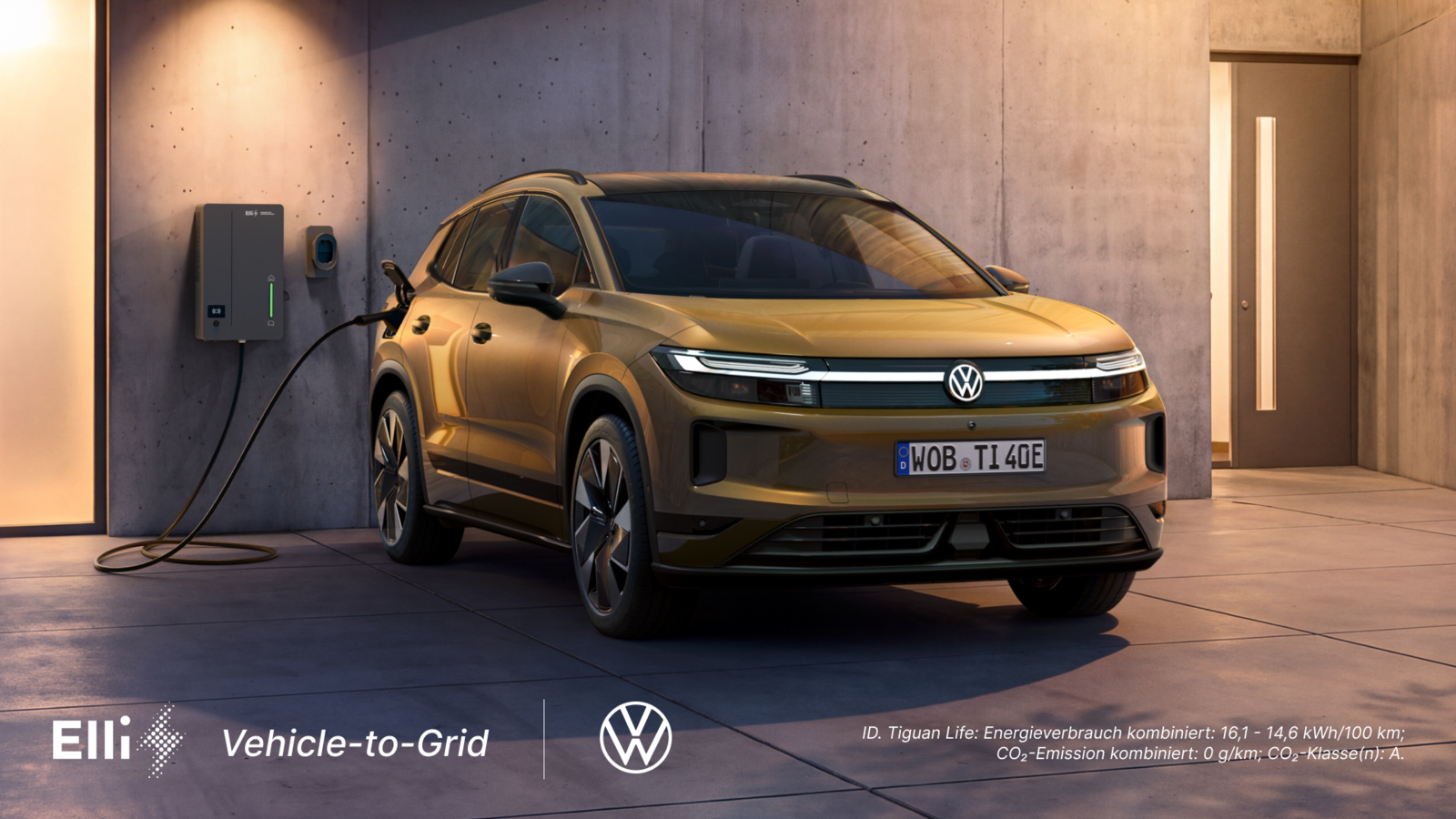
Volkswagen Group's charging subsidiary Elli will start selling vehicle-to-grid (V2G) charging in Germany in December 2026, with a bidirectional DC charger priced at €1,995 including VAT and shipping and a bonus of €0.24 for every hour a car sits plugged into it, Volkswagen announced on November 24, 2026. The offer covers Volkswagen, CUPRA and Škoda customers, with Volkswagen Commercial Vehicles included under separate ordering procedures, and The Mobility House Energy as technology partner. Further European markets are planned to follow in 2027.
Volkswagen calls it Germany's first V2G offering. Two German rivals got there earlier: BMW and E.ON announced what they called Germany's first commercial V2G service in September 2025 and began taking iX3 orders in February 2026, and Mercedes-Benz opened home V2G in Germany on October 12, 2026. The release's headline claims something narrower: the first V2G charging solution "for the mass market".
Paid by the hour, for now
The pay is for being plugged in. Customers receive €0.24 for each hour the car is connected to the DC charger, Elli says; at 250 hours a month that comes to up to €60 a month, or €720 in the first contract year. Each session must last at least three hours to qualify. By our arithmetic, 250 hours is a little over eight hours a day across a 30-day month.
Exporting energy is the part still to come. Customers "are also expected to have the option of feeding electricity back into the grid and receiving compensation of €0.40 per kilowatt-hour," and there is no guaranteed minimum amount of energy fed back. Two Volkswagen Naturstrom tariffs with 12-month terms carry the deal: V2G Flow for household consumption and vehicle charging, and V2G Return for compensation on power discharged from the car. An app takes the time the car is next needed and the charge level wanted then, and schedules charging and feeding back within those limits.
The €720 is also the figure Volkswagen sells the package on. The bonus can offset electricity costs equivalent to up to 15,500 kilometres of driving, the company says, a number its footnote calls a non-binding estimate from an illustrative calculation: €720 at an average €0.33/kWh buys about 2,182 kWh, which would cover up to 15,500 kilometres at the WLTP consumption of an ID.3 Neo Trend. That bonus is promised for the first contract year; the release does not say what it pays after that.
The charger is a compact DC unit delivering up to 11 kW (power, not energy; see kW vs kWh) for indoor or outdoor mounting, supporting 400- and 800-volt cars and the ISO 15118-20 communication standard. Installation is quoted separately. From launch, customers run a digital pre-check, receive an individual quote from an installation partner Elli arranges, and only then can order the charger. A compatible smart meter is required, and Elli advises arranging one early, through the local metering operator or its partner inexogy, because installation can take time. Elli is already testing the system in selected households.
A familiar price list
The bonus matches BMW and E.ON's to the cent. Their V2G offer, extended on November 18, 2026 from the iX3 to the new i3, iX4 and iX5 (our coverage), pays 24 cents for every hour the car is connected with V2G activated, up to 250 hours a month, which comes to 60 euros a month and 720 euros a year. BMW and E.ON pay 42 cents for every kilowatt-hour fed back, two cents more than the rate Elli expects to offer.
The charger price and the partner echo Mercedes-Benz. Its launch offer with The Mobility House Energy sells the first 500 German customers a bidirectional 11 kW DC wallbox from The Mobility House for €1,990 instead of €2,990, until the end of March 2027, and pays for every connected hour with no daily, monthly or annual cap. Elli's uniform €1,995 sits five euros above Mercedes's introductory price and €995 below its regular one. For Elli, The Mobility House Energy provides bidirectional charging hardware and pools the cars' available battery capacity for the energy market on its FlexEngine platform, the aggregator role at the heart of a virtual power plant.
Volkswagen's case for scale is the cars already on the road: over one million MEB-based vehicles in Europe are technically prepared for bidirectional charging, about 360,000 of them in Germany, it says. Whether a given car can take part depends on its compatibility and the functions approved for it.
The rules have been moving too. Germany's grid regulator adopted rules on October 1, 2026 that let bidirectional charge points store grid power alongside solar, under conditions, which bears on any of these chargers installed behind an EEG-supported rooftop array.
Running the house off the car comes later. Elli's 12-month vehicle-to-home pilot with 20 German households logged about 85,000 hours of combined charger online time and more than 6,500 bidirectional charging and discharging sessions, and Elli plans a standalone vehicle-to-home product in 2027. "We are starting in Germany, with Vehicle-to-Home and further European markets to follow," Elli CEO Giovanni Palazzo said at the V2G Leaders Europe conference in Brussels.
Sources
Primary
- Launch of the first Vehicle-to-Grid charging solution for the mass market · Volkswagen Group (Elli)
Supporting
- Mit dem Elektrofahrzeug zu Hause Geld verdienen: Mercedes-Benz startet bidirektionales Laden in Deutschland · Mercedes-Benz Group (Mercedes-Benz Media)
- Bidirectional charging for new BMW models: E.ON and the BMW Group are expanding their Vehicle-to-Grid (V2G) offering · BMW Group (Newsroom)
Copies of cited sources are retained where available. If a link no longer resolves, request a copy at contact@theduckcurve.com.