 The Duck Curve
bp and Iberdrola start 25 MW green hydrogen plant at Castellón refinery
The partners call it Spain's largest operating green hydrogen plant; Iberdrola's power contract is now 170 GWh a year, down from 200 GWh at the 2024 investment decision, with output still put at about 2,800 tonnes a year.
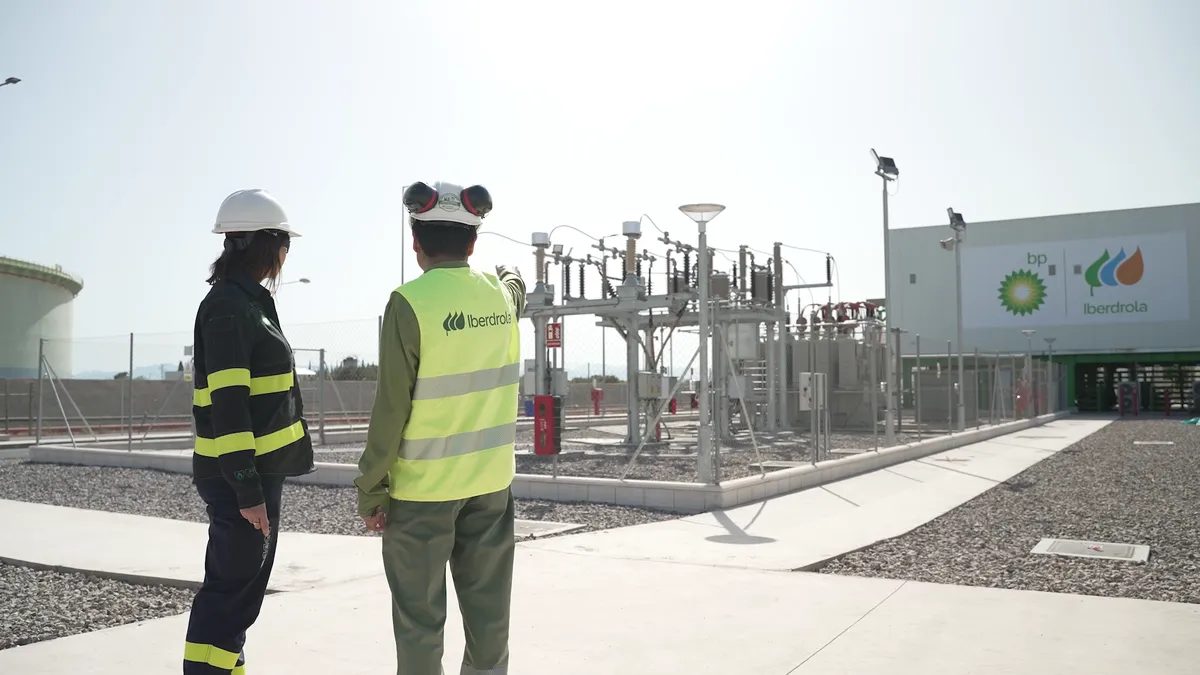
bp and Iberdrola have started operations at their 25 MW green hydrogen plant at bp's Castellón refinery in Spain, bp announced on November 27, 2026. The plant, developed by the 50/50 joint venture Castellón Green Hydrogen S.L. and operated by bp, is expected to produce around 2,800 tonnes of green hydrogen a year. The partners call it the largest green hydrogen plant operating in Spain. Iberdrola supplies it with 170 GWh a year of renewable electricity from its Spanish wind and solar farms under a power purchase agreement.
The customer is the refinery itself. Hydrogen is part of the refining process at Castellón, and bp says replacing some of the refinery's grey hydrogen with green hydrogen is expected to avoid around 23,000 tonnes of CO2 a year and help lower the refinery's carbon costs. The refinery processes around 110,000 barrels of crude a day. Two of the three sentences in bp's launch quote are about its refineries and the fuels they make. Brenda Stout, bp's senior vice president for refining, terminals and pipelines, said the refineries are "helping to meet customer demand for jet fuel, diesel and gasoline," and that "the start-up of the green hydrogen plant with our partner Iberdrola further improves the competitiveness of our Castellón refinery, as we continue to deliver for our customers and shareholders."
Iberdrola España's release the same day carries the same figures and a different bp voice: Olvido Moraleda, president of bp España, who said, "We are proud of the role we play in energy security through our Castellón refinery, supplying the energy customers need." Iberdrola España's chief executive, Mario Ruiz-Tagle, said the project shows how electrification with renewable energy can make industry more competitive while cutting emissions from processes such as refining.
Less power for the same hydrogen
The electricity contract is smaller than the one announced with the investment decision. When the partners publicly marked that decision on September 12, 2024, after signing it in July 2024, they said the Iberdrola PPA would supply 200 GWh a year from Iberdrola's photovoltaic and wind projects. Both November 27 releases put it at 170 GWh. The output estimate has not moved: the 2024 release also expected around 2,800 tonnes a year, and roughly the same 23,000 tonnes of avoided CO2. Neither November release explains the lower power figure.
The gap is about 1,200 hours of running time. By our arithmetic, 170 GWh of energy would run the plant at its 25 MW of power for about 6,800 hours, roughly 78% of the hours in a year; the 200 GWh contract came to about 8,000 hours, or about 91%.
The schedule held. In 2024 the partners expected the plant to be operational in the second half of 2026. That release also said the electrolyser would be five containerized 5 MW proton exchange membrane (PEM) modules supplied by Plug Power, and that the hydrogen would comply with European requirements for renewable fuels of non-biological origin.
The bigger plan has the bigger grant
The 25 MW plant received €15 million from Spain's incentive programmes for the renewable hydrogen value chain, managed by the energy agency IDAE and funded by NextGenerationEU under the country's Recovery, Transformation and Resilience Plan. The next stage has more money attached and is still being explored. On June 25, 2026, as construction finished and commissioning tests began, Iberdrola España said the ecological transition ministry, through IDAE, had approved the reallocation of up to €211 million in IPCEI (Important Project of Common European Interest) Hy2USE funding to Castellón. With that support, the release said, the partners "are continuing to explore opportunities to increase green hydrogen production at the Castellón refinery." By our arithmetic, the ceiling is about 14 times the grant for the plant that now runs.
bp now describes the plant as a capital decision rather than a first phase. Its notes to editors call the project an example of "bp's disciplined approach to deploying capital, investing where there is a strong business case while continuing to deliver for customers and shareholders." In 2024 the 25 MW plant was the "initial" project: bp "continues to assess opportunities to increase capacity in the coming years," that release said, and later phases could supply hydrogen to the Valencia region's ceramics and chemical industries and to heavy transport. Neither November 27 release mentions the expansion.
Small, and running
Castellón is small next to Repsol's approved Spanish electrolysers. Repsol approved a 150 MW unit at Tarragona on November 12, 2026, which it says will be able to produce more than 22,000 tonnes a year, after 100 MW units at Cartagena and the Petronor refinery near Bilbao, both due in 2029. Castellón's advantage is the tense. A German plant of similar size, the 30 MW electrolyser at Bad Lauchstädt, announced its first hydrogen on November 10, 2026; industrial use at TotalEnergies' Leuna refinery is planned from 2027.
Grant approvals do not always become plants. In the Netherlands, four of the seven electrolyser projects subsidised in 2022 have stopped. Castellón now has one of each: a 25 MW plant that runs, and up to €211 million toward producing more, which the partners are still exploring.
Sources
Primary
Supporting
- bp and Iberdrola announce final investment decision for largest green hydrogen plant in Spain · bp
- IPCEI funding supports Iberdrola España and bp's exploration of additional green hydrogen production at Castellón refinery · Iberdrola España
- Iberdrola España and bp begin operations at their green hydrogen plant at the Castellón refinery · Iberdrola España
Copies of cited sources are retained where available. If a link no longer resolves, request a copy at contact@theduckcurve.com.