 The Duck Curve
Interior asks court to remand US Wind permit but leave it in force
After seeking vacatur in September 2025, federal lawyers now want the Maryland offshore wind approval sent back for an OCSLA re-evaluation while it stays in effect, citing impacts BOEM found before approving it.
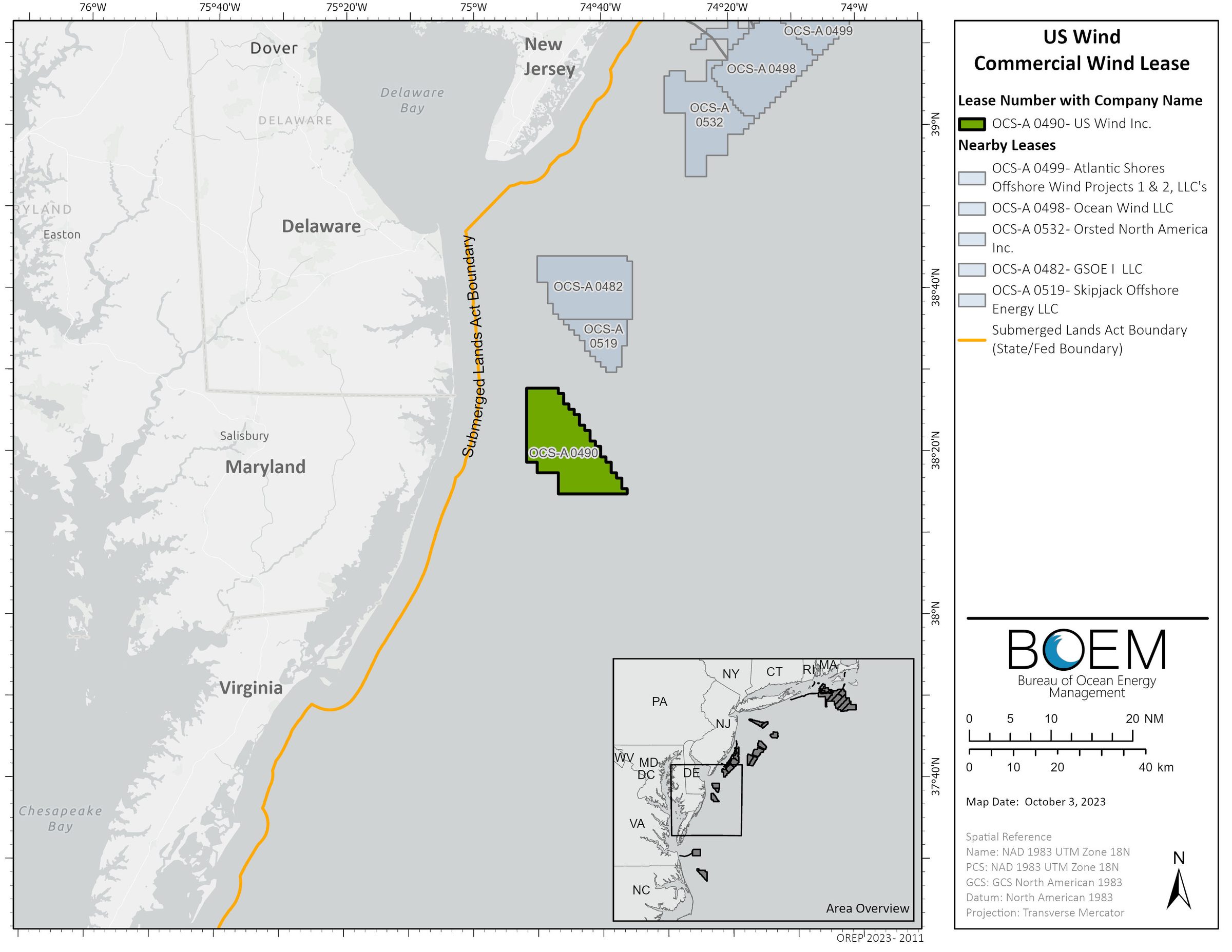
The Interior Department told a federal judge in Baltimore on October 13, 2026 that its December 2024 approval of US Wind's construction and operations plan for the Maryland Offshore Wind Project "warrants re-evaluation," and asked her to send that approval back to the agency without vacatur, so the approval would stay in force while Interior weighs it again. The government's brief, filed in Mayor and City Council of Ocean City v. U.S. Department of the Interior (No. 1:24-cv-03111, D. Md.) before U.S. District Judge Stephanie A. Gallagher, covers a plan of up to 114 turbines that BOEM's project page says could generate up to 2,200 MW, about 10 nautical miles off Ocean City.
The government wants the case narrowed along with the remand. It asks Gallagher to send the approval back for a fresh look under the Outer Continental Shelf Lands Act, skip the plaintiffs' environmental review and historic preservation claims against that approval, and rule for the National Marine Fisheries Service on the whale claims. The request comes in a combined memorandum answering the summary judgment motion from Ocean City and its co-plaintiffs and supporting the government's own cross-motion.
A softer version of the 2025 request
This is the government's second try at the same exit, and the gentler one. On September 12, 2025, the same federal defendants moved to remand the approval with vacatur and to dismiss the case as moot, offering remand without vacatur and a stay only as the fallback. Gallagher denied that motion without prejudice, concluding she needed the administrative record to decide whether remand or vacatur was appropriate, while leaving BOEM free to review the approval internally, as she recounted in a December 15, 2025 opinion. The fallback is now the main request.
The reasons have shifted too. The 2025 motion said BOEM had underestimated impacts on search and rescue operations and that impacts on commercial fisheries might not be sufficiently mitigated. The new brief leans on BOEM's own 2024 compliance review, which found its preferred alternative was expected to have "major [adverse] impacts," including on the North Atlantic right whale, "scenic and visual resources, some commercial fisheries, and scientific research," and approved the plan anyway. Interior now says the decision documents "do not adequately explain" how the project's potential moderate-to-major adverse impacts on other uses of the ocean square with the statute's twelve criteria. The brief's case for a do-over leans on findings the agency wrote down before it said yes.
The whale shows up on both sides of the same brief. As a reason to reconsider BOEM's approval, it is one of the major impacts. As a defense of the Fisheries Service, the brief calls the plaintiffs' right-whale strategy argument "blatantly inaccurate" and stands by the biological opinion's conclusion that the project is not likely to jeopardize the continued existence of listed whales.
The agency that would take the remand has also changed. The brief says Interior recombined BOEM and the Bureau of Safety and Environmental Enforcement into a new Marine Minerals Administration on July 10, 2026, and uses the two names interchangeably. It also says Ocean City has four claims left against the federal defendants, then lists five.
Still in force, for now
The permit's remaining defender is its holder. US Wind filed its own cross-motion for summary judgment the same day, arguing that the administrative record "demonstrates that the challenged agency actions complied with all applicable statutory requirements"; its supporting memorandum was filed under seal. The company said on October 16 that it is "confident that a court will uphold" the validity of its permits, according to Maryland Matters, while the Town of Ocean City welcomed "this acknowledgment," saying "Ocean City has raised these concerns from the start."
US Wind tried to get ahead of this and lost. Its motion for a preliminary injunction against what it saw as a decision to revoke the approval was denied in that December 2025 opinion, which held that no final agency action existed yet: the approved plan "remains in effect," and US Wind had paused its Facility Design Report as a business choice. "No law would impose civil or criminal liability on US Wind if it continued to develop the project," Gallagher wrote, and the company must wait until BOEM "makes some decision that has some legal consequence." The court later dismissed US Wind's crossclaims against the federal defendants, the new brief notes.
Maryland is not the only East Coast project in this posture. The brief cites two District of Columbia rulings, Save Long Beach Island v. U.S. Department of Commerce (August 10, 2026) and Town and County of Nantucket v. Burgum (November 4, 2025), as courts granting voluntary remand of offshore wind plan approvals "to address similar concerns." The administration's other tool, reimbursing developers who give up their leases, is being fought in California, where the state has sued Interior over the Golden State Wind buyout.
Outlook
Under the scheduling order, Ocean City's combined reply and opposition is due December 4, 2026, and the defending parties' replies are due December 25, 2026, which puts the last brief on Christmas Day. If Gallagher grants remand without vacatur, the approval would stay in force during the review, and by the reasoning of her December 2025 opinion US Wind could challenge the outcome only once the agency issues a decision with legal consequence, such as a formal revocation. The 2025 declaration said a new decision after remand could approve, disapprove, or approve with conditions; the new brief does not say which Interior expects.
⚠ The Outlook extrapolates from the court's September 17, 2026 scheduling order, Judge Gallagher's December 15, 2025 opinion on final agency action, and the 2025 Suess declaration as quoted in that opinion.
Sources
Primary
- Federal Defendants' Combined Memorandum in Response to Plaintiffs' Motion for Summary Judgment and in Support of Cross-Motion for Summary Judgment, Mayor and City Council of Ocean City v. U.S. Department of the Interior, No. 1:24-cv-03111 (D. Md.), ECF 164-1 · U.S. District Court for the District of Maryland (via CourtListener RECAP)
Supporting
- Federal Defendants' Motion and Memorandum in Support of Voluntary Remand with Vacatur and to Dismiss, ECF 81 (D. Md. 1:24-cv-03111) · U.S. District Court for the District of Maryland (via CourtListener RECAP)
- Memorandum Opinion denying US Wind's motion for preliminary injunction, ECF 127 (D. Md. Dec. 15, 2025) · U.S. District Court for the District of Maryland (via CourtListener RECAP)
- Order Granting Federal Defendants' Unopposed Motion for Extension of Time, ECF 158 (D. Md. Sept. 17, 2026) · U.S. District Court for the District of Maryland (via CourtListener RECAP)
- Notice of Filing of Document Under Seal (US Wind's Memorandum in Support of its Cross-Motion for Summary Judgment), ECF 161-1 · U.S. District Court for the District of Maryland (via CourtListener RECAP)
- Defendant-Intervenor US Wind's Cross-Motion for Summary Judgment, ECF 161 (D. Md. Oct. 13, 2026) · U.S. District Court for the District of Maryland (via CourtListener RECAP)
- Trump administration asks to reconsider Ocean City offshore wind permit · Maryland Matters
- Maryland Offshore Wind Project · Bureau of Ocean Energy Management
Copies of cited sources are retained where available. If a link no longer resolves, request a copy at contact@theduckcurve.com.