 The Duck Curve
Holtec plans to move tilted Palisades fuel assembly in a drained canister
Holtec asked the NRC to approve the one-time move by October 2; staff proposed a no-significant-hazards finding, took comments through October 8, and pressed Holtec on how the canister lid would handle the bowed assembly.
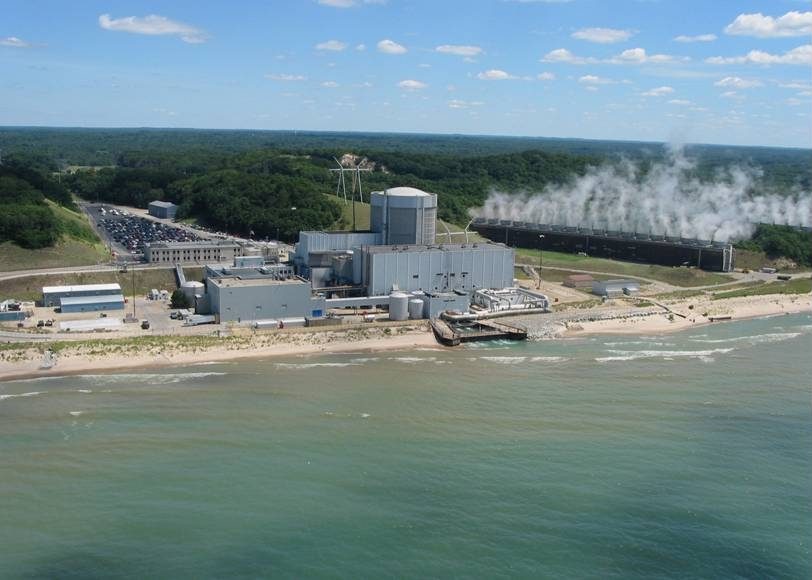
Holtec's Palisades Energy has asked the Nuclear Regulatory Commission for a one-time license amendment to lift a tilted fuel assembly out of the Palisades reactor in Covert, Michigan, and carry it in a drained canister through the containment equipment hatch to the spent fuel pool. The emergency license amendment request, dated September 30, 2026, asked for approval by October 2. The NRC staff has instead made a proposed finding that the change involves no significant hazards consideration, took public comment through 4:15 p.m. Eastern on October 8, and received Holtec's answers to a second round of staff questions the same day. As of October 10, the Palisades docket showed no issued amendment.
The assembly, designated DD41, went into core location H-1 during the core reload that began on August 30, 2026, and "tilted over after being released by the refueling machine," per the request. It now leans at about 30 degrees, its lower tie plate still in H-1 and its upper tie plate resting against the core shroud on the opposite side of the core. Holtec says the fuel rods kept their integrity, no other assembly in the core was affected, and DD41 is stable under continuous camera surveillance. The NRC's Palisades page says the agency "has verified that the fuel rods in the tilted assembly remain intact and safe while the review continues." The problem is the top of the assembly: damage to DD41's upper tie plate prevents the refueling machine from grappling it, which closes the normal route out through a tilt machine and an underwater transfer tube.
Holtec Manufacturing built two pieces of equipment for the job. A fuel movement device with 12 lift arms clamps around the assembly and hangs from the containment polar crane with two chain falls; that lift stays underwater, with at least 10 feet of water over the fuel, and ends with DD41 in a fuel transfer canister on the reactor cavity floor. The canister is then lifted out of the water, drained, rolled through the equipment hatch on the containment trolley, and set by the fuel pool building crane in the pool's cask laydown area. That middle leg is why a license amendment is needed. The plant's safety analysis describes fuel as handled underwater at all times and credits the water for shielding, cooling and retaining released iodine. For this one move, the canister supplies the shielding, a time limit bounds the heat-up, and the accident analysis takes no credit for iodine retention: it assumes a dropped canister damages every rod in the assembly and that all their gap activity mixes instantly into the containment air.
The request sets the numbers. Total time with the fuel exposed to air, from lifting the canister out of the water to placing it in the pool, may not exceed 133 hours, and calculated cladding temperatures stay at or below 517°F against a 752°F acceptance criterion. For a postulated drop on those assumptions, the analysis puts the total control room dose at about 3.04 rem against a 5 rem limit. Holtec's shielding calculation estimates about 110 mrem per hour on contact with the side of the canister, about 60 mrem per hour a foot from the side, and less than 500 mrem per hour on contact at either end.
What the NRC asked
The staff put its first questions to Holtec on a conference call on October 1, and Holtec's written answers of October 2 fill in the sequence. The recovery procedure requires every fuel assembly in the vessel west of DD41 to be removed first, so loaded fuel comes back out before the tilted assembly can. In the pool building, the canister's path takes it over the North Tilt Pit, "where spent fuel is currently stored."
One answer contradicts the request's own description of its analysis. The September 30 filing says the shielding calculation evaluated two conditions, normal handling and an accidental canister drop "that assumes a complete loss of neutron and gamma shielding." The staff noted that the dose evaluation's executive summary expects dose rates around a dropped canister to be "essentially the same as for normal conditions" and asked whether that analysis was done. Holtec said a draft analysis was performed, but that after its canister drop analysis came back, "a complete loss of shielding was deemed not credible and subsequently removed from the radiological consequences analyses prior to review and approval." The filing, in other words, describes an analysis case the final analysis no longer contains.
A second round arrived by email on October 7. "NRC staff understands that fuel assembly DD41 exhibits significant bowing," one question read; the staff added that the canister drawings did not appear to accommodate that much bow and that closing the lid could force the assembly straighter and further damage it or its rods. Holtec answered on October 8 that cameras will check the deformation before the lid is lowered and that, based on a review by its fuel vendor, "the assembly is expected to straighten out without risk of fuel cladding failure inside the FTC," though grid cells may distort. Water sampling and radiation measurements follow the lid, with stop-work criteria for adverse conditions.
Emergency, exigent and the schedule
The NRC's handling opened a public comment window before any approval, one the emergency track Holtec asked for would have skipped. Holtec filed under the emergency provision of 10 CFR 50.91(a)(5), which lets the NRC issue an amendment involving no significant hazards consideration without prior notice, hearing opportunity or public comment, inviting them only after issuance, when failure to act in a timely way would, among other things, prevent resumption of operation. Its stated reason: delay "would result in a delay in the resumption of activities necessary to reach the plant conditions required to restore the plant to power operation."
The NRC's public notice, posted October 6 in the Grand Rapids Press public notices on MLive, calls it an application "for an exigent license amendment," a different category under the same rule, and one that keeps the public in the loop before issuance: the NRC may skip the Federal Register and use local media, but must give a reasonable opportunity to comment. Per the notice, if the no-significant-hazards finding becomes final the staff will issue the amendment without first offering a hearing, and an opportunity for a hearing will be published in the Federal Register later without delaying the amendment's effect.
Opponents used that window. In an October 8 letter, Terry Lodge, counsel for Don't Waste Michigan and Michigan Safe Energy Future, wrote that retrieving DD41 "is obligatory" but urged the NRC not to approve the amendment on an expedited basis without a thorough, independent safety review and full public scrutiny, called Holtec's urgency "purely economic," and argued the request belongs on the normal 30-day comment track.
None of Holtec's three filings says when the lift will happen or when fuel loading, which Holtec said on September 21 remained paused (covered here on September 25), will restart. The restart has a date of its own to meet: a contract to supply power by March 2027, as Nuclear Newswire reported when loading began.
Sources
Primary
- Palisades Nuclear Plant - Emergency License Amendment Request: One-Time-Use Amendment to Allow Alternative Fuel Handling Method for the Recovery of Fuel Assembly DD41 (PNP 2026-052) · Palisades Energy, LLC (Holtec Palisades), NRC Docket 50-255
Supporting
- Palisades Nuclear Plant (facility page: NRC Reviewing Palisades License Amendment Request, Public Comment Opportunity Open) · US Nuclear Regulatory Commission
- Palisades Nuclear Plant - Response to Request for Additional Information Regarding Emergency License Amendment Request (PNP 2026-054) · Palisades Energy, LLC (Holtec Palisades), NRC Docket 50-255
- Public Notice: NRC staff proposes a one-time amendment to the licensing basis for the Palisades Nuclear Plant to address tipped fuel · US Nuclear Regulatory Commission (public notice in the Grand Rapids Press via MLive)
- 10 CFR 50.91 Notice for public comment; State consultation · Electronic Code of Federal Regulations (NARA/GPO)
- Palisades Nuclear Plant - Response to Second Request for Additional Information Regarding Emergency License Amendment Request (PNP 2026-055) · Palisades Energy, LLC (Holtec Palisades), NRC Docket 50-255
- Opposition to exigent processing of Holtec UFSAR amendment for Palisades (Terry J. Lodge for Don't Waste Michigan and Michigan Safe Energy Future) · Law Office of Terry J. Lodge (comment letter docketed by NRC)
Copies of cited sources are retained where available. If a link no longer resolves, request a copy at contact@theduckcurve.com.