 The Duck Curve
Egg-box lithium interface; a nuclear LNG carrier MoU; Peak's $157M round
A Nature Energy paper lifts the current at which a lithium/sulfide interface starts voiding tenfold; Samsung Heavy and Tesser Atomics sign for a nuclear LNG carrier; Peak Energy grows its Series B to $157 million.
Three items from November 19 to 24, 2026: a lithium-metal interface shaped like an egg box, a shipbuilder and a reactor startup pairing up for a nuclear-powered LNG carrier, and a sodium-ion storage maker that stretched its Series B to $157 million.
An egg-box interface delays voiding in a solid-state battery
Shaping the boundary between lithium metal and a solid electrolyte into an egg-box topography raised the discharge current at which voids start forming tenfold, from 0.2 to 2 mA cm⁻² at 2 MPa and 30 °C, Shengming Zhang, Peter G. Bruce and colleagues report in a Nature Energy paper published online November 23, 2026. The solid electrolyte is Li₆PS₅Cl, a sulfide.
Voids that open at the interface during discharge limit the practical performance of lithium metal solid-state batteries, the authors write, which makes the onset current the number to beat. The contoured interface also took pulsed currents up to 3 mA cm⁻² at 30 °C and 8 mA cm⁻² at 60 °C without cell failure. It does not completely eliminate voids, the abstract says, but it suppresses their growth and the voltage polarization that comes with them.
The test that will interest carmakers used discharge profiles derived from the Worldwide Harmonized Light Vehicles Test Procedure, which the authors describe as representing realistic electric vehicle driving demands. Contoured cells sustained them; non-contoured interfaces "fail rapidly." A full cell with a thin contoured solid electrolyte kept the advantage over its flat counterpart.
The fine print is the pressure. Two megapascals is about 20 atmospheres by our arithmetic, the clamping pressure in the all-solid-state module QuantumScape drew in its Osprey whitepaper, and 20 times the 1 atmosphere its own Osprey lab cell cycled under.
Samsung Heavy and Tesser Atomics sign for a nuclear-powered LNG carrier
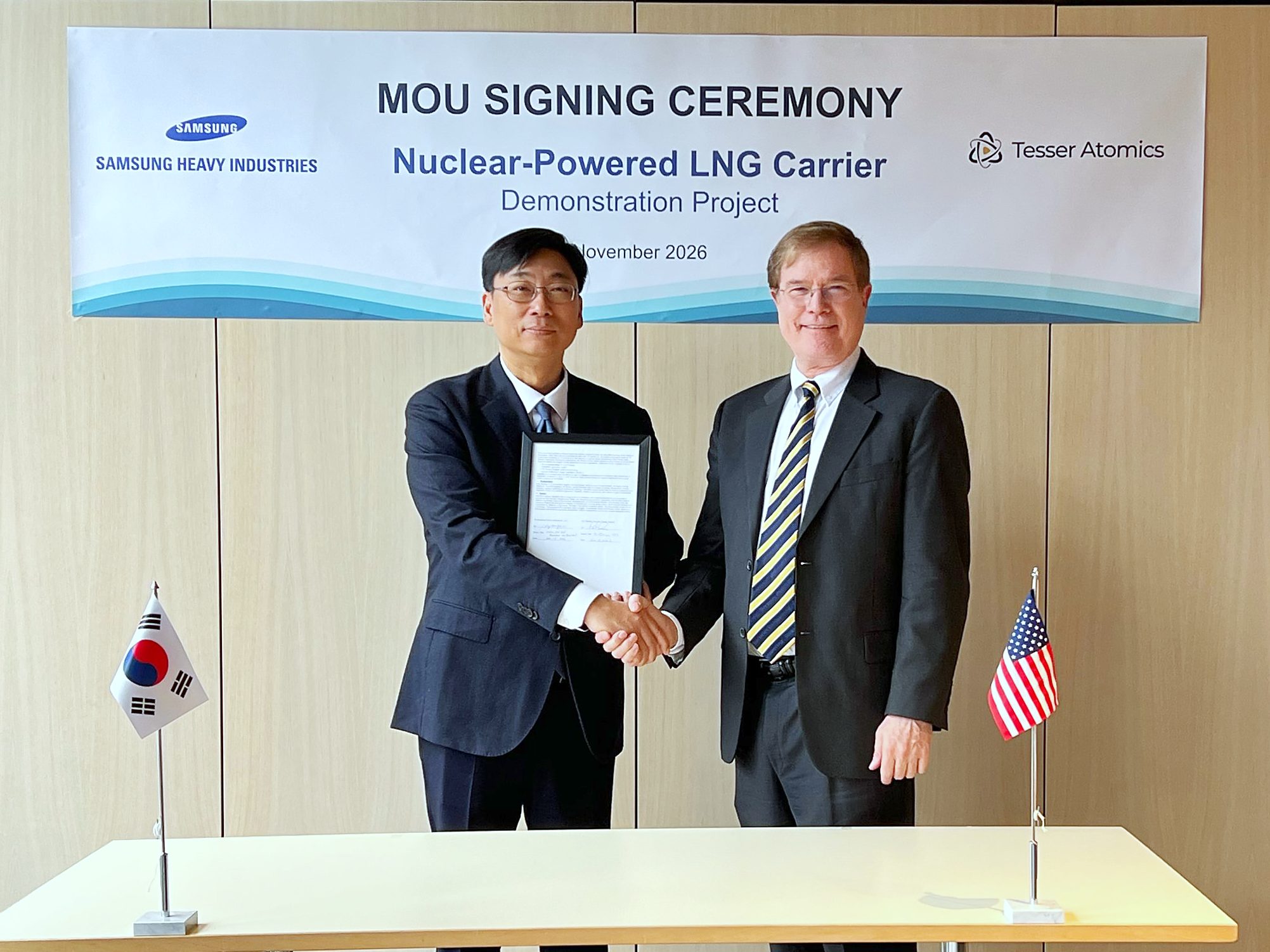
Samsung Heavy Industries (SHI) and Tesser Atomics have signed a memorandum of understanding for a demonstration project to build the first nuclear-powered LNG carrier, Tesser announced on November 19, 2026 from Oslo. The deal is exclusive both ways for the project: SHI is Tesser's only shipbuilder partner and Tesser is SHI's only reactor partner. The demonstration vessel is expected to operate commercially between the United States and Europe.
Tesser's reactor, Triton, is a compact fluoride-salt-cooled high-temperature reactor (FHR) built for ships: TRISO fuel, low-pressure molten salt coolant and online refueling. Tesser CEO Per Peterson also co-founded Kairos Power; Tesser is working to open further markets for Kairos's KP-FHR technology while Kairos stays focused on grid-scale electricity, per the release. The project grew out of NuProShip, a Norwegian research program that evaluated reactor technologies for merchant ships, and continues within SFI SAINT, a program led by the Norwegian University of Science and Technology.
SHI is not new to the idea. In September 2025 it obtained approval in principle from the American Bureau of Shipping (ABS) and the Liberian Registry for a 174,000-cubic-metre LNG carrier powered by a molten salt reactor that it was designing with the Korea Atomic Energy Research Institute, World Nuclear News recalled. That reactor was designed to need no fuel replacement for the life of the vessel. Tesser's pitch runs the other way: "They refuel while they run, so owners can choose when they want to buy new fuel," Peterson said. An approval in principle is an early step on paper. The new MoU is earlier still: the parties intend to develop the ship concept and the marine reactor application.
Peak Energy stretches its Series B to $157 million
Peak Energy, which builds passively cooled sodium-ion storage systems for the grid, has expanded its Series B to $157 million: $132 million in equity and a $25 million debt facility from HSBC, the company said on November 24, 2026. When Peak announced the GM Ventures-led round on October 21, 2026, it was $108 million.
Peak now claims over $2.5 billion in commercial agreements, including deals with Jupiter Power, RWE and Energy Vault, and its release headline cites a growing customer backlog. Peak's stated figure went from over $1 billion to over $2.5 billion between the two releases, a $1.5 billion rise in the floor by our arithmetic.
Peak splits the new money by use. The $25 million HSBC facility "will support project deliveries beginning in 2027 and help Peak scale its supply chain as commercial production ramps," the release says, while the new investment goes to the manufacturing buildout and a data center pilot project. Zack Jacobson, Peak's vice president of finance, said HSBC gives the company "flexibility to fund project deliveries without additional dilution and reserve equity for scaling the business." Peak is ramping manufacturing at its 4 GWh facility in Sacramento, California.
Sources
Primary
- Tesser Atomics and Samsung Heavy Industries Enter Exclusive Collaboration on a Nuclear-Powered LNG Carrier · Tesser Atomics (GlobeNewswire)
- Contouring mitigates voiding at the lithium/ceramic electrolyte interface on discharging solid-state batteries · Nature Energy
- Peak Energy Expands Series B Total Financing to $157 Million to Accelerate Manufacturing Amid Growing Customer Backlog · Peak Energy (via PR Newswire)
Supporting
- Peak Energy Raises $108 Million In New Capital; Announces Oversubscribed Series B to Scale Next-Generation Energy Infrastructure · Peak Energy (via PR Newswire)
- Samsung, Tesser to collaborate on nuclear-powered LNG carrier · World Nuclear News
Copies of cited sources are retained where available. If a link no longer resolves, request a copy at contact@theduckcurve.com.