 The Duck Curve
General Fusion says LM26 hit 1.1 keV electrons in paper under peer review
A Thomson scattering paper written with the UK Atomic Energy Authority puts the peak at 1,090 ± 40 eV; a companion paper by General Fusion staff adds 1,180 eV from X-ray diodes and ion heating.
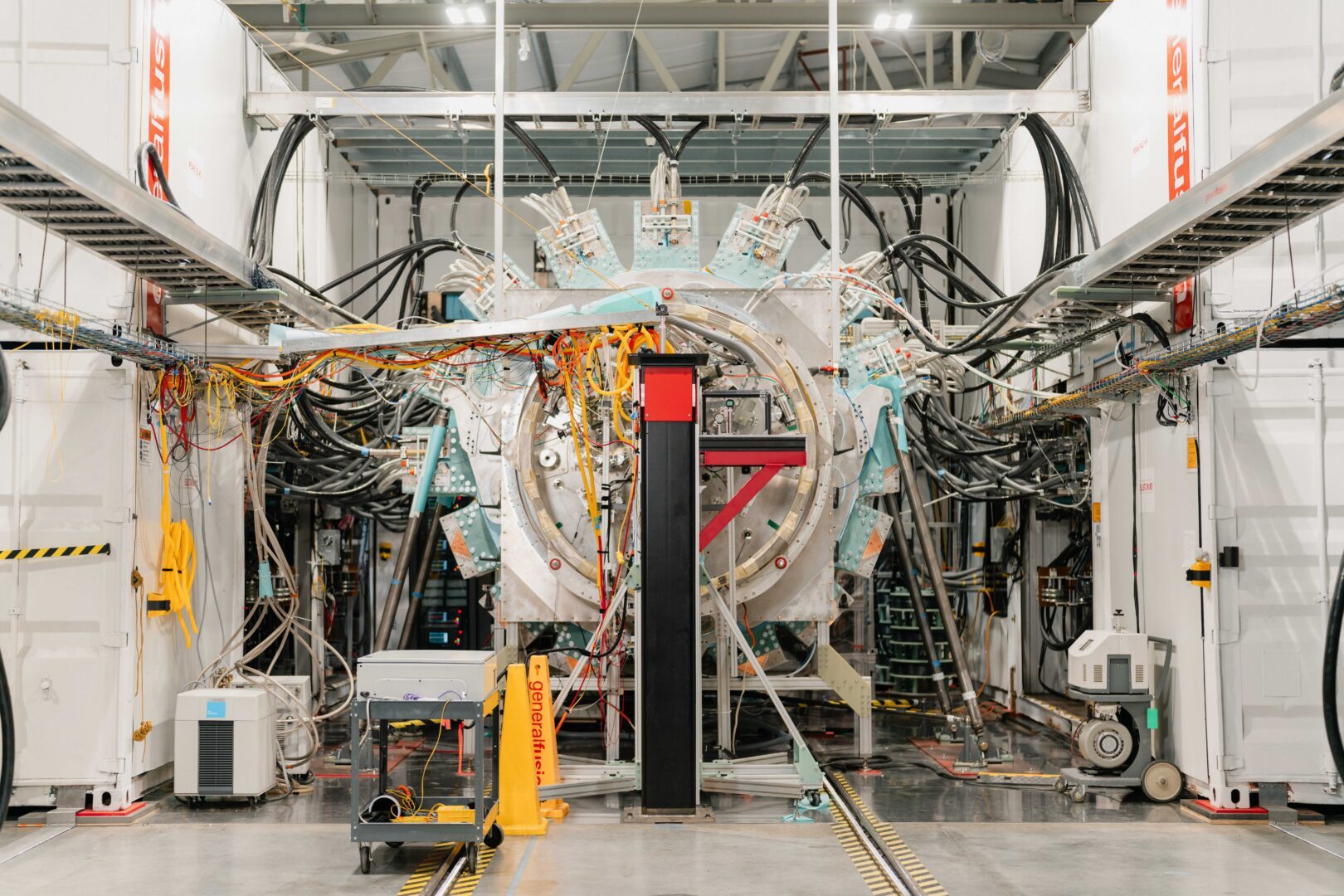
General Fusion says its Lawson Machine 26 (LM26) has heated a plasma's electrons to 1,090 ± 40 electronvolts, about 1.1 keV or 12.6 million °C, by crushing it inside a collapsing lithium liner. The number comes from a laser measurement described in a technical paper co-written with the UK Atomic Energy Authority (UKAEA), which the company posted on October 8, 2026 and has submitted for peer review. Until reviewers weigh in, it is the company's result.
The Vancouver-area developer counts it as the first of three LM26 milestones: 1 keV, then 10 keV, then the Lawson criterion, the combination of temperature, density and energy confinement time needed for net fusion energy in the plasma. In its own release, General Fusion calls LM26 "the first fusion machine in the world to achieve 1 keV with practical low-speed compression," meaning a squeeze that takes milliseconds rather than the microseconds or nanoseconds of other compression schemes. Upgrades for the 10 keV attempt are under way, and the company still aims to begin operating a first-of-a-kind plant around 2035.
Two papers, two thermometers
The headline figure is a Thomson scattering reading: fire a laser through the plasma and read the electron temperature from how the light scatters. Getting that view into LM26 was the hard part. The plasma sits inside a metal liner that shrinks around it, so the system was limited to narrow views and small scattering angles, and it samples 8 moments and 2 points in space per compression. On the shot General Fusion designates LMC-12, the paper's highest reading, 1,090 ± 40 eV, came from the seventh laser pulse, fired 100 microseconds before the liner moved into the beam's path. The eighth pulse, meant to catch the plasma deeper into compression, struck the liner.
So the peak itself was read by a second instrument. A companion paper, also submitted for peer review, reports a peak electron temperature of 1,180 ± 65 eV from filtered X-ray diodes at a radial compression factor of 2.75, a more than fivefold rise from the start of compression. It also infers a deuterium ion temperature of 459 ± 33 eV from the neutrons the shot produced, which the company's modeling suggests may be as much as a twofold increase. General Fusion's release rounds these to about 1.2 keV and 0.46 keV.
UKAEA's part is the thermometer. One of the Thomson paper's 14 authors is from UKAEA's Culham Campus, and the agency designed and built a polychromator for the system at its newly established Diagnostic Innovation Centre of Excellence. The higher X-ray figure and the ion heating come from a paper whose authors all list General Fusion as their affiliation, and the joint release the two organizations issued mentions neither.
The ion number is the softest of the three, and the paper says so. Its error band "comes purely from counting statistics alone and does not incorporate uncertainties from fD or reconstruction of the density or volume," where fD is the deuterium share of the plasma, assumed at 0.7 because it "has not been directly measured for our plasmas."
Nor can the authors yet say which change made the difference. Their analysis has not pinpointed one dominant factor behind the jump from LMC-11, the next-best shot, which tripled electron temperature from 210 eV to 667 eV, and they allow that several small improvements may have added up. The candidates are concrete: a cleaner vacuum (271 nTorr against 350), more lithium wall coatings (11 against 8) and a later start to compression (4 ms instead of 2.5 ms), among other changes.
An old yardstick
1 keV is a first rung, and the record shows it. The UKAEA's chief executive, Dennis Whyte, notes in the joint release that "in 1969, a UK team used the then-new laser-based Thomson scattering technique to verify 1 keV electrons in a Russian tokamak, helping to establish what became the standard magnetic confinement concept." General Fusion's claim is about method, not temperature: it says only a few fusion companies have reached 1 keV, "all using other approaches." In its commercial design, the company says, a liquid metal wall can also shield the machine from neutrons, breed fuel and carry heat to a turbine.
The next rung is far higher. General Fusion's October 6, 2026 prospectus describes 10 keV as approximately 100 million °C, and the companion paper says the machine will be reconfigured "with a conical converging geometry to achieve even higher compression ratios in a similar collapse time."
The money behind the next shot
The milestones run on a schedule and a budget. The prospectus says the LM26 program launched in 2023 and that the company "has as its target completion of these milestones by 2028." General Fusion went public through its business combination with Spring Valley Acquisition Corp. III, which closed on July 10, 2026, bringing net proceeds of approximately $123.4 million. Before that, at June 30, 2026, it had $32.0 million in cash.
The company says that money covers at least a year. The prospectus says existing resources "are expected to provide sufficient funds to carry out our planned operations for at least 12 months from the date of this prospectus," and, about the longer road to a plant: "As such, we expect the Company to require additional financing as we advance towards an MTF fusion power plant." Its audited 2025 statements carried a going-concern paragraph, which management planned to resolve with the business combination and the PIPE financing that came with it. TAE Technologies, which is going public through a merger with Trump Media, is at the earlier stage of that sequence: Trump Media's merger filing says TAE faces substantial doubt about continuing as a going concern, as covered in our October 8 financing roundup.
Outlook
Two things decide how much the 1 keV figure is worth. The first is peer review: Whyte says the agency looks forward to the paper's publication in Review of Scientific Instruments, and the ion temperature, with its assumed deuterium share, is the number most open to revision. The second is money. General Fusion says upgrades for 10 keV are under way, but neither October 8 release nor the prospectus dates the 10 keV attempt itself. What the prospectus does give is a 2028 target for all three LM26 milestones together and a runway of at least 12 months from October 6, 2026, a floor rather than an end date. By our reading, that makes another raise likely before the 2028 target, and the 1 keV papers, reviewed or not, would be part of the case for it. The fusion reference page tracks the wider field's milestones and money.
⚠ The Outlook extrapolates from General Fusion's October 6, 2026 prospectus (a runway of at least 12 months from that date, a 2028 target for all three LM26 milestones together, an expected need for additional financing on the way to a power plant) and from both papers being submitted but not yet peer reviewed. No cited source dates the 10 keV attempt; the expectation of a raise before the 2028 target is our inference.
Sources
Primary
- Thomson Scattering Measurement of 1 keV Electron Temperature on Lawson Machine 26 (submitted for peer review) · General Fusion / UKAEA
- Compressional heating above 1 keV on the LM26 magnetized target fusion machine (submitted for peer review) · General Fusion
Supporting
- General Fusion Group Ltd. prospectus (Form 424(b)(3), dated October 6, 2026; Registration No. 333-298813) · General Fusion Group Ltd. via SEC EDGAR
- General Fusion, UKAEA Announce Magnetized Target Fusion Milestone · General Fusion and UK Atomic Energy Authority
- General Fusion Achieves World-First 1 keV Electron Temperature Milestone on its Path to Commercial Fusion Power · General Fusion
Copies of cited sources are retained where available. If a link no longer resolves, request a copy at contact@theduckcurve.com.