 The Duck Curve
Ford says 2021 Mach-E batteries average 92% health after five years
More than 2,000 owners have passed 100,000 miles on their original packs at better than 91% on average, by Ford's count; the figures measure usable capacity.
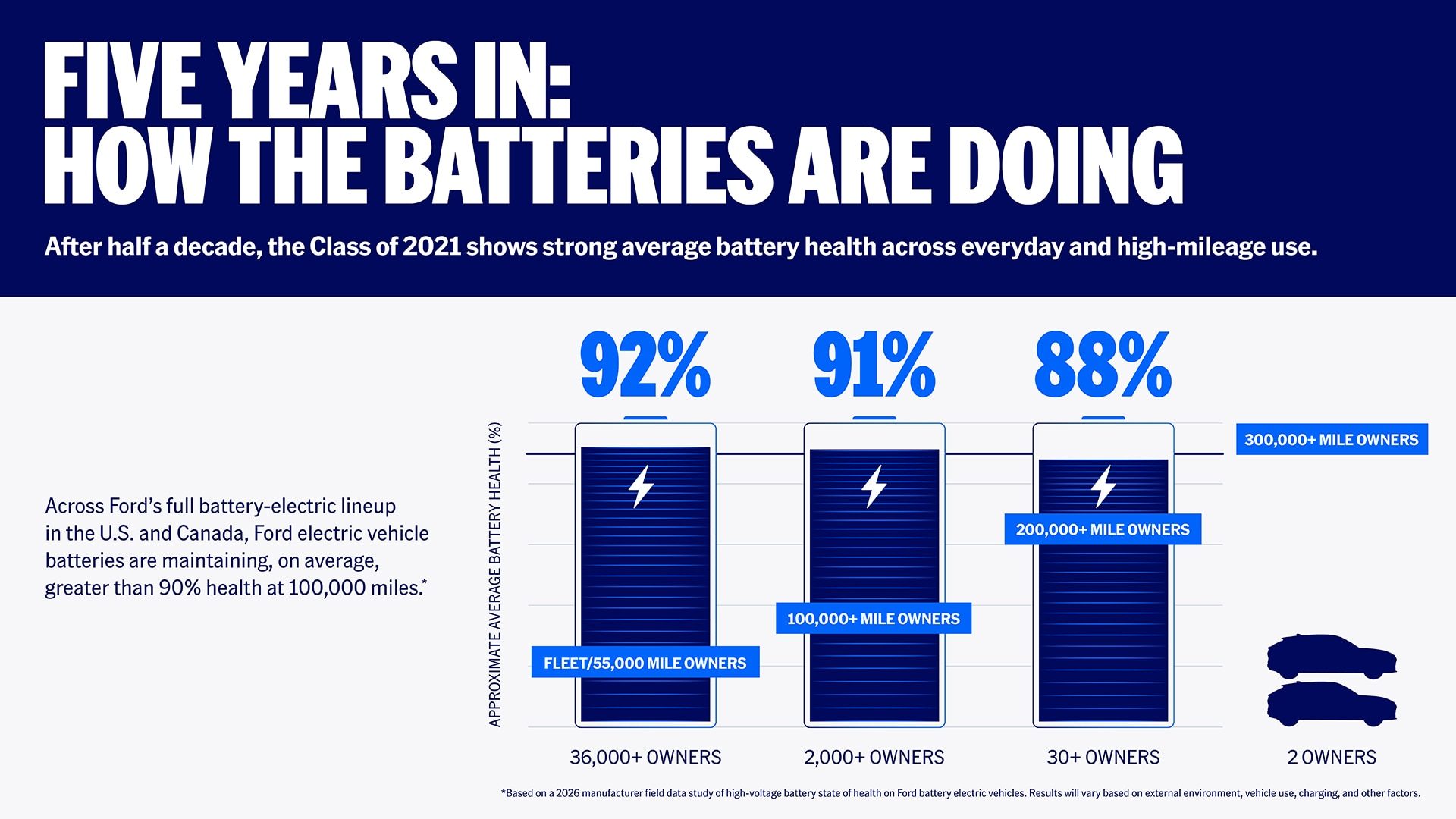
Ford's first-year Mustang Mach-E batteries have kept 92% of their health on average after five years on the road, according to fleet data the company published on November 9, 2026. The figure covers about 36,000 model-year 2021 vehicles sold to retail and fleet customers in the U.S. and Canada, with state-of-health data as of August 2026 and an average ownership period of 5.2 years. It is Ford's own connected-vehicle data on its own packs, reported at an aggregated fleet level.
The average comes with a spread, which Ford gives: 95% of the vehicles fall between 87% and 97% health. More than 2,000 owners have passed 100,000 miles on the original battery, averaging better than 91%, and more than 30 drivers past 200,000 miles are averaging 88%. The cohort has logged two billion all-electric miles, roughly 55,000 per vehicle by our arithmetic.
The study began with a car that is not in it. Kevin Vander Laan, Ford's technical leader for high-voltage battery cells and systems, writes that owner David Blenkle drove past 400,000 miles on the original battery of his 2022 Mach-E, which raised the question of whether he was an outlier. The data set that answers the question covers 2021 models only, and the post gives no health figure for Blenkle's pack beyond saying it "has remained strong through unusually high-mileage use."
Ford also stretches the claim past the Mach-E. Across the battery-electric lineup it has released in the U.S. and Canada over the last five years, the post says, packs that Ford says are designed to last at least 10 years are maintaining, on average, greater than 90% health at 100,000 miles, a figure footnoted to a 2026 manufacturer field data study. The 2021 Mach-Es use NCM chemistry; Ford says some of its newer EV batteries use LFP, which benefits from an occasional charge to 100% to keep the battery management system calibrated.
Ford's number falls inside the range that independent fleet data reports. Geotab, the telematics company, analyzed more than 22,700 electric vehicles covering 21 models in 2025 and found an average degradation rate of 2.3% a year, which it projects leaves the average battery at 81.6% of original capacity after eight years. At that rate, a 5.2-year-old pack would sit near 88%, by our arithmetic. Ford's 92% works out to about 1.5% a year if the loss were linear, also by our arithmetic, which is where Geotab puts its low-fast-charging group (1.5%) and eight of the 11 established models from its 2023 data set (1.4%). Geotab anonymizes its models, so its results do not say whether a Mach-E is among them, and it notes that many EVs lose capacity faster in their first year or two before the rate levels out.
Geotab names high-power DC fast charging as the single largest stressor. Vehicles that used DC fast charging for less than 12% of sessions lost 1.5% a year; those that fast charged more often, with over 40% of those sessions above 100 kW, lost 3.0%. Vehicles in hot climates degraded 0.4% a year faster than those in mild ones. Ford's first tip to owners reaches the same place: charge on Level 2 at home and "save DC fast charging for the days you need it."
One definition matters when reading Ford's numbers. Its footnote says the figures "reflect usable battery capacity," the share of the pack the vehicle lets a driver use. Recurrent, which reports on EV battery health from a community of more than 30,000 electric cars, separates range availability from battery degradation for a related reason: automakers, it says, "use software updates to improve efficiency and release reserved battery over time, giving a consistent experience to drivers." Ford's post does not say whether the Mach-E's reserve has changed since 2021.
Ford says the 2021 Mach-E is its only modern EV cohort to reach five full years of customer driving at this scale, and that the field data feeds its Universal Electric Vehicle platform and the Fathom electric truck.
Sources
Primary
- Five Years In, Mustang Mach-E Battery Data Shows What Real-World Electric Vehicle Durability Looks Like · Ford Motor Company (Ford From the Road)
Supporting
- New Data: How Long Do Electric Car Batteries Last? · Recurrent
- How long do electric car batteries last? The updated guide to real-world EV battery health · Geotab
Copies of cited sources are retained where available. If a link no longer resolves, request a copy at contact@theduckcurve.com.