 The Duck Curve
Endurance says its subsea geothermal plant ran net-positive for 8.7 seconds
The Seattle startup says it also drilled the first subsea geothermal well at Axial Seamount, but that well was too restrictive to run the plant, which drew on a natural vent instead.
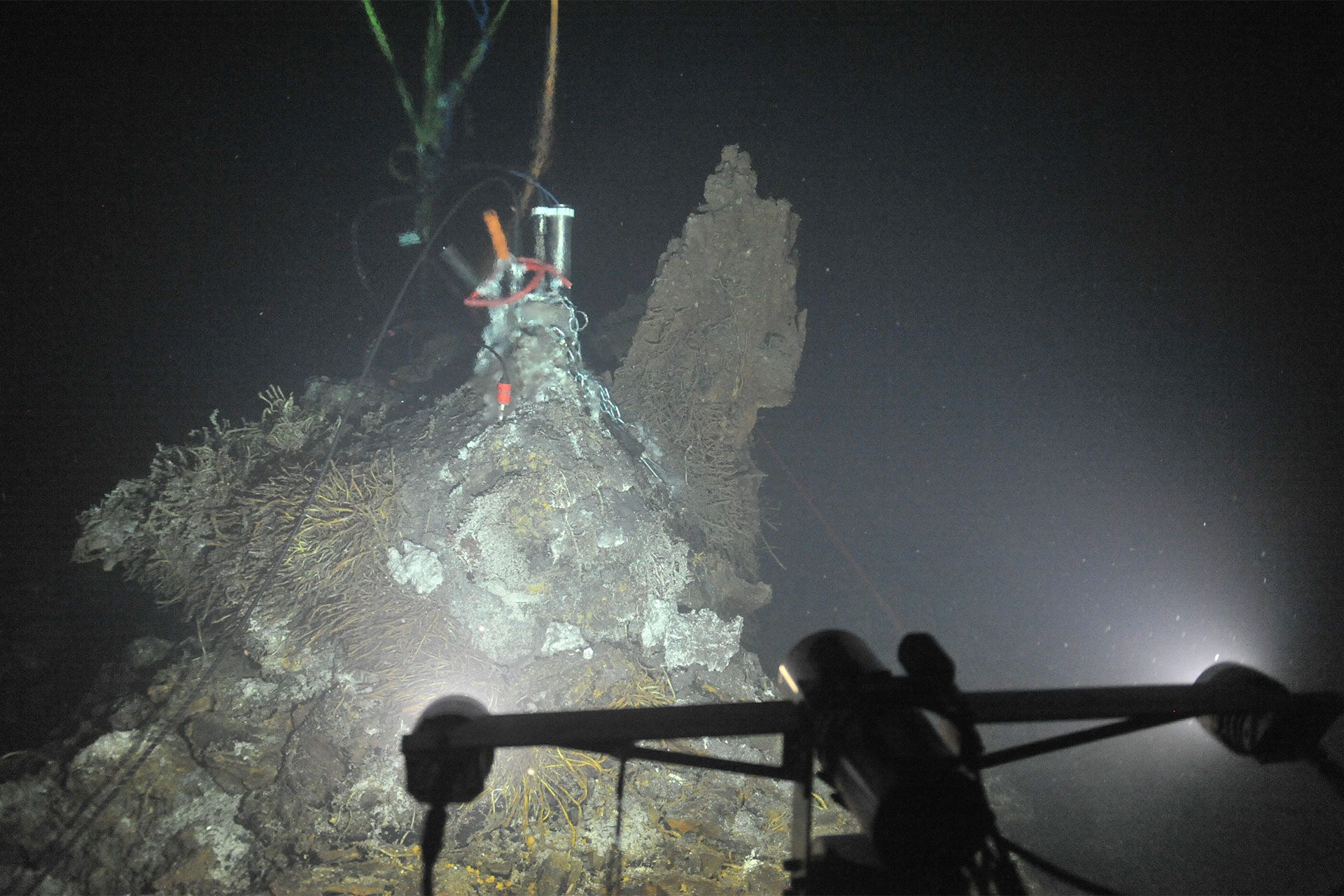
Endurance Energy, a Seattle startup, said on October 19, 2026 that its 3-ton Adélie test plant generated more electricity than it consumed for 8.7 seconds on September 27, sitting on an active underwater volcano nearly a mile down at Axial Seamount, 300 miles off the Oregon coast. Net output in that window had a median of about 2 kilowatts and a peak of 16.5 kilowatts, according to the company's release.
The release pairs that run with a second claim: on the same three-week deployment, Endurance says, it drilled and completed the world's first subsea geothermal well. The two milestones happened at different holes in the seafloor. The company's well, 52 feet (16 meters) deep and about two inches wide, flowed at 260°C after cementing but was "too restrictive to run the plant," so the net-positive run came from a nearby natural hydrothermal vent at about 281°C.
Twenty-nine seconds on the seafloor
The full run was longer than the net-positive part. Heatmap reports the generator ran for 29 seconds in total, and that the 2 kilowatts of net power is what the turbine made minus the 7 to 8 kilowatts its own refrigerant pump and other onboard equipment needed. Canary Media puts the turbine's output at about 60 watt-hours over about 29 seconds, which by our arithmetic is what a 60-watt bulb uses in an hour.
The run ended when battery overcurrent protection stopped the system, per Endurance; Heatmap says a software glitch tripped that protection. About ten minutes later, during a restart attempt, the power cable feeding Adélie's refrigerant pump failed, and the dive was over.
That falls well short of the plan. Heatmap reports the company's goal was to run its 100-kilowatt generator for a full year, and that the team spent the first 11 days of the trip debugging a drill it had never run underwater, which left the well at 52 feet against a 200-foot target. "The success criteria would be if we had left with the generator still on the seafloor; that would have been an example of sustained net power, and we didn't get there," Andrew Redd, Endurance's founder and CEO, told Heatmap.
The release supplies its own yardstick. "Goddard's first liquid-fueled rocket flew for two and a half seconds. Our first net-positive run lasted about nine," Redd said in it. The comparison is generous to the company and candid about the stopwatch at the same time.
How the test was run
Axial Seamount comes with wiring. Endurance ran Adélie in real time from Seattle over the National Science Foundation's Regional Cabled Array, a seafloor fiber-optic network the University of Washington operates as part of the Ocean Observatories Initiative. Heatmap describes Axial as the only place in the world with a cluster of hydrothermal vents connected to shore by fiber-optic cable.
The drilling itself was small. The well is about two inches wide, against the 20- to 36-inch casings that oil, gas and onshore geothermal wells often start with, and the team drilled with filtered seawater rather than drilling mud, the company says.
The environmental results are, for now, the company's own report. Endurance says its voluntary monitoring, checked against 11 instruments run by outside scientists, showed no unusual seismic or volcanic activity and no significant change to the site's natural hydrothermal activity, with more than 40 water, rock and mineral samples now at independent laboratories.
The economics question
Seafloor geothermal has been tried at research scale. Canary reports that Chinese scientists produced a few watts of sustained power from a hydrothermal vent in 2016, where the southwest Indian Ocean meets the southeast Atlantic.
Not everyone is persuaded the ocean floor is worth the trouble. "It's an eyebrow-raising approach," Emily Pope, a geologist and senior fellow at the Center for Climate and Energy Solutions, told Canary. She said it is hard to see how projects could pencil out given the cost and complexity of operating in harsh, salty ocean conditions and the long distances the power would have to travel to reach customers. In Canary's account, remote island nations, seemingly ideal candidates for the technology, could far more easily adopt lower-cost solar power and batteries. "It is adding so much technological challenge to an energy production technology, without there being a really significant demand for it," she said.
Endurance's answer is an island. Its first commercial project is in development in the Kingdom of Tonga, targeting first power in 2027 to supply a grid that the company says runs largely on imported diesel. In parallel it is developing Leopard, a 2-megawatt commercial generator, and Canary describes the Tonga plan as a 2-megawatt project. Heatmap reports that Redd expects subsea geothermal to be cost-competitive with diesel in that first pilot. The company has raised $63 million, including a $54 million Series A led by Founders Fund.
On land, next-generation geothermal is further along. Fervo's first 33 MW GeoBlock at Cape Station in Utah declared commercial operation on September 30, 2026, and Mazama Energy raised $135 million in September 2026 for superhot geothermal at Newberry, Oregon. Endurance's median of about 2 kilowatts net is a proof of concept on a different scale.
Outlook
Endurance says it will deploy Gentoo, a refurbished and upgraded Adélie aimed at higher power and longer generation, in the winter of 2026–27, and that its current lander drill can reach 80 meters (about 260 feet). The company expects deeper wells to deliver the flow the 52-foot well could not. If Gentoo runs on its own well rather than a natural vent, the two halves of this announcement would meet. Gentoo is the next step Endurance has named before its 2027 Tonga target, and if that target holds, a run measured in minutes or hours would say more about it than the 8.7 seconds did.
⚠ The Outlook extrapolates from Endurance's October 19, 2026 release (Gentoo deployment planned for winter 2026–27, an 80-meter drill reach, the company's expectation that deeper wells deliver more flow, and the 2027 Tonga first-power target) and from the 8.7-second net-positive run it reports. It does not predict whether Gentoo or the Tonga project will succeed.
Sources
Primary
- Endurance Energy Drills World's First Subsea Geothermal Well and Runs First Net-Positive Power Plant · Endurance Energy via PR Newswire
Supporting
- This geothermal startup produced a tiny bit of power from the seafloor · Canary Media
- The World's First Subsea Geothermal Well Had 8.7 Seconds of Glory · Heatmap News
Copies of cited sources are retained where available. If a link no longer resolves, request a copy at contact@theduckcurve.com.