 The Duck Curve
ITER's ninth and final vacuum vessel sector arrives from Europe
With sector #2 on site, ITER says every component of its core tokamak is now delivered; six of nine sector modules already sit in the pit, and the last is targeted for mid-2027.
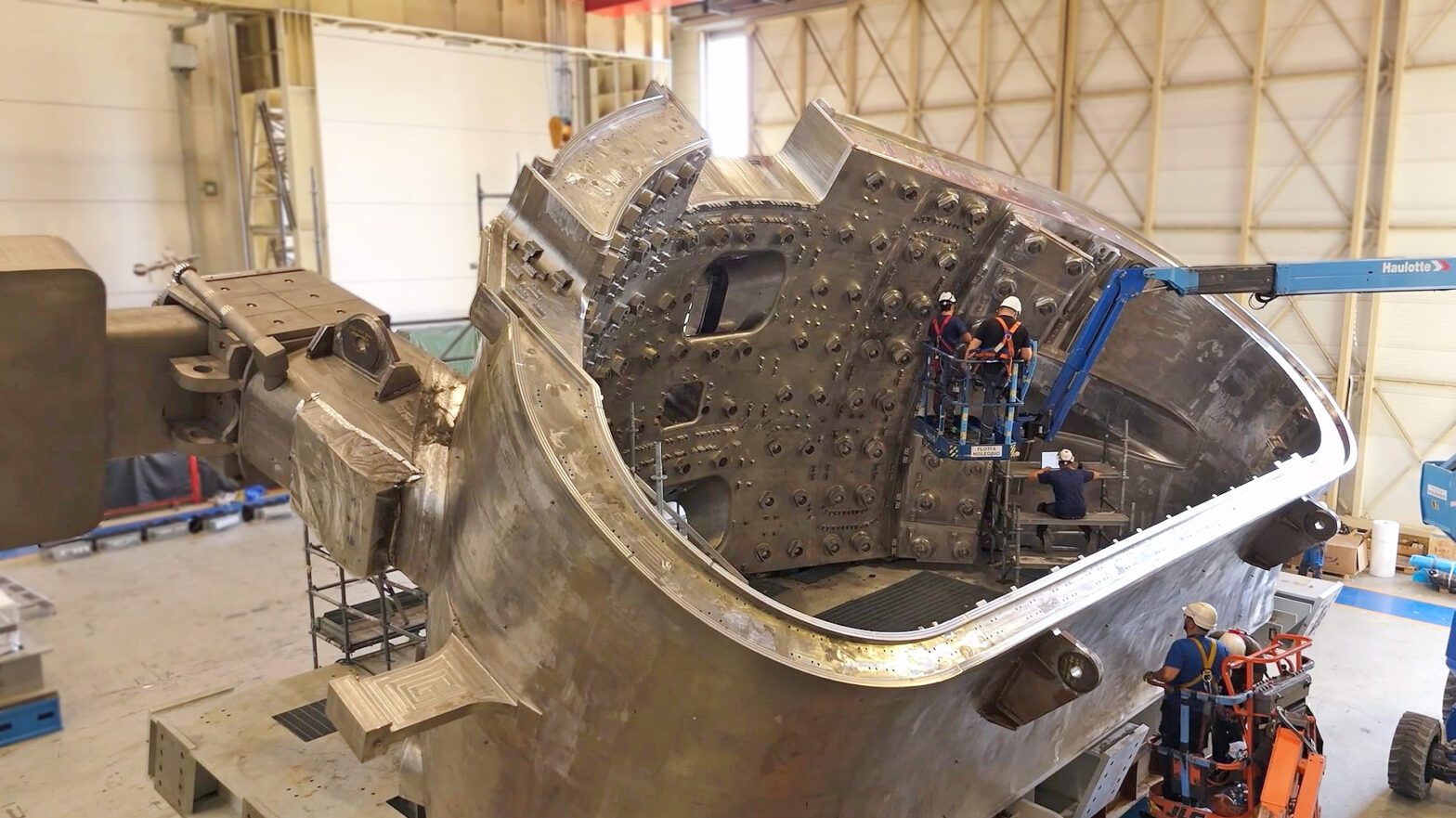
The ITER Organization took delivery of vacuum vessel sector #2 on Friday, October 2, 2026, the ninth and last of the steel wedges that will form the fusion experiment's plasma chamber at Saint-Paul-lez-Durance in southern France. With it, ITER says, all the components needed to complete the core of the machine are now on site. Europe built the sector, its fifth, through its domestic agency Fusion for Energy (F4E) and the AMW consortium of Ansaldo Nucleare, Westinghouse and Walter Tosto, closing a manufacturing effort that F4E says started 16 years before this delivery.
"Vacuum vessel sector #2 represents the last of our core tokamak components," Director-General Pietro Barabaschi told staff, contractors and Domestic Agency and industry representatives at a brief worksite celebration on Monday, October 5. He listed the toroidal field, poloidal field and correction coils, the central solenoid magnets, the vacuum vessel sectors and the thermal shield sets as all now on site, and said the delivery "will allow us to pursue machine assembly activities according to schedule."
The numbering is not the arrival order. Sector #9, also European, arrived on March 6, 2026; the ninth sector to reach the site is #2.
ITER's core is a defined term, and the definition is careful. It counts the cryostat, all the superconducting magnets, and the vacuum vessel with its thermal shield; in-vessel components such as the divertor and the blanket are excluded. Those, plant systems and other equipment are still to come, ITER says, and "much assembly work lies ahead." What closed on October 2 is the delivery of the big pieces, not the building of the machine.
Built in Italy, shared with Korea
The sector left the port of Monfalcone, Italy, in mid-September after final work at Westinghouse's workshop there. F4E says the logistics company DAHER moved it by sea and land, unloading it at the French port of Fos-sur-Mer.
F4E puts Europe's production of its five sectors at more than 2 million hours of work and 750 km of welding beads. Each sector is made of four segments, produced at Westinghouse in Monfalcone and at Walter Tosto in Chieti, then welded into one piece. F4E says the sector's fabrication directly involved more than 150 professionals and at least 15 companies across Europe, and that Europe delivered all five of its sectors in the two years to October 2026. Joined, the nine sectors will form a vessel 19.4 m in diameter and 11.4 m high, weighing approximately 5,200 tonnes.
The Republic of Korea built the other four. According to World Nuclear News, Korea was initially tasked with two sectors and took on two more, originally assigned to the EU, under a 2016 agreement. Europe finished last, and F4E Director Marc Lachaise said its final sector "built on the lessons learnt from ITER Korea in producing the rest of the sectors."
Two-thirds of the torus is in the pit
Assembly did not wait for the last delivery. Each 440-tonne sector is combined with thermal shield panels and two toroidal field coils of about 310 tonnes each into a sector module, and ITER installed the sixth of nine modules, built around Korea's sector #1, on July 28. Its July 29 release called that almost six months ahead of schedule and said improvements in assembly sequencing and execution had advanced the anticipated installation of the final module from December 2027 to mid-2027.
The next module, built around sector #9, is scheduled for the pit in early December: ITER said on September 7 that teams aim to finish its sub-assembly by the end of November and transfer it at the beginning of December. Sector #3 was handed to assembly teams on September 2 after bevel repairs, a handover ITER said completed a three-year campaign to repair sector bevels, and is bound for the Assembly Hall. By our count, that leaves sectors #3 and #2 still to be built into modules.
The same update closed out another repair. The thermal shield program, launched in 2023 after stress-corrosion cracking was found in sections of its cooling pipes, was completed in July 2026 and involved removing about 11 km of pipework. With three sectors now resting on their gravity supports, ITER said the configuration is stable enough to begin preparations for vacuum vessel welding. Joining the sectors into a complete torus comes once all nine modules are in the pit, per the July release.
The schedule being kept
ITER's schedule of record is the 2024 baseline. Presented to the ITER Council in June 2024 and used as a working reference, it put full magnetic energy in 2036 and the start of deuterium-tritium operation in 2039, three and four years later than the 2016 plan, ITER said at the time. Barabaschi put the additional cost for the ITER Organization at EUR 5 billion, a figure then still under review by the ITER Members. ITER named the Covid pandemic and repairs to key machine components as the major drivers of that delay.
At its meeting of June 25 and 26, 2026, the ITER Council expressed appreciation for "the overall project execution under Baseline 2024." It also welcomed an agreement by ASNR, France's nuclear safety and radiation protection authority, to exclude the vacuum vessel from the French legislation implementing the European Pressure Equipment Directive, which the Council said supports schedule and cost savings while maintaining quality objectives.
The Council also noted ITER's engagement with the wider fusion community, including knowledge transfer to private-sector fusion initiatives. ITER's own partnerships are widening as well: China Fusion Energy Co and the ITER Organization signed a memorandum of cooperation on September 15 in Vienna, CNNC said (our report).
Sources
Primary
- A remarkable chapter draws to a close · ITER Organization (Newsline)
Supporting
- New baseline to prioritize robust start to exploitation · ITER Organization (Newsline)
- Vacuum vessel sector #9 on the move · ITER Organization (Newsline)
- 38th ITER Council Meeting: ITER's strong project execution continues · ITER Organization
- Two-thirds of ITER tokamak core now in place · ITER Organization
- A summer of substantial progress · ITER Organization (Newsline)
- Europe's final ITER Vacuum Vessel sector delivered · Fusion for Energy (F4E)
- Europe delivers final ITER vacuum vessel sector · World Nuclear News
Copies of cited sources are retained where available. If a link no longer resolves, request a copy at contact@theduckcurve.com.