 The Duck Curve
Envision launches 8 MW onshore turbine with a 175-meter rotor in Hamburg
The Model T EN175/8.0 is aimed at medium-wind sites and, Envision says, can yield 2–12% more than existing models depending on site conditions; the release names no customer, site, hub height, price, delivery date or type certificate.
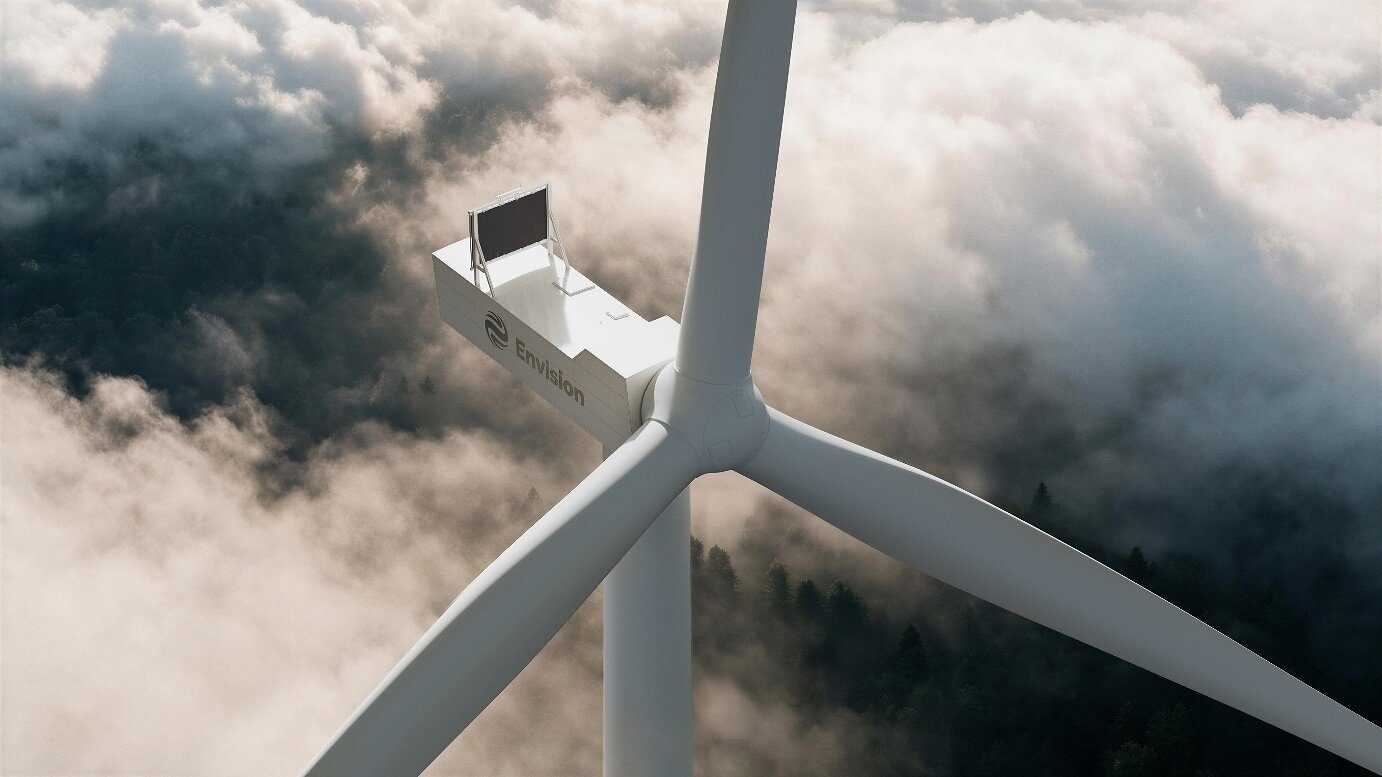
Envision Energy said on September 25, 2026, in a release datelined Hamburg and distributed by PR Newswire, that it launched the Model T EN175/8.0, "an 8 MW-class smart onshore wind turbine featuring a 175-meter rotor," at WindEnergy Hamburg. The trade fair's organizer dates it September 22 to 25, 2026. The release states the rating outright further down: "With a 175-meter rotor and 8.0 MW rated capacity, the EN175/8.0 is designed to increase energy capture at medium-wind-speed sites." It says that, compared with existing models, "the turbine can deliver a 2–12% increase in energy yield, depending on site conditions," a claim about energy over time rather than about the rating (kW vs kWh); that it "targets a sound power level of 107 dB(A)"; and that it is built on a Model T platform "which has accumulated more than 4,000 units ordered and around 1,500 units installed to date." In the eight edition pages linked from its English page, in seven languages, the release names no customer, site, hub height, tower option, price, prototype date or delivery date, and does not say whether the EN175/8.0 holds a type certificate.
Among the features the release presents as new: sixth-generation low-noise airfoils and "newly developed serrated trailing edges, validated through wind-tunnel testing," with optional low-noise operating modes; blades, gearboxes and generators designed and manufactured in-house; a "full-power converter architecture with advanced grid-forming controls" that Envision says enables "stronger voltage and frequency support, rapid fault ride-through response and reliable operation in weak-grid conditions"; normal- and cold-climate configurations, with an optional blade ice-prevention system using "multiple heating zones" tied into the lightning protection; and a control layer Envision calls Galileo, "powered by Envision's Tianji Weather Foundation Model and Dubhe Energy Foundation Model," which the release says lets the turbine "perceive operating conditions, analyze real-time data and autonomously adjust control strategies" rather than "relying solely on predefined control rules." Test results, it says, feed a Galileo digital twin. A closing section headed "From Turbine Optimization to Plant-Wide Value" says Envision "aims to help customers optimize renewable power assets as an integrated energy system" through coordination of wind, solar, storage and industrial loads. Lou Yimin, the company's senior vice president and chief product officer, is quoted: "The next generation of wind power is not simply about making turbines larger."
What the release does not give is anything a buyer would put in a spreadsheet: no rated wind speed or definition of "medium," no capacity factor, no swept area, no hub heights, no IEC class, no nacelle mass, and no number for the 2–12% claim's baseline beyond "existing models." The 4,000 and 1,500 platform figures are Envision's own counts and carry no date other than "to date."
Where 8 MW on 175 meters sits
Six machines from the four European onshore turbine makers whose product pages The Duck Curve read, Enercon, Nordex, Siemens Gamesa and Vestas, carry rotors of 170 meters or more, counting each maker's own portfolio list on those pages; the release compares the EN175/8.0 to none of them. Enercon's E-175 EP5 lists "Nominal Power 6 MW, 7 MW," a 175-meter rotor and IEC wind class S, and Enercon says it is "setting new efficiency standards at low and medium wind sites." Nordex's N175/6.X lists the same 175-meter rotor with a swept area of 24,053 m², a rated power its technical data gives as "6.0-6.X" and a sound figure of 106.0 dB(A) at 6.22 MW; Nordex says that at typical low-to-medium-wind sites it "will achieve between 7 and 14 percent more yield" than its N163 sister models, producing "up to 22 percent more energy than its predecessors" in lighter winds, with a cold-climate variant to -30°C. Nordex's N193/7.X lists "Rated power 7.X," a 193-meter rotor, a swept area of 29,255 m² and "2029 START OF PRODUCTION," and its prose gives "an installed capacity of 7.3 MW" and, for the German market initially, "a maximum capacity of 6.6 MW." Vestas's V172-7.2 MW lists a 172-meter rotor, a swept area of 23,235 m², a maximum sound power level of 107.8 dB(A), six listed hub heights (114, 150, 164, 166, 175 and 199 m, with site-specific towers on request) and, Vestas says, a 12% improvement in annual energy production in low-wind conditions from its powertrain and power conversion changes; its V182-7.2 MW lists a 182-meter rotor, 26,016 m², a standard rated power of 7,200 kW and a maximum of 109.0 dB(A), and describes the V172 as "featuring three flexible ratings of 7.2 MW, 6.8 MW and 6.5 MW." Siemens Gamesa's SG 7.0-170 lists a 170-meter rotor, a rated power of 7.0 MW with a flexible rating of up to 7.0 MW on a separate row, a swept area of 22,697 m² and IEC class IIA/S.
Those pages allow one comparison the release does not: rating divided by swept area, or specific power, in watts per square meter. By The Duck Curve's arithmetic, using Nordex's published 24,053 m² for a 175-meter rotor (π × 87.5² gives the same figure) and each maker's published area otherwise, the EN175/8.0 at 8.0 MW comes to about 333 W/m²; the E-175 EP5 to about 249 W/m² at 6 MW and 291 at 7 MW; the N175/6.X to about 249 at 6.0 MW and 259 at 6.22 MW, with the page's "6.X" ceiling unstated; the N193/7.X to about 250 at its prose's 7.3 MW and 226 at the German-market 6.6 MW; the V172-7.2 to about 310 at its standard 7,200 kW rating; the V182-7.2 to about 277; and the SG 7.0-170 to about 308 at its rated 7.0 MW. The Envision figure is the highest of the seven machines'. Vestas gives the direction on its V182 page: "The larger rotor-to-rating ratio improves performance in lower wind speeds and shifts generation toward higher-value operating hours." The EN175/8.0's rotor-to-rating ratio is the smallest of the seven, and the release's "medium-wind-speed" framing gives no wind-speed number to set beside it.
On rating rather than specific power, the average machine going up in Europe is still some way below any of these seven. Windletter, a newsletter written by Sergio Fernández Munguía, reported on March 18, 2026, reading WindEurope's 2025 statistics report, that the "average rated power of onshore turbines installed in 2025 in Europe was 5.2 MW," up from 4.6 MW in 2024, with Romania's installations the most powerful on average at 6.6 MW.
Envision also markets a Model T Pro platform. Windtech International reported on May 5, 2026 that several Model T Pro models had received DNV type certification, among them an EN-206/11 MW certified for 50 Hz and 60 Hz markets and compatible with steel and hybrid towers. The September 25 release does not mention the Pro platform, give the EN175/8.0's own certification status, or say where it will be built or first installed.
Sources
Primary
- Envision Energy Launches Model T – EN175/8.0 Onshore Wind Turbine, Advancing Plant-Wide Optimization and Lifecycle Value for Future Energy Systems · Envision Energy via PR Newswire
Supporting
- Breaking down Europe's wind power numbers in 2025 (Windletter) · Windletter (Substack), Sergio Fernández Munguía
- Envision Model T Pro platform receives DNV type certification · Windtech International
- V172-7.2 MW · Vestas
- Wind turbine SG 7.0-170 · Siemens Gamesa
- Press: WindEnergy Hamburg · Hamburg Messe und Congress (WindEnergy Hamburg)
- E-175 EP5 · ENERCON GmbH
- N193/7.X · Nordex SE
- N175/6.X · Nordex SE
- V182-7.2 MW · Vestas
Copies of every cited source are retained. If a link no longer resolves, request a copy at contact@theduckcurve.com.